
Chimamanda Ngozi, writer: ‘If our leaders read good novels, they would lead better’
The Nigerian author speaks to EL PAÍS hours before giving her keynote address ‘The Truth of Stories’ at the Guadalajara Book Fair
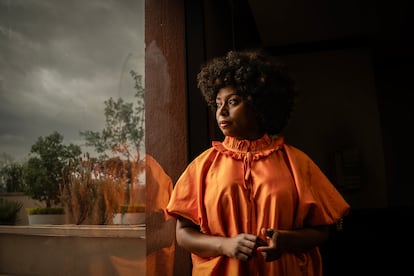

Those who have been patient — or simply lucky enough to stroll through the Guadalajara International Book Fair (FIL) just before its end — have been richly rewarded. Nigerian writer Chimamanda Ngozi Adichie, 48, arrived in the Mexican city on Saturday to deliver her keynote address The Truth of Stories, one of the highlights of the event. The talk had originally been scheduled for the previous weekend but was canceled due to health reasons.
The author of bestsellers Americanah (2013) and We Should All Be Feminists (2014) divides her life between her native Nigeria and the United States, where she has lived for more than two decades. In both countries she is considered one of the most prominent literary voices. She has recently published Dream Count — her first novel in 10 years —which follows the lives of four women from Nigeria. Incisive and bold, Ngozi speaks to the newspaper hours before her talk at the FIL.
Question. When you visit other countries, does your view of the United States change?
Answer. I’m always interested in how the world sees America. My sensibility as a human being is Nigerian, but America is also a second home for me, and I’m very aware of American power. By that I don’t mean political power, but rather soft power — the way that everyone in the world is following American news, when I’m thinking, why should they really?
One of the things I like to do is look at commercials. I like to look at billboards and turn the TV on. I don’t speak Spanish, but I like to see what the culture considers aspirational and how that compares to what America considers aspirational. On the drive to the hotel yesterday, I was happy to see that the billboards seem to show that Mexico like Mexicans.
Q. You don’t see any overlap between what’s aspirational in both countries?
A. It was just 20 minutes, I need a bit more time. But the other thing is, just in the hotel, just listening to people and the way that Spanish is spoken first. The reason that it doesn’t seem to me there’s a kind of pandering to say, “Oh, look, I speak English,” which happens in some countries and which honestly I find annoying because I think that we should all be proud of where we come from.
While we acknowledge American power, we shouldn’t let it overrule that which is ours. We now live in a time where I don’t think American power is necessarily something that anybody should aspire to.
Q. How do you see Trump’s relations with the region?
A. For me, there are two separate things. There’s Trump and then there’s the United States. Leaders who are practical acknowledge that America has so much power that it’s almost impossible to ignore it, so you have to figure out how to negotiate with a very powerful country that’s now led by somebody who is fundamentally unstable. It’s hard for me to talk about Trump and honestly also it’s not a subject that interests me, because it’s a subject without depth.
There’s a news headline every day about something that’s been said and the next day it changes. So there’s no depth. It’s very impulsive, very childish. I come from a country that just three, four weeks ago, we were told we’re going to be bombed by Trump because he’d seen something in Fox News. I feel quite sorry for other world leaders who have to navigate this strangeness, and because of that, I’m very unwilling to be critical.
Q. A lot of young men are leaning towards the political project that Trump represents. How can we attract boys who feel attacked by feminism to feminism?
A. I think that’s an important question, not because I think we have to constantly pander to men and make men’s feelings the most important thing in the world, but because I believe that feminism has to include men. Feminism is a way of dreaming about a just world and we cannot create a just world if we focus only on one half of the population, even though that half is the half that has been oppressed.
There are things that have been said in the name of feminism that are inhumane, and there’s some men that just use that as an excuse for misogyny. But I do think that there are many men who have felt alienated by the idea that there is a collective guilt that the things that men have done to women — and there have been many terrible things —, but that somehow every man is responsible for that. I don’t agree with that. I think that we need more good men to stand up. Boys need more good male role models.
Q. Why do you think there aren’t more feminist men speaking out?
A. Maybe part of it is that they don’t realize how important it is that they should do it. I also think that often a lot of reasonable, thoughtful, intelligent men who respect women, still somehow think that women’s rights is a women’s fight only. You’ll see men who are very supportive, but they don’t turn up at the marches. Maybe it’s also that when you’re part of a group that has privilege, privilege can blind you. That doesn’t make you a bad person, it just makes you a person who’s part of a privileged group.
There are many good men who do not see that they have a role to play. We live in a world where men listen to men, so I think that the role that men have to play is with other men. And they don’t do that because maybe they don’t know that they should. Which is why we should have these conversations
Q. The prejudice persists that so-called women’s issues are not universal and, at the same time, that women cannot talk about topics considered more general. What needs to happen for that to change?
A. Journalists like you need to ask different questions and cover things differently. The media has a lot of power. Never mind that people say traditional media is dying. The media still has a lot of power. And I mean the news media but also the entertainment media. How things are covered really does matter. Just because I talk about feminism, doesn’t mean it’s the only thing I want to talk about. I’m talking about many other things, but often it’s a question that I get asked. It would be nice if that changed. You did actually ask me about Trump, but it’d be nice if people ask me about things that are interesting.
Q. What topic would you like to comment on?
A. It’s also this idea that when you talk about feminism it’s a niche topic, but it isn’t. We could still use the lenses of feminism but talk about politics, history, culture and who has cultural power. I’m very interested in power.
And I look at the people who really have the power in the world and still there’s almost no women. We now live in a world where everything about around us is being shipped by people who somehow have made more money than individuals should have. And those people are mostly men. We’re talking about AI, where nobody’s really sat down to think on a large scale about the consequences of it.
What’s happening is this race for who’s going to be first and there’s more money being thrown at it and the whole conversation is very male-dominated but it’s going to affect everyone. Women should be part of it, but it’s difficult because to get into it, you have to have access to the kind of money that many women don’t have access to.
Those subjects interest me because I think there are consequences for our future, for our children, for our children’s children. AI is going to make all of us incredibly stupid.
Q. Are we paying too much attention to Trump instead of the Elon Musks of the world?
A. Yes. If I ran a media house, there’s so much I wouldn’t cover about the American president. We all know that it’s fluff. Something happens and there’s breaking news in the New York Times and the Wall Street Journal, but even the person who’s breaking the news knows that it’s nonsense. One of the problems is that there is a kind of entertainment imperative. People want to be entertained by the news. I don’t think the news should entertain us: it should educate and inform us. And that is how Trump came to power. He was entertaining. We have to talk about real things. Maybe we shouldn’t pay too much attention to the rants that are posted at 1:30 a.m., because it will have changed by tomorrow.
Q. Let me give you an example. Is Trump’s threat to attack Venezuela real or just empty talk?
A. He’s the president of the United States, and it’s still the most powerful country in the world, so it should be in the news that that’s what he said, but the rest of the news should perhaps give us some context. There are a lot of people in the United States who really don’t know anything about Venezuela. I was reading, and I’ll tell you, I thought that Venezuela was the country from which the most amount of drugs to America comes, but that’s not the case. That’s the kind of coverage I think would be useful. Maybe we can go back and educate people. Somebody should do something very brave about tracing that journey of the drugs and then you realize actually that the amount of drugs does not justify the noise that’s coming from Trump.
Q. Later you will talk about the truth in stories. What kind of truth have you found in yours?
A. Emotional truth. Fiction writing is about truth telling. As a writer, when I’m writing non-fiction, I’m not entirely honest because I censor myself. I censor myself on the people I love. And sometimes about myself as well. When I’m writing fiction, I borrow from my life and people’s lives, but it’s a different plane and so it allows me a kind of radical honesty. That’s why I trust literature more than anything.
When you’re writing from a fictional point of view, there’s a kind of honesty that it allows you. Not everyone does it, of course, but there’s an emotional truth to it, and I think we should all read history the way I do. When I read history and then read a well-written historical novel, I feel a lot more moved by the novel, in the way that literature can tell us how things feel. If we had leaders who read good novels, they would lead better.
Q. What emotions drive your writing?
A. Everything. Love, anger, disappointment, hope.
Q. Do you have hope for the future?
A. I am a person who rejects despair. The most essential thing for human beings is hope. Without it, what is the point of anything? Today, young people are much more politically aware than before, and that gives me hope. People who show courage give me hope. People who stand up for what is right and what is good. There are many reasons not to have hope, but there are also small reasons to have it, and I hold on to them.
Q. Can literature give us the tools to regain hope?
A. Yes. I’m not saying that because I’m a person who writes. I’m saying that as a reader. Reading a good novel can change the way you look at the world, the way you decide to interact with it. I wasn’t joking; very good leaders have been good readers. Abraham Lincoln was a wide reader. People might argue about whether Winston Churchill was a good leader. I think in some ways he was and he was a very good reader. Barack Obama was a reader.
One of the many magical things about literature is how we become alive in bodies that are not our own. In other art forms you’re outside. Music is wonderful but you’re listening from the outside. Art is wonderful but you’re looking from the outside. In literature you go inside and I think when you then become a leader, you’re looking at an issue through multiple eyes because you’ve imagined through literature what it can be. Literature can save us. I really believe that.
Sign up for our weekly newsletter to get more English-language news coverage from EL PAÍS USA Edition









































