
Emily Harrington’s story of resilience, pain, and success on El Capitan comes to the big screen
The documentary ‘Girl Climber’ was released on IMAX in August and on streaming in September and will feature at the Mendi Film Festival in Bilbao next month
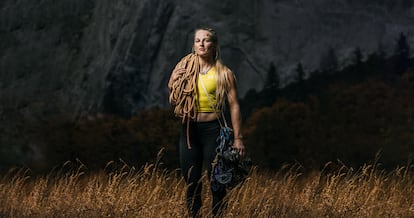

On the same day that the death of Navarrese mountaineer Iñaki Ochoa de Olza on Annapurna was announced, May 23, 2008, Emily Harrington was competing in the Dimarock International Climbing Masters in Vizcaya, in the Basque Country. The American climber, a rising star in the sport at just 22 years old and runner-up at the 2005 World Championship, saw some of her scheduled interviews canceled: all attention was focused on Ochoa de Olza’s disappearance. A few months later, Harrington gradually began to distance herself from competition, overcame a difficult relationship with her weight, and transformed herself into a big-wall climber, even a mountaineer. Nobody could have imagined it in 2008. The girl who at just 10 years old asked for ropes and harnesses at Christmas, who would go on to be proclaimed a five-times national sport climbing champion, turned towards the mountains: “I had already done everything I was capable of doing in the world of competition,” she said.
In 2012, she reached the summit of Mount Everest (8,848 m) with the aid of supplemental oxygen, generating enormous surprise in the climbing media. By then, she had already begun ice and mixed climbing, a transformation that would also lead her to Ama Dablam (6,812 m) in 2013 and to climb and ski Cho Oyu (8,201 m) in 2016, alongside her partner Adrian Ballinger. This change of pace ultimately led her to a type of climbing that not everyone is capable of: self-protecting on big walls without fixed anchors. The walls of Yosemite Valley, and especially El Capitan, became her new playground, and a new kind of obsession as well.
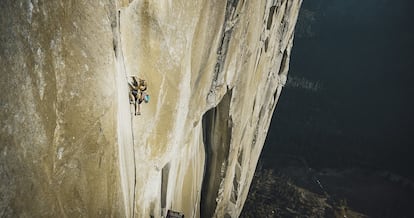
In 2015, she spent six days on El Capitan’s Golden Gate route, free-climbing its 41 pitches — 950 meters of vertical granite with difficulties up to 8a. She was the second woman to achieve this feat, after Hazel Findlay (2011), but she soon wanted more. Only three men had ever free-climbed Golden Gate in a single day: Tommy Caldwell, Brad Gobright, and Alex Honnold, and Emily Harrington was determined to be the first woman. She convinced Honnold to belay her and set to work. After two failed attempts, in 2019, stronger and more motivated than ever, she returned. She began climbing in the middle of the night, by the light of her headlamp, on relatively easy terrain, while Honnold belayed her at the base of the wall. A scream broke the monotony of the cold night. Then came Honnold’s cries of concern and his distraught face, terrified but calm: he managed to climb to his partner, stabilize her, protect her spine, and wait by her side for a complex rescue. In the documentary, the darkness of night prevents us from seeing Harrington, but her muffled screams and Honnold’s wild gaze convey far more anguish than any shot in daylight. Harrington suffered multiple injuries, including a traumatic brain injury. Afterward, she faced a long road to recovery, working to regain her lost confidence and overcome her demons. During her convalescence, those who had criticized her for being too thin years earlier now pointed out her supposed excess weight, implying that she would never be able to match the men in such a challenge.
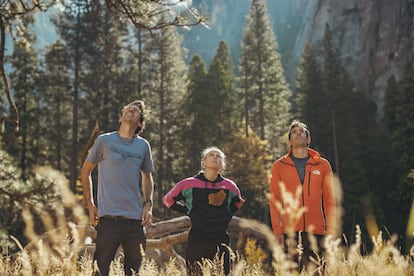
The documentary “Girl Climber” can be seen in Spain on November 21 as part of the BBVA Mountain Film Festival in Torelló, and will also be screened at the BBK Mendi Film Festival in Bilbao on December 13. The film, which premiered last September and was highly praised by critics, delves unfiltered into issues that the climbing community often avoids, questioning the coherence of certain obsessions, resilience, and the true role of women in the world of climbing. The film crew followed Harrington from her first conversations with Honnold, who on this occasion cedes the spotlight to his friend, and finished filming years later, after she became a mother. It is a meticulously crafted work that has the merit of offering moments of unique intensity, such as that shot in which, very close to fulfilling her dream, the American climber falls, hits her head and is taken out of the game (why isn’t she wearing a helmet?), as everything seems to crumble definitively.
Her conversations with Honnold are also honest: her challenge isn’t exclusively about women’s empowerment; it’s about friendship, the value of mixed-gender climbing, and a life-changing adventure that the protagonist isn’t sure she can undertake with any certainty. She isn’t afraid to reveal her weaknesses, her need to reach the best possible version of herself to rise to the challenge. It’s her life’s project, perhaps because she knows that afterward her existence will be different, that the great opportunities will be behind her. When she finally managed to free climb Golden Gate in a single day in 2020, the mainstream press in the United States covered the story: they had a new heroine, something Harrington was quick to deny: “I think above all I learned how to fail. How to deal with uncertainty, effort, and the very real possibility of working on something I might never finish. But I gave myself room to, perhaps, succeed.”
Now, at 39, with a son born in 2023, Harrington lives a serene life, facing challenges on a smaller scale. In 2019, she received an affirmative answer to a question that had kept her up at night: Was she truly a climber capable of taking on the walls of Yosemite, or was she just a pretentious young woman obsessed with an excessive challenge? The need to be accepted into the local community of legends in the Californian valley allowed her to reach her full potential, break free from the mold she had been confined to in her adolescence, and seek a new place to reinvent herself.
Sign up for our weekly newsletter to get more English-language news coverage from EL PAÍS USA Edition









































