
From ‘Bugonia’ to ‘Pluribus’: Why today’s aliens aren’t like they used to be
Modern UFO fables tell us more about human loneliness today than about possible life in the cosmos


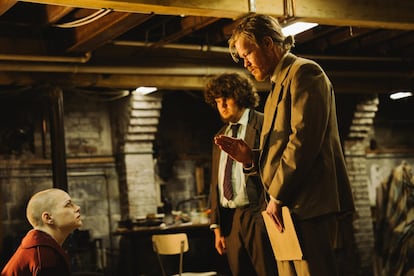
Encouraged by the conspiracy theory of a YouTuber, two cousins kidnap a senior executive at a pharmaceutical company, believing she is an alien from Andromeda sent to destroy human life.
Two scientists who have turned the encrypted message of an extraterrestrial signal into a virus will unleash an epidemic of kindness in which all minds connect in unison — a harmony that a woman immune to this viral global happiness will fight against.
Chile’s ATLAS observatory (the Asteroid Terrestrial-impact Last Alert System) detects the third interstellar object in history, and the internet spends several months in collective delirium, convinced that what is approaching Earth is an alien spacecraft.
Of these three stories, only the one about the furor over the supposed alien ship 3I/ATLAS was true. The alien-kidnapping cousins belong to Bugonia, the latest film by Yorgos Lanthimos — a satire about extraterrestrials that is actually about political alienation in a population lost between distrust of the system, conspiracy thinking, and fake news.
And the woman immune to the Martian happiness virus that has transformed the global population isn’t real, but rather a character played by Reha Seehorn in Pluribus, the new series from Breaking Bad creator and X-Files writer Vince Gilligan. Gilligan came up with the original idea years ago while filming Better Call Saul. He imagined what would happen if, suddenly, the rest of the world became incredibly kind to a single person. Gilligan’s series says far more about us than about whatever might be happening out there.
We have to forget “I Want to Believe” poster that Agent Mulder had hanging in his office in The X-Files. Today’s new fables about extraterrestrial life are no longer like the ones that mesmerized the last century. Even though they still show up in emojis, those silver saucers spotted on clear nights no longer inhabit our collective imagination. The shift in narrative conventions makes sense: if our fears are no longer the same, our extraterrestrial paranoia will also be different.

Carl Jung put it plainly in 1958 when he published Flying Saucers: A Modern Myth of Things Seen in the Skies: “Something is seen, but one doesn’t know what.” In that book, the psychiatrist explored the symbolic nature of extraterrestrial encounters. For Jung, the UFO myth — regardless of the era — should not be read literally but as a symbolic expression of the collective unconscious and the individual psyche. Alleged contact with extraterrestrials, he argued, is really a projection of the shadow: the darker facets of human personality, such as fear of the unknown and the impulse to project internal conflict outward. Several recent books and essays have revived and reinforced this idea. So what has changed now?
UFOs were easier to spot under Franco
Why did the Franco dictatorship, known for harsh censorship, allow —and even embrace — news reports about flying-saucer sightings across Spain? Because they served its purposes. This is the argument of Ana Fernández-Cebrián, a philosopher and professor at Columbia University, in her book Fables of Development: Capitalism and Social Imaginaries in Spain (1950–1970). She shows that while the Franco dictatorship did not invent UFOs, it did capitalize on the surge of sightings because they aligned neatly with the regime’s propaganda interests.
UFO stories were useful: they reinforced Spain’s alliance with the United States, projected images of progress and modernity, offered a form of social distraction, channelled collective fears and desires without politicizing them, and fit comfortably within how the regime framed political and social developments as ordained by God.
Under Franco, it was easier to spot a flying saucer. Fernández-Cebrián provides plenty of evidence: they dominated front pages of newspapers such as Imperio (the Falangist daily of Zamora), appeared regularly in radio programs like the radio network Cadena SER’s Diego Valor, and even made their way into films such as La lupa (1955). At the height of the Cold War, flying saucers became a distorted mirror for Spanish society — a space for imaginative experimentation in a country subject to censorship, gripped by nuclear anxieties and fascinated by technological modernization.

Another group that has connected the dots between alien fascination and social repression is Wu Ming, in the novel Ovni 78. This work, published under the collective pseudonym of a group of Italian writers, explores why Italy experienced what became known as the “Great Wave” in 1978 — the year prime minister Aldo Moro was assassinated, a state of emergency gripped streets ravaged by heroin, and the Vatican saw three different popes. UFO sightings flooded the news and everyday conversations across the country.
It was such a mass phenomenon that even EL PAÍS covered it in a report by Juan Arias: “In Italy, right now, people from all walks of life are seeing flying saucers: entire schools with their parents, truck drivers not given to hysteria, fishermen who know no fear and are well-prepared for any surprise. They have been spotted from airport control towers and, especially in recent days, countless police officers have become key protagonists in this flying-saucer fever,” he wrote.
Ovni 78 brings that episode back to life through fictional and real characters, examining how flying saucers worked as a symbolic projection of fear — a way of giving external form to vague, unarticulated threats.
Tell me another conspiracy theory
While authors like Dan Schreiber now analyze the so-called panspermia — the theory that life on Earth was extraterrestrial in origin — in books such as The Theory of Everything Else, other texts seek to reinterpret the conspiratorial mindset that surrounds us.
“Fables about aliens often relate to the anxiety we feel about the unforeseen and unwanted effects of technological progress,” recalls philosopher Pepe Tesoro in an email exchange.
In 2024, Tesoro published the book Los mismos malvados de siempre. Una teoría de las teorías de la conspiración (The Same Villains as Always: A Theory of Conspiracy Theories), a work that took the conspiracy theorist out of the shadows and into public discussion. The book analyzed modern conspiracy theories as social symptoms in times when the present feels hostile. “Although a more benign version of aliens became popular in the 1980s compared to the 1950s, which were marked by the Cold War-era fear of annihilation, it seems that this conflicted relationship with outer space has returned today,” he explains.
For Tesoro, contemporary times have brought back alien fables, but now to symbolize our own isolationism. “This enormous technological acceleration and political instability, figures like Elon Musk or Peter Thiel, companies like Palantir, the climate crisis, and the genocide in Gaza have brought back to our imagination the darker side of technological progress,” he explains.
“It’s natural that alien fables are making a comeback, but the human species is no longer portrayed as a heroic, unified collective subject worth saving,” he continues. “It’s not even the handsome and competent investigator, like Fox Mulder in The X-Files, who confronts the alien. Today, the individual is depicted as simply alone, distraught, and abandoned.”
Hence, Tesoro explains, in all these new series and films, “isolation, confusion, and the anxious condition of the individual are the starting point.” Any alien encounter, if it occurs, will be because humans feel more alone than ever in the universe.
Sign up for our weekly newsletter to get more English-language news coverage from EL PAÍS USA Edition









































