
Rise and fall of ‘The Witcher,’ Netflix’s answer to ‘Game of Thrones’
The fourth season of the most-watched series on the platform lost 50% of its audience with the replacement of Henry Cavill by Liam Hemsworth
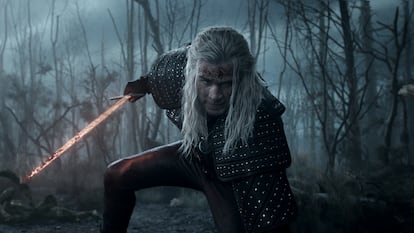

It is hard to recall a series that has experienced such a spectacular debacle as The Witcher. The adaptation of the saga, based on the epic fantasy books by Polish author Andrzej Sapkowski and popularized by the video game version, started in 2019 as one of Netflix’s pet projects. It sought to be the platform’s equivalent to Game of Thrones, forging a franchise with multiple derivatives. It’s the kind of thing Netflix has struggled to replicate since Stranger Things. The Witcher’s audience figures during the first season provided a glimmer of hope, but six years and five seasons on, the numbers have plummeted, spin-offs have been cancelled, and the protagonist replaced.
Let’s start with the star of the show. It is true there are many series that have introduced a new actor to play the same role. It happened with the role of Vivian Banks on The Fresh Prince of Bel-Air and with Daario in Game of Thrones. There have also been cases where the protagonist has left and another character has come in, notably in House of Cards, Spin City, The Office, The Conners, and Two and a Half Men. What is almost unprecedented is that a protagonist on whom much of the success of a series is based leaves and another actor comes in, which is what happened in the fourth season of The Witcher. The show lost Henry Cavill, who had the right name to make the series attractive to audiences unfamiliar with the saga.
The change wasn’t just esthetic: Cavill had been a promoter and fan of the franchise before the small-screen adaptation was released. So much so that he himself campaigned for the role of the sorcerer Geralt of Rivia. Hence, when announcing his exit, loyal fans were quick to speculate that Cavill had left due to disagreements over how the original work and his character were portrayed. Even so, the actor was diplomatic when it came to his Instagram post in 2022, wishing Liam Hemsworth — younger brother of Chris — all the best.
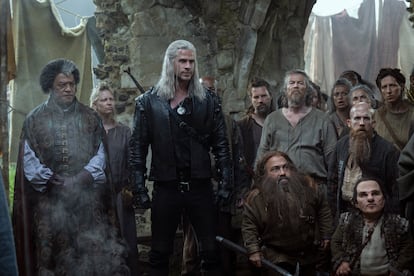
The fourth season begins by trying to win new fans with a summary of the story of this monster hunter and the two women in his life. The recap allows the project to recreate some iconic moments from the past, but with its new star in place. The screenwriters wanted viewers to get hooked on the plots without having to have been previously invested in The Witcher’s complex world. And they wanted to avoid having to explain the change of actor, taking their cue from the Doctor Who series, which has been switching actors across five decades. The problem was that there were no new viewers.
As Netflix has just announced, the eight-episode fourth season had 7.4 million viewers in its first four days, a drop of almost 50% compared to the 15.2 million during the third season. It was not even ahead in the ranking of the most-watched premiere, coming second after the romantic comedy Nobody Wants This, released a week earlier. But the decline is not only due to Hemsworth. Viewer numbers had already fallen by half since the series began; it managed 76 million in its first six months and became the platform’s most successful first season at the time, as well as having a musical hit with Toss a Coin to your Witcher.

The Witcher still has a fifth season to be released, which has already been filmed and will cover the books Baptism of Fire, The Tower of the Swallow and The Lady of the Lake. But the series that was presented as Netflix’s great hope did not die in a day; it went into a gradual decline due to an inability to convince both viewers familiar with the original material and those who weren’t. It just goes to show that battalions of dragons and swords are not enough to recreate the success of Game of Thrones, as Amazon demonstrated with its The Lord of the Rings: The Rings of Power, whose audience is diminishing by the season.
Sign up for our weekly newsletter to get more English-language news coverage from EL PAÍS USA Edition









































