
Neither blonde nor dumb: Marilyn Monroe against Hollywood’s wolves
A major retrospective revisits the actress’s films and legacy as a performer, beyond the stereotypes that defined her image

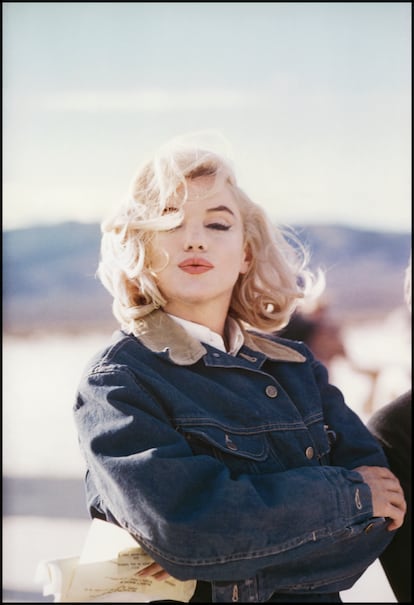
Marilyn Monroe had to fight many wolves, most of them Hollywood producers and directors, but also sexual predators of all kinds. She recounted this herself in an article published in Motion Picture Magazine in January 1953, when she was only 26 and already had several comedy films to her name. Although her life was cut short by a fatal overdose on August 4, 1962, shortly after her 36th birthday, she appeared in 32 films.
This text, written in her own hand and titled The Wolves I Have Known, is part of the retrospective that the French non-profit film organization Cinémathèque française is devoting to the unforgettable actress to mark the centenary of her birth, which was celebrated on June 1. It says much about the film industry that turned her into a sex symbol, but also about her ability to take control of her own career. Sadly, many other wolves haunted her life: a difficult childhood spent in multiple orphanages, a mother struggling with mental illness, three turbulent marriages, fragile health that led to two miscarriages, multiple addictions, and an unstable emotional life. Despite all this, she was an independent woman, founded her own production company, and left behind a remarkable body of work.
Co-produced by the Cinémathèque française and the La Caixa Foundation, the exhibition will travel in expanded form to CaixaForum Barcelona in the spring of 2027 and to CaixaForum Madrid in the autumn of the same year.
Marilyn Monroe needs no introduction. Perhaps that is why the first image in the exhibition is not of her, but of a crowd of fans and curious onlookers gathered behind a police line, apparently watching an incident unfold at night. It is easy to guess what comes next: the actress’s most iconic image, taken during the promotion of Billy Wilder’s The Seven Year Itch (1955). In it, Monroe stands in a white dress as a gust of air from a New York subway grate lifts her skirt. In the publicity photograph, her underwear is visible, but anyone looking for that shot in the film itself will not find it. Hollywood dared to be more provocative in promotion than in the final product. Marilyn Monroe was one of the great victims of this American double standard.
Despite her success, the actress, born Norma Jeane Mortenson, is still too often reduced to the status of a sex symbol, an impression reinforced by images like these. Yet she pursued her dream of becoming a serious actress, having been fascinated by cinema since childhood and inspired by an industry in which her mother had worked. For that reason, “one of the goals of the exhibition is to place her film performances back at the center of attention and invite visitors to view them from a different perspective,” says curator Florence Tissot.
Tissot also highlights Monroe’s famous line in Gentlemen Prefer Blondes (1953), directed by Howard Hawks: “I can be smart when it’s important, but most men don’t like it.” That may hold the key to understanding the public image she projected. As Sarah Churchwell writes in The Many Lives of Marilyn Monroe: “Beliefs often precede facts and reveal more about us than about the star.”
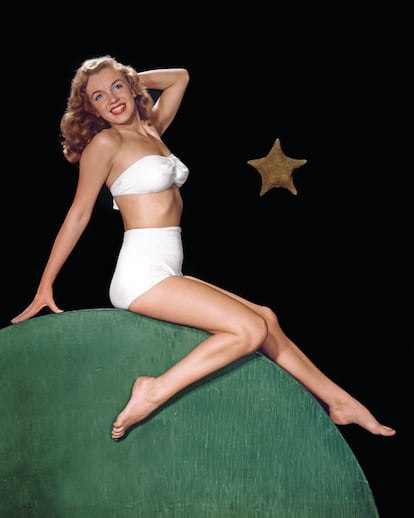
To understand why Monroe was boxed into every stereotype that could be attached to a stunning blonde woman of the era, even though her natural hair color was actually red, as photographs from her teenage years show, the exhibition looks back to the beginnings of her career. It traces the story of a young woman born in Los Angeles who dreamed of making movies and whose looks undoubtedly worked in her favor. She altered her appearance only enough to achieve the now-iconic face framed by a beauty mark and a graceful figure she carried with unmistakable sensuality.
Working first as a model, and later as a pin-up, she even posed for a nude photograph that would be published three years later, after she had already entered the film industry. These experiences helped her secure her first screen roles, mostly supporting parts in comedies in which her looks and supposed naivety attracted most of the attention, as rumors grew that she was playing herself.
She was undoubtedly a gifted comic actress, but she also delivered more substantial performances when given the opportunity, a point the exhibition repeatedly emphasizes through its chronological journey. Filled with previously unseen documents, iconic costumes, personal belongings, photographs, and clips from her films, the exhibition highlights scenes chosen to showcase the full extent of her talent on screen.
A perfectionist who suffered from stage fright, Monroe devoted herself to continuous training. She studied at the Actors’ Laboratory Theatre and worked with Michael Chekhov, a disciple of Stanislavski, as well as acting coach Natasha Lytess, mime artist and dancer Lotte Goslar, and teacher Lee Strasberg. Together, they helped her move beyond the stereotypical image that had been imposed on her.
She prepared meticulously for every role, focusing not only on her acting but also on her voice and dance technique, as she demonstrated in musicals such as Gentlemen Prefer Blondes and Some Like It Hot (1959), also directed by Billy Wilder.
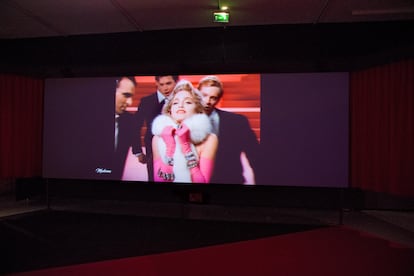
The purpose of this approach is clear and deliberate: to rediscover the artist and the woman behind the myth. The exhibition includes her sensual gowns, among them the fuchsia dresses that helped propel her to stardom, but also a replica of the cream-colored, crystal-encrusted dress that Kim Kardashian squeezed into for the Met Gala. Monroe wore the original in 1962, the year of her death, when she famously sang Happy Birthday to U.S. President John F. Kennedy at a time when her health, already weakened by addiction, was rapidly deteriorating.
Also on display are a bottle of Chanel No. 5, the perfume she claimed to wear to bed, and a white fox-fur stole, the perfect accessory to her low-cut gowns. Yet beyond these fetishized objects, greater prominence is given to archival material documenting her career: articles, photographs, and even the June 1953 cover of the influential Cahiers du Cinéma, which consecrated her as a serious actress, the same year she starred in Niagara, one of her first leading roles under Henry Hathaway, and How to Marry a Millionaire, alongside Betty Grable and Lauren Bacall, the first film released in CinemaScope, the widescreen technology developed by 20th Century Fox.
At the same time, visitors gain a broader understanding of Monroe’s personal life, which was always closely intertwined with her film career. She spoke openly about suffering abuse as a child in foster homes. She married police officer James Dougherty at just 16, and her later marriages were equally turbulent: first to baseball legend Joe DiMaggio, a union that lasted less than a year, and later to playwright Arthur Miller, who wrote for her the role of a divorced woman adrift in The Misfits (1961), a character with many parallels to her own life. It was the last film released. She starred alongside Clark Gable, who died only days after filming ended, and Montgomery Clift, with whom she shared a deep friendship forged through their mutual struggles. He, too, would die a few years later.
The exhibition is far less flattering in its portrayal of 20th Century Fox, which exploited Monroe’s contract as much as possible, often paying her significantly less than her male co-stars. Eventually, she grew tired of the treatment and moved to New York to establish her own company, Marilyn Monroe Productions. In doing so, she became one of the first women in Hollywood to launch her own production company. She founded it with her friend, photographer Milton H. Greene, who took many of her finest portraits, stripping away the affectation of naivety that had become part of her public image. Greene also introduced her to Marlon Brando, with whom she had a romantic relationship.
If Monroe was pigeonholed during her lifetime, the myth only grew after her death. The point is made clearly through a clip from the television series Mad Men (2007), shown in the exhibition. In the scene, an advertising executive proposes a campaign for the lingerie brand Playtex by dividing U.S. women into two categories: Jackie Kennedy and Marilyn Monroe. “Every single woman is one of them,” he declares, while Peggy Olson (played by Elisabeth Moss) looks on in disbelief and challenges the male fantasy. Refusing to accept the dichotomy, the agency’s only female copywriter asks, “Who do you think I am?” To which the young executive Ken Cosgrove (played by Aaron Staton) jokingly replies, “Gertrude Stein.”
Like the great Peggy Olson, this retrospective dismantles the U.S. double standard that insisted women could only be Jackie or Marilyn, and that Monroe could only be either a sex symbol or a star. The truth, of course, is that she was both.
Playing Marilyn
Monroe’s death from an overdose only intensified the sensational legends surrounding her. To this day, what happened on the night her heart gave out has never been conclusively established beyond the autopsy’s finding of acute barbiturate and drug intoxication. Her tragic end only deepened the myths. While the years immediately following her death were dominated by reductive narratives about her mental health, more recent decades have seen artists reclaim and celebrate her legacy.
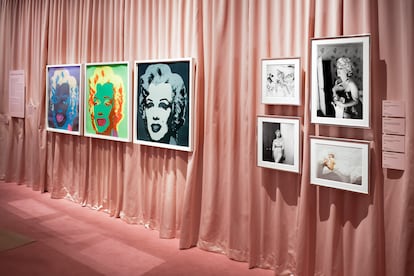
From Madonna’s Material Girl video (1985) to Andy Warhol’s colored reinterpretations of the iconic promotional image from Niagara, and Canadian model Winnie Harlow’s Marilyn-inspired Halloween costume in 2019, Monroe’s image has remained a powerful cultural reference point. She has served as an inspiration for performers and actors ranging from Beyoncé and Michelle Williams to Margot Robbie, and even Channing Tatum and Ryan Gosling, all of whom have offered their own interpretations of the unique figure of Marilyn Monroe.
Sign up for our weekly newsletter to get more English-language news coverage from EL PAÍS USA Edition









































