From barroom drink to signature cocktail, aguardiente aims to become a luxury beverage
With high-quality ingredients, sophisticated distillation processes and new ways to enjoy it, the Colombian spirit seeks a place on the global stage
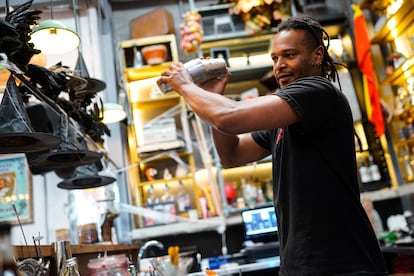

From being sipped from a plastic cup with a straw, to being served in a glass on the rocks — accompanied by pineapple or goldenberry extract — aguardiente or sugarcane liquor is now reaching the bars of prestigious establishments. The indispensable companion of parties and long nights in Colombia, it’s the latest addition to the family of Latin American spirits that have undergone a process of sophistication. They’ve become premium products, while still remaining popular drinks: tequila, mezcal, cachaça and pisco. Now, it’s aguardiente’s turn.
Better known in Colombia as guaro, it’s the unofficial national liquor and the first alcoholic experience for many Colombians. Locals don’t debate whether or not to drink aguardiente, but rather which type. Until early 2016, the industry was dominated by the regional liquor companies, which hold a monopoly on spirit production in Colombia. Traditionally, each of the 32 departments (states) has its own: Antioqueño, Néctar, Llanero, Líder, Pijao, Blanco del Valle, Platino, Quindiano...
Historically, aguardiente was an industrial product, made with little attention to detail. This is according to Natalia Carreño, founder of the Aguardentería Demente resto-bar in Bogotá, which has a collection of 25 types of aguardiente. “Industrial ones are all very similar; they all have the same tasting notes,” she explains.
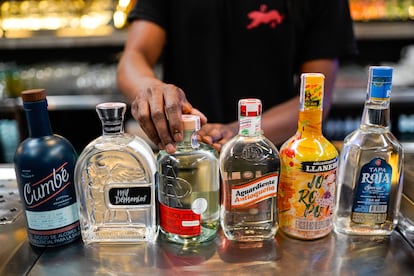
The approval of new legislation in 2016, and then again in 2020, allowed private producers to open up production in Colombia. And then, “a movement began, with different techniques and botanicals, each with its own secret,” Carreño adds. As the laws established criteria to define what exactly constitutes aguardiente — a sugarcane distillate with between 16% and 36% alcohol content, along with the presence of anise or fennel in any of its varieties, in macerated seeds or oils — the popular guaro began to take on a new, more sophisticated face.
More careful production, wider reach
Mauricio Gutiérrez, the founder of Mil Demonios, Colombia’s first premium aguardiente, explains: “You go anywhere in the world today and they serve you tequila. That’s what we want to see with aguardiente: to give this Colombian spirit the credentials to be world-class. As Colombians, we should be just as proud of aguardiente as Mexico is of tequila and Peru or Chile of pisco.”
Gutiérrez produces and exports an aguardiente that doesn’t contain anise, but rather fennel, ginger, lemon and coriander. He also uses extra-neutral alcohol, which has been distilled several times to remove higher alcohols. “Those are the ones that cause discomfort… the ones that give you a hangover, the ones that make the effects of alcohol happen faster and make the drinking experience one you’d rather forget,” he chuckles.
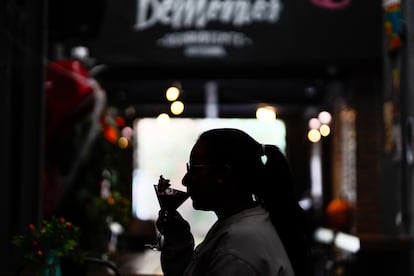
Science backs him up. Nicolás Ríos, a professor in the Department of Chemical Engineering and an expert in distilled spirits at the University of Los Andes, in Bogotá, explains that, with each distillation, the alcohol “comes out purer,” reducing the amount of unwanted compounds that produce unpleasant smells and flavors. Furthermore, filtration with activated carbon, like the kind used by Mil Demonios, eliminates the remnants of strong or unpleasant compounds, known as “fusel.” Ríos explains that this softens the flavor, without changing the alcohol content. “When it comes out of the distillation column, each molecule is like a square; when you filter it, the corners become smoother, making it easier to drink,” he describes.
Julio Molano, founder of Desquite, another brand of aguardiente that is produced in the municipality of San Francisco, asserts that there are five criteria that the alcoholic drink must meet to be considered “premium.” First comes the quality of the sugarcane, which Molano cultivates independently in the Gualivá region, located in the northwestern part of the department of Cundinamarca. Next is the distillation process, which he carries out using a continuous copper still. This allows the process to occur without interruption, in order to obtain 96% proof alcohol. The resulting spirit is mixed with water — the third element, also sourced from the region — and with high-quality anise essential oil, the fourth requirement. The product is filtered three times and then bottled. The packaging — which, Molano affirms, must be distinctive — is the final requirement.
Added to all of this, of course, is the story that each brand of aguardiente wants to tell. They all appeal to the affection that Colombians have for this beverage, celebrating it as a fundamental element of culture and national identity… but each one presents something new. For instance, Desquite uses virgin sugarcane syrup — the molasses used to make panela, another national symbol — to create one of its aguardientes. Mil Demonios, for its part, packages its product in a bottle that seeks to resemble the gate of a colonial house in Cartagena.
A new way to consume
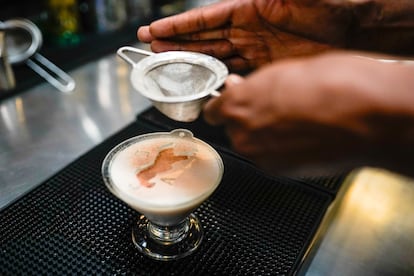
With the arrival of these new brands of aguardiente, the way it’s consumed has also changed. It’s no longer just taken as a shot to “knock you out,” as Johan Yepes, head bartender at Aguardientería Demente, puts it. Rather, it can now be explored via cocktails. Using Desquite, Mil Demonios, Júbilo, or Cumbé — which is aged in oak barrels from the city of Manizales — Yepes prepares cocktails that have transformed the way people approach and understand aguardiente consumption.
“People drink [it] slowly — one or two [glasses] — without needing to get drunk. Some try it and say, ‘Oh, how delicious, I didn’t even like aguardiente before,’” he says. Among his specialties are preparations that combine aguardiente with hibiscus flowers and red chilis soaked in it for seven days; or with with pineapple extract and a touch of mezcal. He also puts together corn extracts with aguardiente and martinis, or aguardiente mixed with kiwi, cilantro and lime. He mixes the spirit with passion fruit, makes aguardiente margaritas, or simply serves it on the rocks with lime.
Yepes explains that guaro is a versatile and relatively unexplored liquor. “The vanilla and wood notes that the barrel imparts to Cumbé, or the botanicals of fennel, ginger and cilantro in Mil Demonios, combine very well,” he assures EL PAÍS, enthusiastic about the world of possibilities that aguardiente offers. “We have to be bolder, explore more… [we have to] produce aguardientes with higher alcohol content and different flavors. That’s when you start to wonder: ‘how does this aguardiente taste with this fruit, or with this other [ingredient]?’”
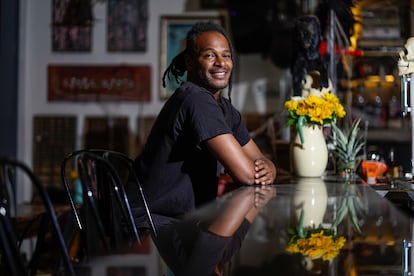
“Colombia is a country of aguardiente. And even if it becomes more sophisticated — [if] the recipe changes and the ingredients vary —guaro will continue to be part of the national identity. There’s no risk of it ceasing to be,” the restaurateur Natalia Carreño emphasizes. “It’s not that it doesn’t exist elsewhere, but it’s our drink,” she adds. “People are eager to try new things, but there are also those who come to restaurants looking for the aguardiente from their region: a Llanero, a Doble Anís. And there’s something for everyone.”
Sign up for our weekly newsletter to get more English-language news coverage from EL PAÍS USA Edition