
‘The Hand That Rocks the Cradle’ still carries scares in 2025, with a twisted nanny and an auteur director
Hollywood newcomer Michelle Garza Cervera is at the helm of the Disney+ project, where Maika Monroe replaces Rebecca de Mornay as the evil child carer
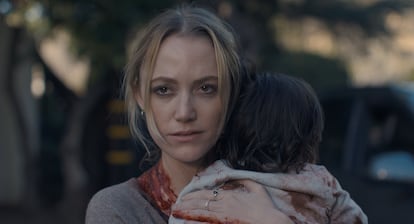

What’s scary is scary. Horror is a universal genre that feeds on darkness, silence, and creaks on the floorboards, on a rich cultural heritage and on each person’s subconscious to provoke its ultimate goal: the scream, the jump. And if in 1992, The Hand That Rocks the Cradle, starring Rebecca de Mornay’s terrifying nanny Peyton, managed to make even Herod’s hair stand on end, a similar story would surely work now, 33 years later. With that premise, Disney thought, why not do it again?
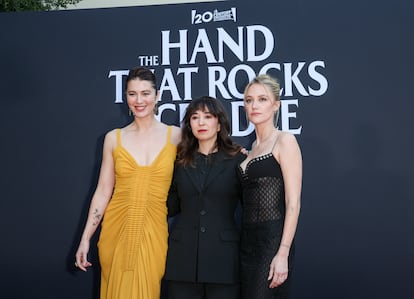
Released on October 22 in the United States, the new version of The Hand That Rocks the Cradle — available on Hulu and Disney+ — will once again terrify parents in the 21st century, and even people who don’t have kids. This time, the role of the nanny is played by Maika Monroe, a young Californian actress born just months after the premiere of the original, who worked on Independence Day: Resurgence in 2016 and the equally terrifying Longlegs (2024), as well as the series The Stranger. She is joined by Mary Elizabeth Winstead as the long-suffering mother and Raúl Castillo as the slow-moving father, along with the girls Mileiah Vega (Emma) and the twins Lola and Nora Contreras (Josie).
But the substance has also changed. The script is not written solely by Amanda Silver, as the original was, but also by Micah Bloomberg (creator of the series Homecoming), who has updated it to focus on a Latino family in Los Angeles (where, after all, almost 50% of the population is Hispanic), now surrounded by technology, which is of little use in finding the manipulative caregiver. The director of the original, Curtis Hanson, died a decade ago, and the project is now headed by Michelle Garza Cervera, who, at just 38 years old and after experimenting in the horror genre (especially with the acclaimed Huesera: The Bone Woman), is taking on her first project in Hollywood.
Cervera is a lover of horror and of distilling it in all its forms, from simple glances to the purest gore. She triumphed a couple of years ago thanks to her shocking debut film, Huesera, and now she is looking to adapt Mónica Ojeda’s literary success Mandíbula. But in the meantime, Disney called and she decided to dip her toe into Hollywood.
Question. You’ve come from very auteur projects, from short films to movies like Huesera. What was it like to get the call from Disney?
Answer. The truth is, I feel very lucky. Everything happened in large part because of my debut feature, Huesera. One of the executives saw it and really liked it; he’s a fan of the genre. We had an incredible conversation; it’s clear they know a lot about horror, which is what I love most. They invited me to the Disney offices to screen it, and a line of communication opened up with them. They shared with me that they’d been mulling over the idea of a remake of The Hand That Rocks the Cradle for a long time, and that they had ideas for doing it. I came up with a concept, and we started working from then on. It’s been incredible because, despite being a different world for me, in English... the truth is that when it comes to doing the work, it’s the same. It’s the same process I’ve always worked on in Mexico, obviously with many different things, but I really enjoyed it.
Q. And what of that slightly indie cinema is there in this big-studio film? How was that different when working?
A. Obviously, when I got here, I was a little intimidated by Hollywood and all the toys they have [laughs]. It’s a huge industry, and it’s not that it feels old, but it’s that they have decades and decades of processes, and you come here from a very different world. I tried to focus on what my work is, the character work, the narrative, the camerawork, everything I love the most, and I felt very at home there. It was very intimidating and honestly, it is a very different process, because I had previously worked with scripts that I had written, not just from a directing position, but I wanted to experience it. They invited me, and although I had several projects that I was still working on, I said to myself: ‘I have to try it.’ We often have [preconceived] ideas about what it’s like to make a studio film, and I really wanted to go through that process, and life put that in front of me.
The truth is, I’m very grateful for the project, very proud, and I think that despite being a big studio film, there’s a lot of me in it, the way I like to narrate and construct. That’s what I’m most proud of, of managing to bring many processes that are very specific to how I work to this film.
Q. The film has many auteur touches, such as the way the two protagonists are treated, their parallels, the play on reflections... were you trying to scare the audience?
A. Yes [laughs]. I love creating an atmosphere of tension and anxiety that makes you feel like violence could explode at any moment. I feel like that kind of construction gives a sense of growth; it’s what I find most enriching, and also complex and very delicate to construct in a thriller. I’d done horror before, so here it was thriller elements with horror film tools, but also testing things out and experimenting. I feel proud when I see audiences responding to those moments of tension, which sometimes seem subtle, but underneath there’s a lot going on. I love those silent moments in film, where you’re just seeing the face of a character who’s silent and you’re feeling all the layers of the character.
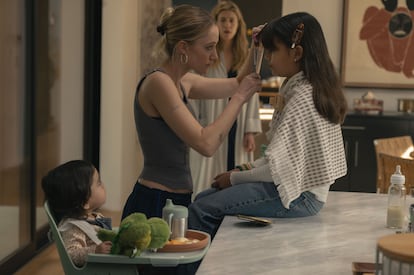
Q. You move between very subtle moments and gory scenes. How do you play with that horror arc?
A. I’m so happy we managed to build it. The truth is, there were many elements, many symbols, and I think we worked with the entire team to be able to combine it and reach that point where I felt the film responded and had its own universe.
Q. As you say, you were involved in directing but not writing the script, but even so, it has touches. Its Latino characters, that piñata, those girls... Did that Latino element come from Disney, or did you also have a little input?
A. I was fortunate when I approached them with the idea, with the general concept; basically, it was to have the characters in gray areas, not that they weren’t like good and evil, but rather a mixture, a play between the two. That was the challenge. Then they hired the great writer Micah Bloomberg, and I was there from the first draft of the script, giving notes, giving feedback. We did have a lot of chances to work with him, and I wanted to include Latinx elements, opinions, like being Latinx from Los Angeles, like having your family still in Mexico, like the layers of the legacy of violence. At the end of the day, these girls are the ones who are, in a way, absorbing that violence; there’s a theme of how the cycles of violence continue. And there was something very interesting about including an element of migration in that regard.
Q. Now you’re a Latina in Hollywood, whether or not you intend to pursue a career here. How has the industry treated you as a Latina? Have you felt discriminated against or protected?
A. The truth is that I have heard of other directors who have had quite terrifying experiences of arriving in Hollywood, Spanish-speaking directors. I feel like I had a very fortunate process, and I think it has to do with the people around me. I felt surrounded by people who’ve perhaps made many more films than I have, but in my excitement at the fact that this was only my second film and my first in the United States, they jumped on that bandwagon of curiosity with me, of understanding the project.
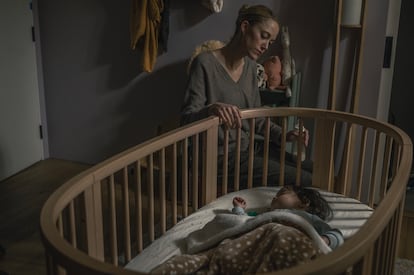
I felt like I was playing with a team of people I had admired for a long time, with excitement. I didn’t feel that Hollywood is a cynical place that’s only about the industry, as is often perceived, but rather a creative game, and I think I was very lucky. Obviously, there are many more layers after making the film, which have to do with sales, distribution... It’s huge and very impressive to witness, but it’s no longer my job. I think I did what I had to do, and the process of my work itself was very fortunate, and I felt very, very blessed in that sense.
Q. So, as a young, Latina woman in Hollywood, you felt loved and respected by this huge industry.
A. The truth is, yes, it was incredible. I felt very embraced. We also had a team including many women. There was a moment when we were designing a big fight scene and there was the stunt coordinator, all the stuntwomen, the actresses, me... Only women on set. There were about 12 of us women designing a fight scene. And there were many Latinas and Latinos on the project. You could hear a lot of Spanish on the set, and that’s something that also represents a city like Los Angeles, which is very Latino. I liked that I felt that Los Angeles, the real one, which is full of Spanish, on set.
Q. Have you found this experience fulfilling? Would you like to do it again? Would you like to combine your more independent filmmaking with commercial work?
A. Of course. The truth is, it doesn’t have to be one or the other. It was great to have this experience; I maintained a lot of the indie aspect in this film, and I’m very proud of it. But I feel a responsibility to continue storytelling and making films from my country and in my language... although I’m not closing any doors either. What I do think I wouldn’t do again is a remake. I’ve already tried that and it was great, but I feel it’s time to embrace original projects and things I’m writing myself. But you never know where things are going to take you.
Sign up for our weekly newsletter to get more English-language news coverage from EL PAÍS USA Edition









































