
U.S. pianist Eric Lu wins prestigious Chopin Competition in Warsaw
The victory by the American musician, who already has an established career, came as no surprise. The Polish competition was widely followed on social media and reflects the current Asian dominance in the world of piano

“Fryderyk Chopin represents the sound of our freedom, the spiritual voice of the Polish nation.” These words greet visitors to Żelazowa Wola, about 31 miles (50 km) from Warsaw, the manor where the famous composer was born in 1810. The first monument in his honor was erected there in 1894, when the country was still under Russian rule. After Poland’s independence in 1918, the site was converted into a museum surrounded by a beautiful park.
Another emblematic site linked to Chopin—this time to his death—is the Holy Cross Church in Warsaw, where his heart rests, brought from Paris in a brandy flask by his older sister in 1849. Between the commemorations of his birth and his death, one of the most prestigious classical music competitions in the world is held every five years in Warsaw: the International Fryderyk Chopin Piano Competition.
The event began in 1927 as a Polish nationalist demand: a way to “purify” the interpretation of Chopin’s piano music from foreign influences considered “hypersensitive and morbid.” It was promoted by pianist Jerzy Żurawlew, a pupil of one of the composer’s students, who gave it a new format inspired by high-level sports competition in order to motivate young pianists.
However, the successive victories of Russian performers in the first editions made it clear that Chopin’s “Polishness” had an international dimension to it. The competition later launched the careers of keyboard greats such as Maurizio Pollini, Martha Argerich and Krystian Zimerman. Today, that dimension is truly global, judging by the origins of the contestants.
The 19th edition of the Chopin Competition began on October 3rd and concludes today, the 23rd, with the third winners’ concert. Eighty-four pianists from 19 countries performed on the stage of the Warsaw Philharmonic in three solo elimination rounds and a final.
The numbers reflect the current Asian dominance of the piano: 28 Chinese pianists, 13 Japanese, three Taiwanese, three Koreans, plus one representative each from Malaysia and Vietnam. Even the American and Canadian laureates are of Chinese descent. Europe was represented primarily by 13 Polish pianists, along with English and Italian trios and individual representatives from France and Spain.
The scale of the competition goes beyond the packed halls at every session and the long lines during the concerts, but also extends to the millions of viewers who follow it online, as well as on television and radio.
While the 18th edition, postponed to 2021 due to the Covid pandemic, broke all records on YouTube with more than 37 million views, this one seems to have surpassed it, according to Artur Szklener, director of the Fryderyk Chopin Institute, which has been responsible for organizing the competition since 1950. This year, moreover, there has been a significant following through TikTok.
As a closing ceremony, a solemn awards ceremony was held on October 21 at the Teatr Wielki/Polish National Opera, presided over by the President of the Republic, the ultra-conservative Karol Nawrocki, along with other dignitaries.
After several official speeches, in which Poland’s identification with Chopin’s music—banned during the Nazi occupation—was emphasized and gratitude was expressed for Warsaw’s return to the capital of classical music during these days, the first of three closing concerts was given with all the award winners.
During the ceremony, the significant absence of the jury’s president, the American pianist Garrick Ohlsson, winner in 1970, was glossed over. It was even more conspicuous considering that this year’s winner is the first American citizen to achieve the feat since then.
It was also the first time a non-Pole chaired the jury, but this didn’t prevent the usual clashes of egos and interests that, year after year, leave worthy candidates out in the early rounds. The most famous case is that of the iconoclast Ivo Pogorelich, whose elimination in the third round in 1980 led Martha Argerich to leave the jury in protest.
The new scoring system, which prorates the scores for the four stages of the competition, giving the final a 35% weighting in the overall score, also didn’t help. The jury’s deliberations continued for another five hours, well into the early hours of the morning.
It was interesting to follow the long wait from the stalls of the Warsaw Philharmonic, where the finalists, accompanied by family and friends, were spread out around the hall, many engrossed in their cell phones. This atmosphere of nervousness, fatigue, and cordiality was captured in 2021 by Jakub Piątek in the documentary Pianoforte (HBO), and is being recorded again this year for the release of a series.
In fact, at the time the decision was announced, at exactly 2:28 a.m., there were about two hundred people, including fans and journalists, in the foyer of the Polish auditorium, who had been waiting there for hours.
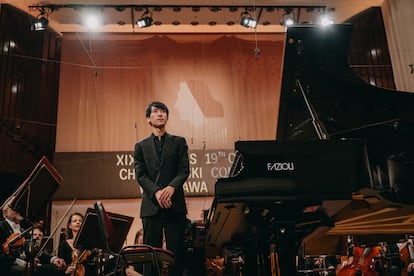
It came as no great surprise that 27-year-old Eric Lu, from Bedford, Massachusetts, took home the top prize. His background is unusual compared to the other contestants: he’s already a pianist with an established career, having won fourth prize in this same competition in 2015, and first prize in Leeds in 2018. He is represented by the influential agency Harrison Parrott, and has released four albums as an exclusive Warner Music artist.
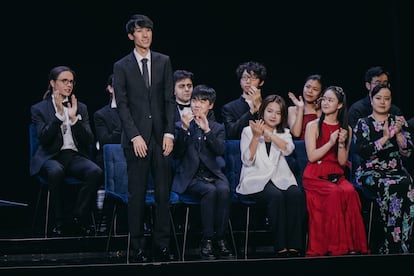
Furthermore, like the 2015 and 2021 winners, Seong-Jin Cho and Bruce Liu, he was a student of one of the jury members: the Vietnamese-Canadian Đặng Thái Sơn, the first Asian citizen to win this competition in 1980. Lu also had another of his former instructors from the Curtis Institute in Philadelphia, Robert McDonald, on the jury.
In any case, his poise and experience throughout the competition—despite having to postpone his performance in the third round due to illness—guaranteed him success.
“This competition has been a big gamble for me,” Lu acknowledged the following day, during a brief meeting with EL PAÍS at his hotel, after meeting with representatives from the Deutsche Grammophon record label. “Since I already have an established career and representation, I felt that if I didn’t play well, I could lose some of what I had already achieved,” he added.
He downplayed his illness: “I think I’ve been sick in all three competitions I’ve entered.” He also noted that his experience was an advantage in the final, having played with orchestras such as the London, Boston, and Chicago Symphonies: “Before, I didn’t really know how to play with an orchestra and I focused only on my part.”
He also chose a Fazioli piano instead of the more common Steinway, based on his familiarity with the Warsaw Philharmonic’s acoustics: “Here the orchestral sound can overwhelm the piano, and the Fazioli brings more brilliance, clarity, and color, which made me feel more comfortable.”
His performance made the difference on the first day of the finals, October 18. Another new feature of this edition was the inclusion of a compulsory work for solo piano before the usual concerto for piano and orchestra. One of the most complex and fascinating compositions of Chopin’s late period was chosen: the Polonaise-Fantasy, Op. 61 (1846), in which many scholars have seen an artistic transfiguration of his emotional crisis with George Sand and the progressive physical deterioration caused by tuberculosis.
Lu offered the best version heard that day of the Polonaise-Fantasy, followed by a convincing performance of the Piano Concerto in F minor, in which he masterfully overcame a poor orchestral accompaniment.
More surprising was the second prize awarded to Kevin Chen, 20, from Calgary, in Canada. This young Canadian of Chinese descent failed to shine on the third day of the finals, with a discontinuous Polonaise-Fantasy and a somewhat monotonous version of the popular Piano Concerto in E minor.
The pianist told EL PAÍS at his meeting on the 21st that after winning the Franz Liszt Competition in Budapest, the Competition in Geneva, and the Competition in Tel Aviv, he had no plans to enter any more competitions. He also acknowledged that he hadn’t practiced much in the days leading up to the final: “I think I played for 30 minutes at most, apart from rehearsing with the orchestra, as I preferred to rest and not expend too much energy before the performance.”
Much more interesting was the third prize, awarded to Zitong Wang, known in Spain for her victory in the 2022 Cidade de Ferrol International Piano Competition. Opposing Lu and Chen, the 26-year-old Chinese pianist delivered particularly outstanding performances throughout the competition. The jury recognized her innovative version of the Piano Sonata in B-flat minor in the third round, whose final movement sounded shrouded in a dense mist.
“It was a kind of experiment in terms of pedal use and playing style,” she explained to this newspaper on October 21, “because I’ve known the work since I was 12 and it’s been a while since I’ve played it.” His performance in the final, on October 19, didn’t shine so much for the Polonaise-Fantasy as for an imaginative Concerto in E minor, which she elevated with an exquisite final rondo. “It was very difficult to start my performance with the Polonaise-Fantasy—even though I could say it’s my favorite Chopin piece—but curiously, it was the first time I’d played the Concerto in E minor,” she said with a laugh.
The fourth prize was awarded ex aequo to two completely different, but equally interesting, pianists: the very young Chinese Tianyao Lyu, who just turned 17 and won the award for best concerto performance for the youthful spark she brought to the Concerto in E minor; and to the 30-year-old Japanese pianist Shiori Kuwahara, who possesses an impressive technique and a much more organic way of playing.
The fifth prize, also ex aequo, combined the brilliance, although without much magic, of the 25-year-old Polish pianist Piotr Alexewicz—the only one of the 13 Polish pianists in the competition to reach the final—with flashes of musicality from the 24-year-old Malaysian Vincent Ong.
Finally, the sixth prize was awarded to one of the most poetic and interesting pianists of the entire competition: the 24-year-old American, also of Chinese descent, William Yang. He performed the best Polonaise-Fantasy of all the finalists, with a personal conception designed to give fluidity to the multiple transitions of the score, together with an innate sensitivity to the subtleties of Chopin’s writing.
Unlike the rest, it was no challenge for him to begin his performance in the final with this late work, as he confessed to this newspaper: “I had the same experience at the Chopin Competition in Miami, and there I realized the challenge of moving from one of Chopin’s last great works to the more youthful style of his concertos.”
In the explanation of his performance—which culminated on the 19th with a magnificent interpretation of the Concerto in F minor—he spoke of his interest in the narrative sense of Chopin, which makes his way of playing almost addictive: “I am interested in differentiating each theme with its own tonality, delving into the different layers of his writing and exploring each dynamic,” he added.
This year’s edition also featured some unfair judging. This was the case with 24-year-old Georgian David Khrikuli, who studies at the Reina Sofía School of Music in Madrid. A pianist of great strength and charisma, he performed the most heroic version of the Polonaise-Fantasy and then displayed dramatic and musical intensity in the central larghetto of the Concerto in F minor. However, he did not win any prizes.
Khrikuli also spoke to EL PAÍS, visibly shaken: “After the verdict, five members of the jury approached me to tell me they weren’t happy,” he confessed. Still, he expressed gratitude for the experience: “Being part of this competition has been very important to me and will always be one of the best events I’ve ever participated in.” However, he wasn’t entirely sure whether he would compete in a piano competition again.
These days, in addition to Chopin, there has been no shortage of the traditional performance of Mozart’s Requiem in the Church of the Holy Cross, a custom in Warsaw every October 17 to commemorate the death of Chopin in front of the place where his heart rests.
On this occasion, Ukrainian Vadym Kholodenko performed an arrangement by Karl Klindworth for solo piano on an imposing Erard from Chopin’s time. It was a performance full of drama and somber undertones, also closely linked to the history of this competition. It is worth remembering that in its second edition, in 1932, the winners gave a recital on a Pleyel piano from Chopin’s time, and that in 2018 the competition inaugurated a category dedicated to historical instruments, which will be repeated in 2023 and scheduled again for 2028.
It was certainly easy to travel back in time to 19th-century Warsaw these days. To get to the recital at the Holy Cross Church, it was necessary to cross the set of a Netflix series based on Bolesław Prus’ The Doll, currently being filmed in the city. For the occasion, the iconic Krakowskie Przedmieście Street has revived the traditional Russian setting described in Prus’ novel.
Sign up for our weekly newsletter to get more English-language news coverage from EL PAÍS USA Edition









































