
A piano that survived Hiroshima commemorates the victims of Nagasaki
US musician Jacob Koller is performing a recital in Japan with an instrument that was saved from the atomic bomb, and donated to restorer Mitsunori Yagawa to promote peace

What struck him most about Japan was the audience’s listening skills. “Even when I played in a restaurant, people maintained an attitude of absolute respect for the music,” says Jacob Koller, 45, from his home in Kofu, Yamanashi Prefecture.
In 2009, the U.S. pianist was welcomed in Tokyo as a rising jazz star: he had just collaborated with Terence Blanchard and reached the final of the Cole Porter Scholarship in Indianapolis. After his tour of Japan, he was supposed to return to the United States, but he didn’t. Because if there was one thing Koller was good at, it was improvising. “The Tokyo atmosphere seemed so different from what I was used to that I decided to stay.”
Between tours and concerts in Japan, Koller fell in love, had two children, and one day landed a gig in Hiroshima. “I needed to rent a piano, and they gave me the contact information of someone who could help me,” he recalls.
Mitsunori Yagawa was not the typical supplier with whom he would haggle over prices before a performance. In his workshop in the Asaminami neighborhood, the renowned Japanese tuner kept seven pianos that had survived the roar of Little Boy — the atomic bomb dropped on the city on August 6, 1945.
“After one of the many conversations we had, in 2021 he offered me the chance to play one of his instruments at the Atomic Bomb Dome,” says Koller, referring to the concrete skeleton located at the epicenter of the explosion, a symbol of nuclear devastation that has been declared a World Heritage Site.
This Wednesday, Koller will sit at one of these pianos to commemorate the 80th anniversary of the second atomic bomb that devastated Nagasaki, three days after the hell of Hiroshima.
“First, we will visit Shiroyama Elementary School, where 1,400 students died,” explains the pianist. “And in the evening, I will play a program at Brick Hall that includes classical works by pianist Rentaro Taki, old folk songs, Ko Matsushita’s hymn For the Smiles of the Earth, and Rest in Peace” — his personal tribute to the thousands of victims who could not be identified.
There will also be room for improvisation. “I almost never read sheet music; I prefer to let myself be carried away by the energy of the moment.” Just like that day, 16 years ago, when he decided to stay. “Today, even more so.”
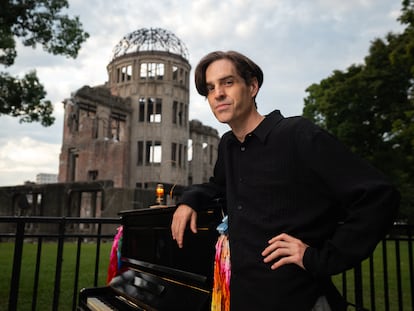
For the 2021 concert, Yagawa lent him a Korean Horugel piano that still has fragments of glass from the explosion embedded in its wood. “It has a very distinctive sound,” Koller explains. “The bass is very deep and resonant, while the treble has a sharp, almost ghostly tone.”
At first, his fingers couldn’t handle the keys. “During rehearsals, I was nervous; I couldn’t handle the pressure.” Some attendees at the Dome were reluctant to believe that it was a U.S. musician who would be paying tribute to the victims of a bomb dropped by the United States. “I completely understand why they felt that way, but Yagawa encouraged me to keep going. He told me to listen to my heart and trust in my talent.”
Since then, Koller and Yagawa have collaborated on numerous concerts, including a performance at Tokyo National Stadium in front of 65,000 spectators. “I have always been against war, and since the U.S. invasion of Afghanistan and Iraq, I only support pacifist politicians,” says Koller, whose YouTube channel has racked up millions of views. “In my recitals with Yagawa, I cover a very diverse repertoire, from Japanese popular music to classical pieces, jazz standards, and pieces I composed myself.”
Koller’s latest album, Prelude for Peace, is dedicated to his wife, Noriko, who recently passed away. “Before she died, she left me a message on my phone asking me to continue playing for her in heaven.”
On the morning of August 6, 1945, Yagawa’s father was 26 years old and working as a firefighter. “Although he was hit by the blast wave 800 meters from ground zero, he miraculously escaped unharmed,” Yagawa says via video link from Hiroshima. “My mother, who was at home, was unharmed as well.”
Yagawa was born in 1952 and has no memories of the war. “My father began to drink frequently and was always lamenting: ‘What’s the point of having survived?’” At school, where Yagawa learned to play the saxophone, a teacher recommended that he train as a piano tuner. He listened and went to work at Kawai, one of the country’s leading musical instrument companies. “Eventually, I founded my own company, Yagawa Piano Factory & Workshop,” he says, adding: “I never tried to be a pianist.”
In 1998, the first hibaku piano arrived at his shop. Hibaku is the term in Japan for instruments connected to the atomic bomb and the memory of its victims, known as hibakusha. “The only condition from the donating family was that I use it to promote peace,” Yagawa recalls. “We started in 2001 with a concert in Hiroshima, and the audience’s response was overwhelming.”
His appearances in the press and on television allowed him to connect with other owners of hibaku pianos. “All of these pianos needed repairs, but I always refused to restore them with modern parts that would detract from their original state,” he affirms. “I simply gave them a second life by adjusting the mechanics and preserving their status as witnesses to a crucial chapter in our history.”
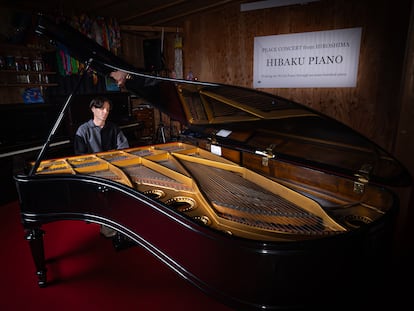
Anyone who makes a reservation can visit the “atomic pianos,” as Yagawa calls them, which he sometimes decorates with paper cranes (orizuru) as a sign of respect. “An instrument that does not make sound is a relic,” reflects the 73-year-old restorer, who has turned his small shop into a cozy museum. “Two of the seven hibaku pianos are always loaded in my truck, ready to go on tour.”
This year alone, he will have organized 270 recitals and workshops with the help of his team. In total, over this past quarter-century, more than 3,500 events have featured artists such as Herbie Hancock and George Winston. “I take care of transporting them by road with a clear goal: for new generations to learn that war is never the solution.”
Sign up for our weekly newsletter to get more English-language news coverage from EL PAÍS USA Edition









































