
Meredith Monk, the voice as a spark of a sonic revolution
The New York singer, composer, and performer received the Golden Lion at the Venice Music Biennale at the age of 82
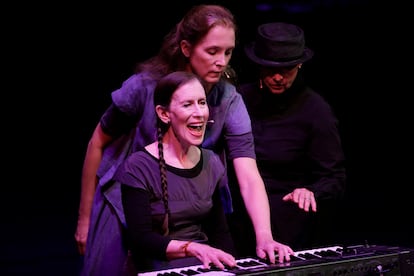
In 1974, Meredith Monk, 82, moved into a fifth-floor apartment in Manhattan’s Tribeca neighborhood. “Back then, this beautiful loft you see was nothing more than a dusty, broken-down warehouse full of rats,” says the American singer, post-minimalist composer, and performer, as she turns her computer screen to show a large, uncluttered living room that still preserves the original floorboards (“indestructible wood,” she says proudly) from the old textile factories of lower Manhattan. “When I moved in, there was just a toilet and a sink — that was all we artists who were just starting out could afford.”
At Teddy’s on the corner — “a mafia restaurant” — Philip Glass, Trisha Brown, and Laurie Anderson used to go for meals. “Then everything got expensive and chic‚” she protests, still smiling. “Luckily, I have rent stabilization, otherwise I could not stay here.”
The year after moving there, Monk received an invitation from Luca Ronconi, then director of the Venice Music Biennale, to present Education of the Girlchild at the Italian festival — an opera-ritual about the memory of the female body. “Until that moment, I hadn’t really considered that my work could have an audience outside my own country,” she admits. “So I took it very seriously.”
For days, she scoured Venice in search for a space that could meet the physical and acoustic demands of the piece and of her company, The House, which was made up entirely of women. A vaporetto took her to the old shipyards on the island of Giudecca. “It was the perfect place… We were performing and scorpions were going across the floor and bats were flying through.” When the performance ended, Ronconi approached her with tears in his eyes to congratulate her and ask her to return. “And so I did, and the next year, we brought Quarry, a piece about the Second World War.”
Half a century after her debut in Venice, Monk returned to the Biennale to receive the Golden Lion in recognition of her long and prolific career. “It’s so moving,” confesses the artist, who last Saturday performed a selection of works from her catalog at the Malibran Theatre, alongside singer Katie Geissinger and pianist Allison Sniffin. “My mind was flooded with memories of my happy days at the legendary Casa Frollo, where Isadora Duncan and Eleonora Duse once stayed. I’m curious to see if the trattoria Montin is still around — I’ve never had another quattro formaggi like it.”
The award ceremony took place on Monday at Ca’ Giustinian, the historic headquarters of the Biennale, whose 69th edition has been marked by controversy over leadership changes pushed by the Italian government of Giorgia Meloni to tighten control over Venice’s cultural institutions.
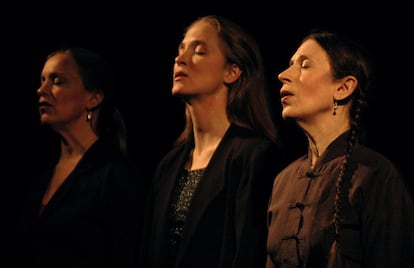
Monk was born into a family of musicians from the golden age of America’s radio days. “For me, singing was like breathing; it was very natural,” she continues. “Maybe that’s why traditional technique felt so limiting.”
During her college years at the very liberal Sarah Lawrence College, she worked to perfect a sound that didn’t come only from the throat, but from the entire body. One afternoon in 1965, at the age of 22, she had a revelation at the piano. “Suddenly I understood that the voice could contain infinite possibilities of color and texture — the equivalent of an abstract, primitive, and visceral visual experience.”
Her instrument then took on a choreographic dimension. “Eurhythmic dance helped me develop a nonverbal language. I could find all these different qualities in my voice embodied through my body. So I started working on my voice the way that I did if I was making choreography. I intuitively knew there was great potential in that unknown territory, and that I was meant to do this.”
Her first stage work, Break, marked a radical break with tradition: without words, without musical accompaniment, using only poetic gesture as expressive material. “I based it on the syntax of cinema to create a kind of dizzying montage, cutting fast changes of a space, fast changes of persona. The structure was very jagged, very much like broken glass.”
Today, each of those fragments represents the different facets of Monk — singer, performer, composer, and dancer — under the sign of a style that is at once ancestral and futuristic, archaic and visionary. “I like to think my works live in the cracks between artistic disciplines — where the voice begins to dance, the body sings, and theater turns into cinema.” According to the Venice Music Biennale, Monk demonstrates “an unwavering capacity for innovation, transforming music into an immersive ritual experience.”
A few days ago, Venice’s Sale d’Armi at the Arsenale hosted the Italian premiere of one of her monumental pieces, Songs of Ascension, a set of 21 songs originally conceived for artist Ann Hamilton’s Tower, whose architecture functioned as a resonance tube in which the voices spiraled upward until dissolving into light. “I grew up in a Jewish family — more anarchist than practicing — and that heritage translates into a certain inclination toward the minor key,” explains Monk, who was a student of Buddhist nun Ani Pema Chödrön. “The idea for this piece came from a conversation with a Zen friend and teacher. The ascent means liberation rather than escape, a lifting of consciousness that stays rooted in life,” says the New York artist. “Its circular writing lets different times fold over one another, as if to train our attention on the present.”
After a somewhat apocalyptic period, during which she composed Book of Days, Monk realized she shouldn’t waste more energy trying to identify the culprits behind the “cruelty and violence” in our era. “When I was 30, I used to wonder what my voice would be like at 80. Now I know that beauty and imagination remain the best antidotes to darkness and ignorance.”
That is the goal of Cellular Songs, which she recently recorded for the ECM label with her Vocal Ensemble, combining women’s voices, choreography, and video. The title doesn’t refer to cell phones (in fact, Monk describes herself as “semi-Luddite”) but to biological cells cooperating in a kind of microscopic utopia. “Art, like biology, always finds new forms of resistance. The time for pointing fingers is over,” she says, pausing for a few seconds in silence. “Now, more than ever, it’s time to stay united.”
Sign up for our weekly newsletter to get more English-language news coverage from EL PAÍS USA Edition









































