
Lola Young, the new British voice in the long shadow of Amy Winehouse
The ‘Messy’ singer lives with success, addictions, and a schizoaffective disorder that takes her from periods in rehab to wild creative phases. On September 19, she released her third album ‘I’m Only F**king Myself’
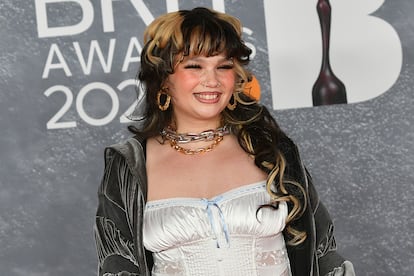

Nothing about the appearance of Lola Young is strictly original. Like many other girls in London — although born in Croydon, she grew up in the southeast of the city, in Beckenham — Young is alternative, sports a mullet haircut that combines light and dark highlights, piercings, and fake eyelashes. In reality, what draws attention when you see her for the first time is a mixture of races, which, although subtle, immediately speaks of a blend of origins. It is the genetic inheritance of her Chinese-Jamaican father, although it was her stepfather, a professional bassist, who, along with her mother, facilitated the development of the young woman’s true distinctive feature: a raspy voice that evokes too many battles for such a young artist, who released her third album, I’m Only F**king Myself, on September 19.
Between home-organized salsa sessions, visits from musicians like Paolo Nutini and Joni Mitchell, piano, guitar, and singing lessons, and open mic nights at local pubs at just 13 years old, Young was heading towards a future for which, as she herself has said, “I didn’t have a plan B.” Next up, at 14, was entering The BRIT School, a prestigious academy focused on the performing arts and creativity, attended by other unmistakable voices of the British music scene before her, such as Amy Winehouse and Adele.
In the United Kingdom, Lola Young’s voice is already established. She rose to fame thanks to a Christmas advertisement for the British department store chain John Lewis that went viral in 2021, a story of interplanetary friendship in which the song she performed caught the public’s attention. Two years later, her debut album, My Mind Wanders And Sometimes Leaves Completely, was released, taking her on tour to several European cities before a single, included on her second album, This Wasn’t Meant For You Anyway (2024), gave her the final push. Titled Messy, the track, just over four minutes long, was a declaration of intent by its author, who had been diagnosed years earlier with a schizoaffective disorder, to which was later added severe Attention Deficit Hyperactivity Disorder (ADHD).
At 17, Young was burdened with an overwhelming diagnosis that she had previously confused with the schizophrenia of a paternal uncle and the clinical depression of another relative. Her ADHD, as she told The Telegraph in February 2022, might not have been helped by the cannabis she confessed to smoking excessively to deal with a “very heavy, and very unusual” childhood trauma, although she did not go into detail: “Weed is psychoactive, and when you already have an underlying health condition, it can trigger the brain,” the singer told the British newspaper. The truth is that a manic episode for Young can end in a range of intensities: minimal, if it doesn’t catch her by surprise and she can take her medication, and, in other more severe cases, being hospitalized. She illustrated this with a metaphor: “Imagine a bottle overflowing. At a certain point, it becomes impossible to put the lid back on, because it’s simply been shaken up far too much.”

If this unpredictability — episodes can last a month or keep her awake for nights on end — makes her tours complicated, the state she finds herself in during them can, she says, boost her creativity. She says the excess dopamine can unlock her imagination and sharpen her senses, making her much more productive: “It’s like being on a drug, my mind is just racing and I want to write loads of songs,” she told The Telegraph. Furthermore, Young is addicted to cocaine, which is why she entered a treatment center for five weeks in November 2024. Her path was beginning to sound like that of another star student of The BRIT School: Amy Whinehouse. The image of the late artist, who died at 27 from alcohol poisoning — although she had issues with many other drugs throughout her life — at times overlaps with that of the more vulnerable Young. With one difference: Winehouse’s famous line “They tried to make me go to rehab. I said no, no, no” — although she did go to rehab four times — is contrasted with a woman who has an emotional cushion and the tools to find a different ending.

This ace in the hole may have helped convince Young to work with Nick Shymansky. Winehouse’s former manager agreed to work with the singer after meeting her at a performance in south London in 2017. In reality, it took him a little longer to make up his mind: Shymansky hadn’t collaborated directly with any artist since the Back to Black singer’s death and had vowed never to do so again. Upon meeting Young, his reluctance evaporated, and he decided to represent her alongside his friend Nick Huggett, who had helped sign Adele.
@lolayounggg my d£aler is currently looking for a new job
♬ dealer Lola Young - lolayounggg
But guiding Young posed the danger of stumbling over the same stones Winehouse had encountered. After entering rehab last November, Young returned to work and the public exposure that comes with it in early 2025: Jimmy Fallon in January, Coachella in April... It even seemed like a single from her new album, the song Dealer, which Elton John says is “the biggest hit I’ve heard in years,” might be released. But then Young relapsed, and Shymansky suggested she stop everything, even postponing her fall tour. Finally, after returning to treatment, the artist decided to continue with her planned schedule and release her third album. Upon her return to the stage last August, she was accompanied by a sobriety counselor and surrounded by a team dedicated to protecting her. In a recent interview with The Guardian, Young recalled that when Shymansky began managing Winehouse in 2006, “mental health wasn’t a conversation, addiction wasn’t a public conversation, and so people end up dying because they’re not open, they’re not able to seek help.” Amy’s shadow seems less threatening for her heiress.
Sign up for our weekly newsletter to get more English-language news coverage from EL PAÍS USA Edition









































