
Kim Novak, actress: ‘In Hollywood, you’re worth as much as your last film’
At 92, the star has received the Golden Lion for Lifetime Achievement award. In an interview with EL PAÍS, she discusses her departure from the industry, her celebrated role in Alfred Hitchcock’s ‘Vertigo’ and why she doesn’t want Sydney Sweeney to play her in a future biopic
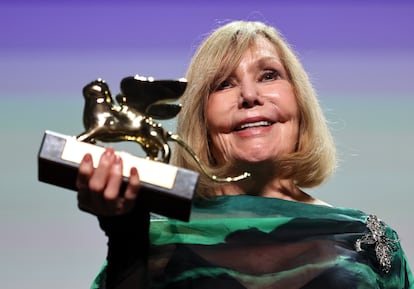

Hollywood always sells itself as a place where dreams are made. For Kim Novak, however, it plunged her into a nightmare.
The film industry gave her glory, fame, public adoration, and the lead role in one of the most important films in history: Alfred Hitchcock’s Vertigo (1958). But at the same time, Hollywood was beginning to deprive her of the most important thing: herself.
She began to notice that her identity was merging with the characters she played: they were trying to transform her into something she wasn’t. And so, she left, just as she was riding the crest of her wave. She stepped back from the spotlight, retreated to her home in Oregon, and devoted herself to painting and caring for wild animals. They, at least, treated her as she truly was. This is what she recounted in her interview with EL PAÍS at the Venice Film Festival on Tuesday, September 2.
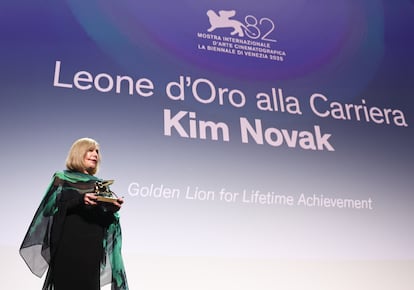
The actress — almost 60 years after her withdrawal from the industry — is back. She went to Venice to accept the Golden Lion for Lifetime Achievement, to support the screening of the documentary about her life — Kim Novak’s Vertigo (2025), directed by Alexandre O. Philippe — and to finally tell her story.
She’s 92-years-old, with a deep voice and measured speech. However, she doesn’t hold back on any subject presented to her — even when it comes to expressing her rejection of Sydney Sweeney portraying her in an upcoming biopic. “It’s nice to be able to express what I really feel,” she asserts.
On many occasions, people have tried to stop her from doing this. The first — as she confesses in the documentary — was her own mother. In 1933, she almost aborted her daughter: Marilyn Pauline “Kim” Novak. In any case, Kim acknowledges that her mom gave her self-confidence. Her father, on the other hand, conveyed that he wasn’t proud of her.
Novak’s idol was her grandmother. And, later, the actress Greta Garbo, in whom she saw herself reflected: fragile and shy, yet powerful.
A model and art student, she entered Hollywood at 21 by chance: she accompanied a friend to a casting. But a talent scout noticed the young woman’s magnetism. Subsequently, Columbia Pictures signed her. From then on, Harry Cohn — the dictatorial and bullying studio boss — tried to mold her to his own tastes. She couldn’t be called Marilyn, because Monroe would overshadow her. She had to change her hair color and avoid donuts: Cohn called her “the fat Polish girl.” Meanwhile, Novak resisted, shining brightly in Picnic (1955), Bell, Book and Candle (1958), The Man with the Golden Arm (1955) and Jeanne Eagles (1957). Novak felt that the character she played in the 1957 movie was the opposite of her, because she did as she liked.
In the end, however, Novak followed suit: Hollywood was trying to change her, so she bet on herself. Over the decades, she also survived three house fires, a fall from a horse and breast cancer. “When I left cinema, I felt guilty that maybe I hadn’t fulfilled my destiny. But I had to think about my survival,” she says in the documentary.
Novak ultimately succeeded. And now she’s here to tell the story.
Question. How do you feel? What does it mean to you to be back at a major festival, to collect an award?
Answer. It seems like a dream. I’m not even sure that it’s real. But it’s great because I’m starring in my own dream.
Q. When you accepted the award, you called for us to save “our democracies.” Why was that message important to you?
A. It means so much to me, to be able to suddenly have a platform where I’m able to voice these thoughts. I feel like I’m playing a small part. I wish I could inspire more people to pay attention, because what’s going on is terrible. It’s so important that we look at it, so we get enraged enough to want to do something. And if we all do it, we could do it, because the majority of people want to keep their democracies, their freedoms.
When I think about how many lives have been lost, how many soldiers have gone to war and given up their lives for a democracy… we have to be as brave as those soldiers. They were willing to give their lives. We have to be willing to give whatever it takes, because it’s our freedom.
Q. You also had to save yourself. You once said that leaving Hollywood was a matter of “survival.”
A. You can feel when you’re starting to lose touch with what you believe in.
And I was beginning to lose touch: “Is this my thought, or is it the character I just played?” So many voices were in my head, because when I acted, I put myself totally in the role. I became that person and she became me. And, each time, you’re giving up a little bit of yourself.
I didn’t always like the characters I played. It was essential to hold on to who I was. It was time [to leave]: I could feel it. Many things happened at the time. If you’re watching, you can see a detour sign before you get to the actual detour. And I could anticipate these.
Q. What signs?
A. This sounds crazy, but one of the things that I thought to myself was: “the day that I can no longer put on false eyelashes, I’m going to get out of the business.” Because I always did my own makeup, my own hair. I always do my own thing. And I thought the day that I could no longer take care of myself, then I should get away from that and find the life that I fit into.
When I left Hollywood, I got involved with animals. I did this on purpose, because they’re totally genuine, especially wild animals. Dogs and cats, they’ll forgive you for anything — they love you no matter what. But I wanted to be loved with it mattering. The only way I could prove to myself that I really was authentic was to get involved with goats and raccoons and animals like that.
You get used to people in Hollywood. It’s all about how much money you make, how many movies you made, how many were hits. And so, to suddenly find that you’re accepted by these wild animals and that proved to me that I was real and that I had worth.
It isn’t enough to think you have worth in Hollywood. Your worth is strictly determined by your last movie.
Q. What aspects of the film world did you like?
A. The best part was working with great directors who allowed me to be myself: to use my body, mind and everything else to make a good film. I had a lot of incredible co-stars and filmmakers. I didn’t leave [the industry] because I didn’t like what I was doing, but for another reason. It’s nice to be able to express how I truly feel now. Although, when you work with less-than-great scripts, it’s not very satisfying. I always felt like I wished I had subtitles: “These aren’t my words. A bad writer wrote them; I have to say them, but I don’t believe in them. Sorry if I’ve offended you.” I could only feel good about myself when I was doing something of value that had meaning.
Q. You’ve spoken about great directors and actors. What comes to mind when I mention Vertigo?
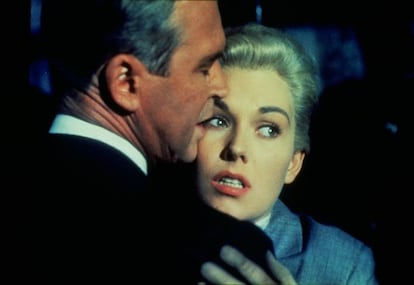
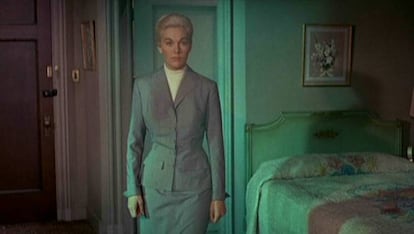
A. A great experience. It was such a release of what I was feeling in Hollywood, where they make you over, try to change you into someone you’re not. I was able to use that in that film and apply that.
I think if I had listened to them and put all the makeup on just the way they wanted it, they would have just kept getting copies of others. Somehow, you have to be able to bring something original.
Q. What if I mention the name James Stewart?
A. He was one of my best friends. I adored that man so much. He made everything so much easier. Alfred Hitchcock, too.
Q. What do you remember about the director?
A. He allowed me the freedom of defining my own character. He was totally unfree as far as what you wore, how you wore it, where you stood… all those things were fixed, but I didn’t mind that. He let you have your own concept. He was the best at that.
Every time I worked with a director that I didn’t think was good, they didn’t really want to know what you thought. They just wanted to tell you what they thought.
Q. There’s a movie in the works by Colman Domingo — Scandalous! — where Sydney Sweeney will play you. What do you think about that?
A. I don’t care that they’re making it, but they’ve chosen the wrong person to play me.
Q. Why?
A. She’s very popular and, I must say, I’ve seen her and I think she’s a very, very good actress.
But she’s the opposite of me. Now, I understand she probably likes the challenge of it… but it’s unfair to me, because I am who I am and she has to pretend to be me. And pretending isn’t as good as the real thing. And there are actors who could be right for this because they think the same way I do. She’s thinking about how to pretend to. She might even get an award for it, but it wouldn’t be expressing who I am.
Q. Who would you have chosen?
A. I can’t think of names. I know them when I see them; I can tell that “she could do it.” Because you can feel they have the heart. But she is very manipulative and I’m praying that, for some reason, she’ll find another movie that she’d rather do. If the gods are willing, they’ll do that for me. Because I don’t really like her.
Sign up for our weekly newsletter to get more English-language news coverage from EL PAÍS USA Edition









































