
Fashion designer Giorgio Armani dies at 91
The Italian founder of one of the most influential fashion companies of the last half-century passed away surrounded by his loved ones
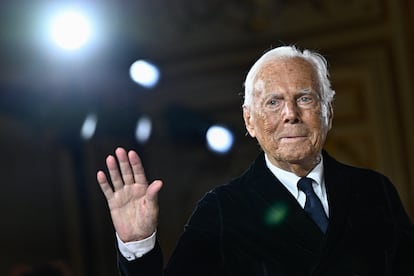

Fashion designer Giorgio Armani passed away on Thursday, September 4, at the age of 91, as confirmed in a statement from the Armani Group, the fashion company founded by the Italian designer.
In the statement, Armani’s team said that “ll Signor Armani, as he was always respectfully and admiringly called by employees and collaborators, passed away peacefully, surrounded by his loved ones, after working until his last days.”
Armani featured on his final magazine cover just this past Saturday: he posed in shorts, in the garden of his home, holding a book for HTSI, the supplement of the financial newspaper The Financial Times. With a half-smile and one of his signature navy-blue t-shirts, the designer explained his absence from his last three fashion shows due to health issues: “I oversaw every aspect of the show remotely via video link, from the fittings to the sequence and the make-up. Everything you will see has been done under my direction and carries my approval,” he told the newspaper.
This month, he had planned to participate in the celebrations of his 50th anniversary in fashion, with an exhibition at the Pinacoteca di Brera in Milan.
Armani will go down in history as a fashion legend: a tireless worker, uncompromising aesthete, and founder of a multimillion-dollar brand built on clear principles of timeless elegance, an androgynous style, and subtle Eastern influences.
He was the first Italian designer to conquer modern-day Hollywood, dressing its stars and creating unforgettable images — from Richard Gere in American Gigolo, where in the 1980s he demonstrated that his unstructured jackets could be sexier than underwear, to George Clooney in elegant tuxedos on any red carpet, and the iconic movie The Untouchables by Elliott Ness.
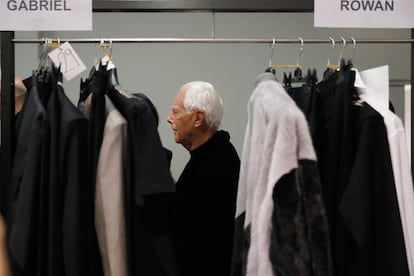
He was one of the first designers to master the lucrative —but treacherous — world of licensing, which had undone great creators before him, and skillfully managed the diversification of his brand. Initially focused on high-end prêt-à-porter for both men and women, today the company produces watches, sofas, skis, and even luxury flowers and chocolates — not to mention its hotels, restaurants, and hugely successful perfumes. In 2024, the company reported revenue of over $2.68 billion (five percent less than the previous year, amid the luxury sector crisis; profits fell by 24%).
Armani’s story illustrates the industrial phenomenon that fashion became in Italy during the last third of the 20th century, and the power amassed by its leading figures. He was one of the pioneers who established Made in Italy, a label that still serves as a mark of quality for textile manufacturing in the international luxury industry. Even today, in an era of consolidation, Giorgio Armani — the company — remains one of the major Italian fashion houses that are still independent. That situation could change now, following the founder’s passing.
Born on July 11, 1934, in Piacenza, during the height of Mussolini’s Italy, Armani was the youngest of three siblings in a middle-class family. He grew up fascinated by the elegance of Hollywood stars, and when he launched his own fashion brand in 1975, Cary Grant inspired both his menswear and womenswear lines. His style was classic, comfortable, and powerful — perfect for a new generation in the 1980s, built around the values of success and wealth.
Armani never portrayed himself as an eccentric creator in an ivory tower; rather, he was an efficient worker surrounded by impeccable order, focused on dressing people for real life. His own uniform was designed not to distract from the message he wanted to convey, though it evolved over time — from the “blue jackets, blue pullovers, and gray pants” he confessed to Martin Scorsese in Made in Milan, the 1990 mini-documentary about the designer, to the more casual, sporty look he favored in later years.
“My favorite garment is the blue T-shirt. It suits my personality — pragmatic and not flashy. A kind of uniform that doesn’t distract, that focuses attention on my gestures and words,” he told EL PAÍS in 2019.
The creative legacy of Armani — a man capable of distinguishing countless shades of gray, brown, and beige, and of renewing season after season his effective black-and-white advertising formula — has been embraced by many designers in recent years and has once again become a code for a certain idea of elegance. It is an Italian style more Milanese than folkloric, yet universal in its appeal. Just this past weekend, a digital archive was unveiled, preserving historical garments and images from the fashion house.
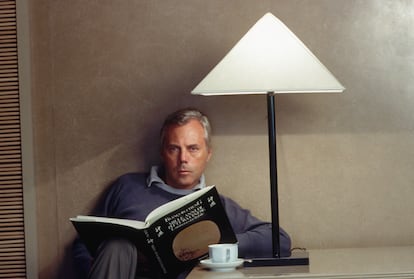
“In this company, we have always felt like part of a family. Today, with deep emotion, we feel the void left by the one who founded and nurtured this family with vision, passion, and dedication.” With this statement, his employees and family paid tribute to the designer and entrepreneur who founded a firm with 50 years of history — one that has been fundamental in shaping the style and evolution of Italian and global fashion over the past half century.
Armani’s intention was to ensure an orderly succession, placing his longtime right-hand man, designer Leo Dell’Orco, along with his closest collaborators and family members, at the helm. Any disruption to this plan could send shockwaves through the company.
Sign up for our weekly newsletter to get more English-language news coverage from EL PAÍS USA Edition









































