
A tornado to revolutionize Hollywood: Artificial intelligence reinvents ‘The Wizard of Oz’
The Las Vegas Sphere premieres a $100 million immersive version of the 1939 classic


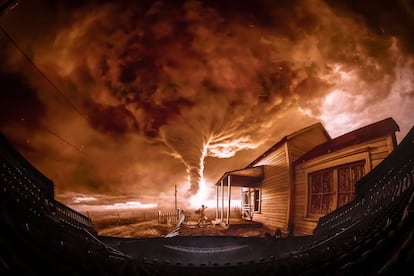
The Wizard of Oz is back. Audiences no longer just see the tornado that ripped Dorothy Gale from Kansas to Munchkinland. Now they can experience it thanks to powerful fans creating hurricane-force winds that tousle the audience’s hair and lead some to cover their faces, while the room is covered in confetti like debris inside the eye of the storm. The Las Vegas Sphere, the enormous entertainment venue opened two years ago in the American casino city, has injected new life into the influential 1939 classic with the promise of turning what was once a Technicolor trip to another world into a sensory experience. To look to the future, Hollywood is turning to the past.
Judy Garland, who died 56 years ago, is no longer the big star of this new era. The actress shares the spotlight with artificial intelligence, a tool that dared to imagine what was off-screen in Victor Fleming’s Oscar-winning film. The premiere of the new version last Thursday will fuel the existential debate about the future of cinema in the age of AI, a topic that sparked a 148-day strike in Hollywood in 2023.
“We’re breaking a lot of ground with this. We truly believe we’re opening a new chapter in the way stories are told. AI will change the film industry. And I think what we’ve done is push it to its limits,” Jim Dolan, CEO of Madison Square Garden Entertainment and owner of the Sphere, told EL PAÍS in Las Vegas. The company invested $100 million, more than double the initial budget, in making this version, shattering the original’s $2.8 million ($76 million at today’s exchange rate).
The Wizard of Oz was first shown at Grauman’s Chinese Theater in the heart of Hollywood. In the late 1930s, the theater had a seven-meter-high screen. It was enough to dazzle audiences with its transition from sepia tones to brilliant colors thanks to the then-revolutionary technology of Technicolor, which combined three color negatives into one. That first showing would be like watching a movie on a cell phone today. Oz now exists on a screen 111 meters high and 157 meters wide.
Dolan opened the Sphere in 2023 with an immersive show by the Irish group U2. Since then, the venue has focused on musical acts, from veteran rockers the Grateful Dead and the Eagles, to the jam band Phish, to the current Backstreet Boys residency. The site has previously screened a film, Darren Aronofsky’s Postcard from Earth, but this is the first time a classic has been adapted for this screen, the size of three football fields. According to the entrepreneur, 200,000 tickets have already been sold for screenings over the coming weeks. The cheapest costs $104. The movie will have three showtimes and will be available at the new Abu Dhabi Sphere, which is due to begin construction soon.
To adapt The Wizard of Oz to this giant format, with 16K definition, the Sphere enlisted Ben Grossmann, a visual effects supervisor who won an Oscar in 2012 for Martin Scorsese’s Hugo. Grossmann hired an army of 1,000 artists, who went to the MGM archives and reviewed the original script, technical shoot guides, production reports, and outtakes. All of this was then entered into Google’s DeepMind program. Nearly another 1,000 engineers and creatives spent more than two years shaping this new digital world until arriving at the version that premiered last week.
“We needed to see things that were there in the original, but that you couldn’t see through the camera. It’s not about photography, it’s about taking you there. We adopted a philosophy as if we had invented a time machine that transported us to the world they were imagining,” Grossmann, who serves as producer, explained.
The technology broadens the audience’s view, allowing them to see, to their left and right, animals on Dorothy’s farm that didn’t exist in the original film, or characters who had been left out of frame in important scenes. The castle interiors in this version feature ceilings that are tens of meters high, making the audience feel as if they’re right there with the protagonists. The Wizard’s face has the imposing size of a small building, which successfully conveys to the audience the fear Dorothy and her friends felt.
The Wizard of Oz will save the Las Vegas tourism industry pic.twitter.com/7n2VtL7cV3
— Las Vegas Locally 🌴 (@LasVegasLocally) August 29, 2025
The experience is also complemented by snowflakes falling, a shower of rubber apples, pyrotechnic effects, and a series of enormous blue flying monkeys hovering above the audience in one of the film’s most iconic scenes. The audience’s seats vibrate in the tense moments.
Some visual effects, however, take people away from the story or prove distracting. The digital makeup sometimes makes Dorothy and the actors in costume look like caricatures. Most disturbing are the faces of the extras and the new people digitally created on the sides to fill the enormous screen. Some have familiar faces. Others are blobs reminiscent of Borgia’s Ecce Homo.
Dolan confesses that his face briefly appears over one of these characters. The production team also inserted the face of executive David Zaslav, president of Warner Bros. Discovery, a key figure in approving the use of AI in the film. In old Hollywood, products were inserted into the background of films. In the age of artificial intelligence, it’s the faces of moguls.
Grossmann points out that the design team’s work isn’t over. “There’s no finish line. The original filmmaking team didn’t finish the 1939 project either; they just abandoned it and moved on when shooting time ran out. And as I say this, people are still working on our film. Not because we’re not ready for the premiere, but because we have to keep working on it for next month and the month after that,” he said in an interview in the Sphere.
Because of this constant digital retouching, Grossmann isn’t bothered by the catastrophic claims that artificial intelligence will eventually replace filmmakers. “We ended up giving more work to more artists on this project than Hollywood has employed in recent years,” he says. The special effects specialist has worked on Sin City, Shutter Island, and Alice in Wonderland, but he’s never worked on a production as large as this one in his 30-year career.
Grossmann also has to defend the integrity of the new work. The machine creates the information that was left out of the original frame. “It does this because this model knows what Judy Garland’s eyelashes looked like that day, what scene it was,” he notes. “I think these tools will allow for new waves of creativity and expression. Art will remain art.”
An impact that is still valid
The allure of the Oz universe for Americans is far from fading. In December of last year, one of the four pairs of slippers Judy Garland wore during the filming of the 1939 movie was auctioned off. The shoes sold for $28 million, making them the highest-valued piece of film memorabilia, shattering the record set in 2011 by the white dress worn by Marilyn Monroe in The Seven Year Itch. Auction house Heritage estimated the slippers would fetch $3 million, but the bidding surpassed that figure in mere seconds.
Last year, Universal released Wicked, the Oscar-winning film version of the Broadway musical inspired by The Wizard of Oz. The film grossed $755 million at the global box office, becoming the sixth highest-grossing title in the studio’s history. The sequel, also directed by Jon M. Chu, will be released on November 21. This one will have to compete with the original, which was scaled up thanks to digital anabolics.
Sign up for our weekly newsletter to get more English-language news coverage from EL PAÍS USA Edition









































