
‘Aberrant and repulsive images’ against fascism: 50 years since Pasolini’s scandalous masterpiece, ‘Salò’
The Italian filmmaker’s final film, completed shortly before his murder, suffered censorship, criticism, and the theft of several of its reels by a criminal gang
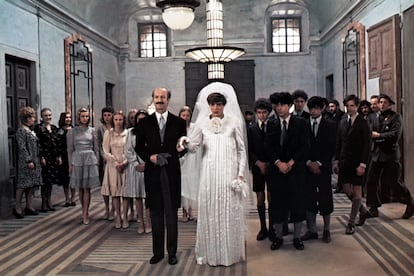

Watching Pier Paolo Pasolini’s Salò, or the 120 Days of Sodom today is as extreme and at times unbearable an experience as it was 50 years ago, when it marked its troubled premiere. Its scenes of forced sex, bodily sadism, coprophagy, humiliation, and mutilation, filmed in magnificent settings and with exquisitely beautiful formal apparatus, generate the same horror, the same moral repugnance. But above all, the field in which the film extends its relevance with greatest authority is the political, which is the what most interested its director. What Salò enunciates — a study of the violence that underlies the exercise of power in capitalist societies — has not lost one iota of its potency and validity. Perhaps that message was the veiled motive behind the initial attacks on the movie by extremist groups, while a furious rush to ban its screening — including a prison sentence for its producer — was unleashed in the courts: there were no longer any means to enforce the court’s conviction against Pasolini, the director, since he had been murdered shortly before the film’s release. A death that is still considered, incidentally, one of the most high-profile cases in Italy’s recent history, and which for many is linked to the prophetic message of Salò itself.
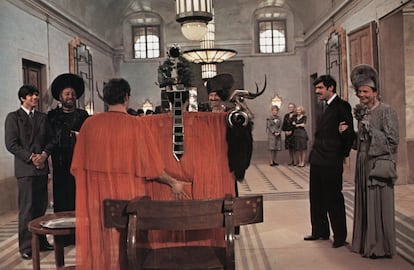
In the mid-1970s, several films of uneven quality pushed the boundaries of what could be shown on screen and redefined the very concept of scandal, while simultaneously expressing the general malaise of the times. Bernardo Bertolucci’s Last Tango in Paris (1972) and Jean Eustache’s The Mother and the Whore (1973) did so from a sense of post-1968 disenchantment and existential crisis. Just Jaeckin’s Emmanuelle (1974) drew from a sense of bourgeois frivolity. Marco Ferreri’s The Big Feast (1973) drew from a sense of vitalist nihilism. Bertrand Blier’s Going Places (1974) drew from a desire to shock. And Nagisa Ōshima’s In the Realm of the Senses (1976), a sublime combination of the anthropological and the spiritual. But none of them went as far in all their premises as Pasolini’s film.
By that time, the Italian filmmaker himself had made his own contribution to this trend with the three films that made up his Trilogy of Life, adaptations of Boccaccio’s The Decameron, Chaucer’s The Canterbury Tales, and the anonymous Arabian Nights, which were huge hits with the public and earned him awards at the Berlin and Cannes film festivals. In them, sex and bodily enjoyment were portrayed through a celebratory lens, as part of an optimistic and unprejudiced ode to life. But, immediately after this, Pasolini’s mood was no longer on that wavelength. In June 1975, he published a column in the newspaper Il Corriere della Sera titled, very graphically, Abjuration of the Trilogy of Life, in which he lamented that once innocent bodies had been violated by the power of consumer society and went so far as to state that he hated sex and sexual organs. “Today, the degeneration of bodies and sexes has taken on a retroactive meaning,” he added to justify his abjuration. Immediately afterward, he embarked on the filming of a new literary adaptation of a sexually charged classic text. This time, it was The 120 Days of Sodom, a novel written in 1785 by the Marquis de Sade during his confinement in the Bastille prison for various reasons related to his libertine behavior. That unfinished work, in which four powerful men unleashed their pleasures, with increasing violence, on a group of young people, represented the extreme of the Marquis de Sade’s literary and ideological program, which reacted against the rationality of the Enlightenment with a kind of cruel satire. As such, it had been especially appreciated — like the rest of its author’s work — by the surrealists, from Georges Bataille to Luis Buñuel.
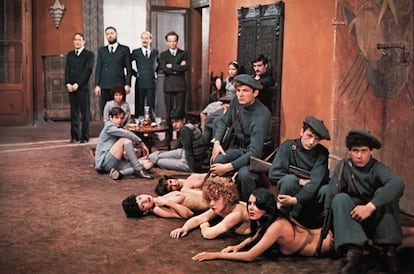
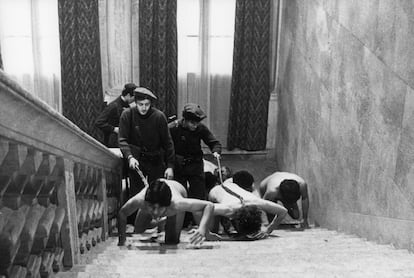
But Pasolini had different intentions. For starters, he moved the action from the 18th century of the original to the period of the Salò Republic, the swansong of Mussolini’s government in Italy before its fall during World War II, which already implied a declaration of political intent. The four protagonists became the leaders of the fascist regime: a priest, a judge, a banker, and a duke — respectively representing religious, judicial, economic, and social power — who kidnapped a group of teenagers and, with the complicity of four experienced prostitutes, raped them and subjected them to all kinds of abuse until they were torn to pieces in an unbearable scene of blood and destruction, which preceded a strangely healing ending in which two soldiers of the National Republican Army danced body to body while talking about their long-awaited return home to their girlfriends.
Originally, the film was to be directed by another Italian filmmaker, Vittorio de Sisti, with a script by fellow director Pupi Avati, who, as he would recount decades later, involved Pasolini and his friend and collaborator Sergio Citti in his work. This first project ended up foundering due to production difficulties, and Pasolini himself took it up again with the help of the very solvent producer Alberto Grimaldi. His idea was to begin a Trilogy of Death that would be the antithesis of the Trilogy of Life he had just abandoned, despite the success it had brought him (or perhaps precisely because of that success, which led to feelings of guilt). The film was shot in natural settings and at properties in northern Italy that represented the luxurious villa — decorated with classical and art deco furniture and avant-garde works of art — where the story unfolded. Despite the good atmosphere that Pasolini and his collaborators tried to create, it was a tough shoot due to the inevitable emotional response that the scenes of violence generated in the actors and other crew members. To ease tensions, a soccer match was organized against a team from Bertolucci’s Novecento, a film epic also being shot at the time and which also reflected the abjectness of Italian fascism in its plot. The fact that Pasolini himself participated as a player did not prevent the Salò team from losing the match (apparently, Bertolucci, who refused to play, slipped a couple of professional footballers onto his team, posing as film crew members).
But the biggest setback came when several reels of the film were seized — along with those of Fellini’s Casanova and Damiano Damiani’s Il Genio — by a criminal gang that demanded a ransom for their return. The payment was not made, and instead the footage was completed with second takes and countertyped positives. Production on the film ended in the fall of 1975. On the night of November 1-2, with the film still unreleased, Pasolini was assassinated at the age of 53 by a 17-year-old boy, Giuseppe Pino Pelosi, in circumstances that are still not entirely clear and that have since evoked a political assassination. According to some theories, Pasolini received a call urging him to keep the appointment, claiming that the stolen film reels would be returned to him.
Three weeks later, on November 22, 1975, the film premiered at the Paris Film Festival, amid the expected scandal, which only worsened afterward. In Italy, it was initially rejected by the still-operating Censorship Commission for its “aberrant and repulsive images of sexual perversion that offend morality.” It finally premiered in Milan on January 10, 1976, with a screening ban for under-18s. But then Alberto Grimaldi, its producer, was tried for corruption of minors and obscenity (he was sentenced to two months in prison, but later acquitted), and the film was seized. More than a year later, it was re-released with several cuts, and then a Rome cinema where it was being shown was attacked by a far-right group. The legal proceedings multiplied, and finally, in 1978, the Court of Cassation approved the free circulation of the full version of the film, although it was not shown again in the country until 1985. Not coincidentally, many of the stops on this via crucis are similar to those experienced in The Golden Age (1930), a masterpiece by Luis Buñuel who also made a sui generis adaptation of The 120 Days of Sodom by Sade.
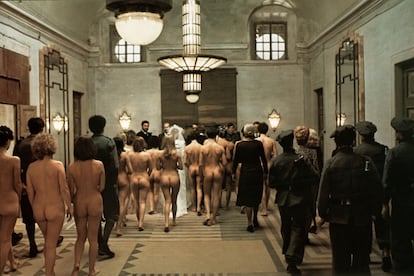
From the outset, the film sparked furious reactions both in favor and against among intellectual circles. The writer Alberto Moravia was one of its main defenders (the author of La Romana signed, along with other writers, a petition for the film’s absolution, which they considered “the last important work of one of the leading Italian intellects of this century”). However, Italo Calvino, in a text entitled Sade is within us published in Il Corriere della Sera, harshly criticized it, primarily for the decision to set it in a fascist milieu. Meanwhile, the philosopher Roland Barthes also considered the equation between sadism and fascism to be “crude,” although he admitted that, on the emotional level, Sade and the fascists are perhaps not so far apart.
In reality, Pasolini was less interested in limiting himself to the historical period of the Salò Republic than in suggesting the ramifications of fascism in the late-capitalist world, which he had long denounced in his writings. In the film, the bodies of the young people kidnapped by representatives of the main institutions of power embody the perversion of a consumer society that not only turns bodies into disposable commodities, but also subjects them to a cycle parallel to the episodes that structure the film’s narrative. In the Circle of Manias, these bodies are fetishized, thus converted into commodities to be consumed. In the Circle of Shit, this same commodity begins to degrade through use and is subjected to extreme humiliations such as forced coprophagy. And in the Circle of Blood, the bodies, already expendable commodities, are definitively annihilated. The final orgy of blood is contemplated from the point of view of the Duke, who observes it, like the spectator, from a distance and through binoculars. With this choice, Pasolini placed the audience in the perspective of the ultimate torturer, forcing them to question their role in society’s infernal cycle, while simultaneously interposing a Brechtian distance that made the horror somewhat more bearable to contemplate.
A prolific and passionate writer, Pasolini had no qualms about explicitly considering consumer society a new fascism, more subtle and effective than the one that fell during World War II. He singled out junk food (here represented by the fecal matter that kidnapped youth are forced to ingest) and the mass media as its agents, which he was particularly harsh on. In his 1973 text Sfida ai líder della televisione, he singled out television as responsible for the dehumanization of society, “not as a technical medium, but as an instrument of power, and power in itself.” An idea that is particularly relevant in times when trash TV has come to be held up as an antidote or relief against fascism: for Pasolini, who never even contemplated the extremes to which the genre would reach in his country (and everyone else’s), trash TV was fascism in images. On the other hand, Salò shares with more recent works — Sirat, by Oliver Laxe, for example — the determined will to traumatize the spectators and the exhortation to spirituality as a way of combating the generalized anesthesia imposed by late capitalism.
Pasolini’s readers often wonder what he would say about the direction taken by the consumer society he so denounced during his lifetime. However, it’s possible that everything he could say on the subject is already contained in Salò, or the 120 Days of Sodom, in its own terrible and poetic way. It reveals all his rage and desire for provocation. This is how Moravia explained it: “It’s not a cruel film, because Pier Paolo Pasolini wasn’t, but a figuratively provocative film.”
Sign up for our weekly newsletter to get more English-language news coverage from EL PAÍS USA Edition









































