
The power of the cat
Are the estimated 700 million felines on Earth the sacred animals of our times?
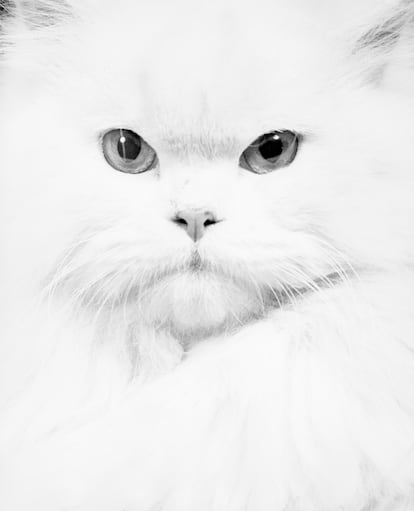

They scratch the sofa, cover the house in hair, sleep around 15 hours a day and wake their owners at dawn for no apparent reason. They complain when they see a closed door, as if they were always on the wrong side of it, show disdain for the toys purchased for them and love the boxes in which they arrive. They are so independent and maniacal that, when one of them is particularly loving, they get called a cat-dog.
There is no reason nor objective criteria behind the assertion that a cat is adorable. Nonetheless, they are. Or at least, they appear to be.
Felines are at a high point in the history of their relationship with humankind. Videos and memes in which they star have taken over social media, they play leading roles in ad campaigns for luxury brands and cars and legions of volunteers care for those who live in the streets, investing time and money into their well-being. Last summer in New York, hundreds of people went to the movies to watch 73 minutes’ worth of cat videos. In Toronto, there’s an annual walk for those who wish to contemplate pussycats in the windows of their homes. The most-visited exhibition in 30 years at the Manggha Museum of Japanese Art and Technology in Kraków, Poland, focused on cats, attracting 57,186 people. In Athens, a plump orange-and-white cat named Titan has come to have his own entry on Google Maps, just a few feet from that of the Acropolis.
There are three world cat days: February 20, August 8, and October 29. There is but one day dedicated to world peace.
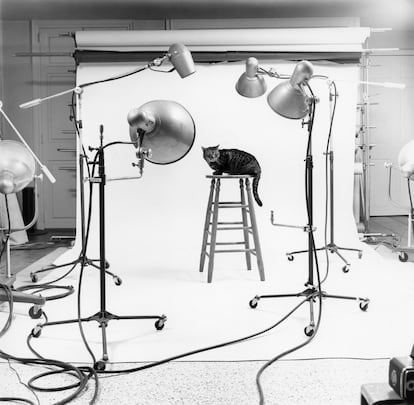
What is it about felines? From whence comes the influence they wield in today’s society? Their relationship with humankind has always been interesting. In the beginning, it was them who approached us. The first known registry of co-existence — which is not the same as domestication — between the two species dates back more than 10,000 years. What happened then? We began to establish permanent communities, store food and generate trash, which attracted rodents and with them, cats. 5,000 years ago, the second phase of integration arrived. The Egyptians began to purposefully interact with the most sociable of cats. In artistic reproductions, a curious (if familiar) evolution is apparent. First, felines appear hunting rats outside. Then, underneath tables, having made it inside the house. Then, some are depicted being buried, having been bestowed with full honors. Some even came to be considered deities. A perfect sequence for a hieroglyphic comic strip.
As time passed, they would accompany humans on their journeys around the world, though it’s not fully clear whether this was due to their peculiar talent for providing company or skill at hunting rats and snakes. But they’d never fully shake the infamy that began in 1233 with the papal bull in which Gregory IX described orgies of witches in which Lucifer appeared disguised as a black cat. That text led to many cats being hunted and executed under suspicion of practicing witchery. This bad press installed itself in popular imagination. By the 20th century, when they had firmly entered the category of pet, cats were still linked to the cliché of the lonely — old maids or confirmed bachelors — and orphans. When the journalist who wrote this article told his mother that he planned to adopt a cat, her initial reaction was: “So you’ll never get married?”
Despite all that, domestic cats have done infinitely better than their feline relatives like the tiger and the lion. It is estimated that there are more than 700 million cats on Earth. Of these, around 400 million are domesticated. With the appearance of the internet, they found yet another stage on which to star. All of a sudden, legions of cat lovers realized they’re not so lonely, after all.
Delia Rodríguez, a journalist who specializes in the relationship between technology, media and society, explains, “The internet is designed to find others who have the same hobbies. And one of our most common interests is sharing our lives with animals. If there’s a lot of cats on the internet, it’s because there’s a lot of cats in the world. And because they are very entertaining, of course.” In the opinion of Delia, who owns a canine, “in contrast to dogs, which you take for walks and socialize, cats are primarily seen on the internet.”
“They’re perfect for a 10-second video,” says U.S. writer and science educator Abigail Tucker on a video call. “Cats are creatures of stillness, and then suddenly they have these incredible bursts of agility where they flip backwards or jump a meter and a half,” continues the author of The Lion in the Living Room. “They do this because it’s in their nature: they are ambush predators that remain still until they are no longer still. And that, in addition to being photogenic, is very interesting to humans.”
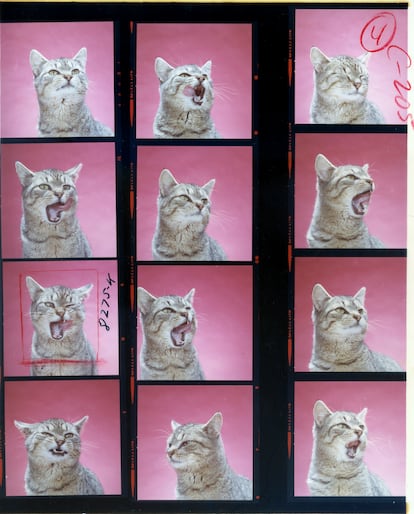
— Why cats and not, for example, foxes?
— They weren’t the ideal candidate, of course. Explaining what a cat is good for is complicated. They’re soft, they’re aesthetically attractive and don’t stink, but they’re not going to defend your home, you can’t ride them to get somewhere, they don’t produce eggs or wool… The majority of domestic animals have solid hierarchical structures. Cats have no leaders. Plus, they’re hyper-carnivorous. And meat is the most expensive food. That makes it even more interesting to think about how cats have really triumphed. A lot of it was accidental and had to with their appearance. Their size, that adorable face and big eyes, resemble human babies. But in reality, they have those eyes and that small nose not to appear adorable to us, but because they are visual hunters. Their meows are like a baby’s cry. They activate a lot of the same impulses in us as a newborn. It may have to do with an error in our instincts.
— An error that says something about us as a society?
— Humans are so spoiled and used to doing what we want and getting what we want that maintaining such a pure relationship with an animal, in which we don’t get anything material in return, is very refreshing. And then there’s the absolutely real sensation that they don’t need us. That’s why when my cat lies down next to me, I could die from love.
— Meaning, those who live with cats survive on hope.
— Absolutely. They are the consummate survivors. They thrive on islands in the middle of the ocean where not even insects can survive. They’re as fine on top of a volcano as they are in the Australian outback. So we shouldn’t assign so much importance to them being at ease in our houses. We try to make our homes a nice place for the cats, we buy them beds so that they’re comfortable, toys to make them happy and some of them even have their own room. It’s kind of hilarious, when you think about it.
Long before the advent of the internet, the story of domestic cats took an important turn in 1947. That change was less technological and more mundane. Edward Lowe was a businessman born in Minnesota. He sold a mix of clay, sawdust and sand that absorbed industrial spills. One day, a neighbor who was sick of picking up his cat’s feces in the house asked Lowe if he could lend a hand. The salesman gave the neighbor a bag of clay granules, saw the situation’s potential, and invested in an ad campaign. When Lowe died in 1995, the company he had founded thanks to those neighboring cat feces was worth more than $500 million. The salesman had laid the groundwork for a global industry. In 2024, according to data from Euromonitor, the cat litter industry was worth $11.3 billion worldwide, having risen 6.4% from the year before.
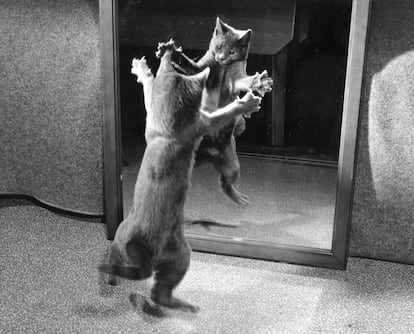
“The global cat trend is in a very interesting moment. You can see it in the specialized product lines that are on the rise,” says David Palacios, a 35-year-old Barcelona-based journalist who heads PETS International Magazine, which was founded in Amsterdam in 1989. “The profile of people who live with cats is getting younger and younger. It has a lot to do with today’s lifestyle, in which individuals live in smaller apartments and spend more time outside the house. Cats are more independent, it’s easier to travel with them.” In the United States, one in every three households has a cat — 76.5 million. In China, currently estimated to be home to more than 70 million felines, their numbers are predicted to grow between 4% and 6% by 2030. In Spain, where there are calculated to be 5.8 million cats, people can spend up to $167 a month on their food, litter, health, and toys, according to numbers from the Spanish Association of Companion Animal Industry and Trade. The country’s Organization of Consumers and Users puts this number at $95.
Such numbers indicate that the rise of cats is a global, cross-sectional trend in the process of expansion. And strangely, their modern-day conquest replicates their first triumph, which took place more than 10,000 years ago somewhere in the Middle East. Cats continue to be the ones to approach humans. They do so in a multitude of surprising ways, and many times, against the initial will of the people involved. Of the 56 interviewees of eight nationalities consulted for this article, 42 used the word “arrived” to explain how their kitty became part of their lives.
The diminutive Papi, a female tabby cat, turned up one day at the window overlooking the garden of Sandra, an administrative worker, and Juan Miguel, a construction worker, in Ibiza. “She was so small that we could only see her ears. Later, we saw her enter the kitchen and come up to the sofa. We fed her… and that was eight years ago. The cheeky girl adopted us,” says Sandra, whose only complaint is that Papi likes her husband more than her.
Omar, a 34-year-old soccer player and nurse, spent years being opposed to having a cat. He wanted a dog. María, his spouse, a 34-year-old journalist, preferred a feline. Their story is one of legions of those who flatly declared their house would never be home to a cat… until one just showed up. It is also one about the unique mental process from outright denial to devotion that cats so often inspire. “I never imagined that I’d have one. But we got to know some friends’ cats and then María kept sending me photos and I kept saying no. I don’t know how to explain it, but from one day to another, there was a cat in the house. Now I ask myself how I could have gone so long without having a cat,” Omar says as he works on a homemade toy for Grey.
Similarly, it seemed there was no amount of insisting by her boyfriend that could make 33-year-old marketing director Raquel consider the idea of having a cat. “I am very independent and I was anxious about it depending on me,” she explains. But they adopted one. She says that it was a little like couples who have a kid to solve their problems. She insisted on naming their Siamese Mico, after her boyfriend. A year later, they broke up. The split was amicable, and they shared custody: the cat spent 15 days with one, then the other. As time passed, Raquel’s ex began to ask her to take care of the cat more and more. “One weekend when I asked him to take the cat, he said no,” she says. “A little later, I discovered he had a girlfriend who was allergic to cats. That same day I sent him an email, he answered and I took a photo of myself at the vet with the [ownership] papers. I’m very happy with Mico, he’s a great companion. And independent.”
Yanira, who oversees health, workplace safety and environment for a company, bought Bambú at a somewhat complicated moment for her personally. “I remember I went to pick him up and I was feeling overwhelmed by the responsibility, but once I had him in my arms, he started purring and kissing me,” she says. “I immediately stopped feeling overwhelmed.”
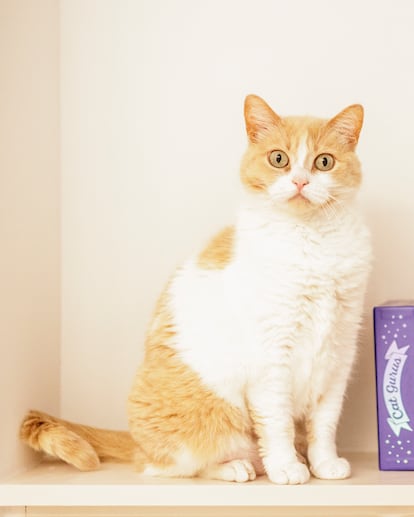
Although a purebred cat can cost between $700 and $2,300, the cat-selling business is not particularly lucrative. There’s no consensus among the scientific community as to how many breeds of cat exist, but many estimates place the number in the forties. There are more than 300 dog breeds. “When an animal comes into the human sphere,” explains Tucker, “it can pass through certain changes. Their ears droop, their tails curl… Dogs, for example, have been around us for a much longer time. They have handed us the control of their DNA, and there are incentives to mold them. But not cats. When it comes to cats, form does not follow function.” Among the small concessions that cats have made to semi-domestication is their blend of colors — until around 1,400 years ago, they were mono-hued. In the case of domestic cats, there’s been a reduction to the size of their head — nothing too serious to their survival — plus shorter feet and a friendlier meow. Essentially, the cat sleeping peacefully in an apartment in Madrid is the same as the one walking the streets in Antananarivo, the capital of Madagascar.
Here is a not-unimportant fact when it comes to felines: their reproductive capacity is so efficient that, if their cycles were perfectly aligned (they can manage three gestations a year in which it is not unusual for six or more offspring to be born), a couple and their descendants could produce more than 350,000 cats in just five years. That’s why it’s so common to see ads for cat who are up for adoption. In Spain, 89.4% of all house cats were adopted; in Portugal, 96.7%. That’s why it’s important to manage the species, which, given free reign, becomes invasive and can cause problems for other creatures.
David San Martín is 36 years old and works as an aeronautical engineer. One day coming home from a party, he saw someone kick a cat that was walking around their neighborhood. He brought the cat home. Mica lived with him for eight years, and marked the beginning of a singular story. “I can’t stand animal mistreatment. That day, I decided to buy a cage and take action, from the starting point of the problem. During the last 11 years, I’ve come into contact with around 10,000 cats, primarily catching, sterilizing and releasing them, as well as rescues. There have been a lot of ups and downs. I have invested $93,000 of my own money. I’ve had up to 30 cats in my house.” Today, he lives with his girlfriend and three cats, and heads up Fundación Bigotes (in English, Whiskers Foundation) — which has two locations in Madrid, more than 20 volunteers and will soon open a veterinary clinic. The organization holds training courses in Ibiza, Indonesia, and Cuba. San Martín dedicates six hours a day to its operation and firefighters know to turn to him when they have a complicated rescue on their hands. “I am very optimistic when it comes to the control of the feline population. Before, in Madrid, four or five new cats would come to us every week. Now, barely one a month.”
Located a 21-minute walk from Madrid’s Atocha train station is the Gattos veterinarian hospital. Marisa Palmero and Vanessa Carballés are veterinarians, business partners and directors of a facility that they define as, “a passion made reality that wound up being a good idea, although at first a lot of people, when we told them we were going to focus solely on cats, covered their head with their hands. Now, there are even conferences dedicated to cats, but at the time, it was unthinkable.” They took the step to open the hospital in 2008 and today, their business employs 35 professionals, including 33 veterinarians, three administrative staff and a cleaner. Their patients — they had 12,000 last year — come from around the world, as do their medical staff, who show up at the clinic to be trained. Across 3,200 square feet and two floors, the facility has five consultation rooms, space to house 28 patients, labs and X-ray rooms. Across the street is the surgical center, with three surgeons in residency.
Listening to how they treat their patients, one almost wants to be a cat. An initial consultation costs $110. “We spend two hours with the patient, studying their history. We relax them, we run tests, ultrasounds, collect necessary samples and give them their results in real time. They leave with their diagnosis and treatment plan.” Palmero and Carballés each have three cats of their own. What they don’t know is how to get them to stop scratching the sofas. Nor how to stop telling their patients “how beautiful they are.” They give talks around the world, but when they speak about their own pets, they might as well be the besotted pet guardians who bring their furry friends to their clinic. “The cat is a challenge. It is an animal who tends to hide its problems. Evolution in this specialty in recent years has been incredible,” they say.
— Since we’re here, a question: what the hell is purring?
— Are you trying to stump us? they laugh.
That inexplicable sound of many a theory and little certainty is one of the primary arguments presented by people who live with cats when it comes to enumerating their pets’ virtues. Because, despite the 2002 lyrics of Joaquín Sabina and María Jiménez’s song Gato (“y antes de que me quieras como se quiere a un gato me largo con cualquiera que se parezca a ti,” which roughly translates to “and rather than you loving me like you love a cat, I’ll leave with anyone who looks like you”), feline love seems to have evolved into quite a positive force. Happiness, commitment, will to live and loyalty are some of the concepts that are among the first things out of a cat owner’s mouth when asked why they harbor the creatures.
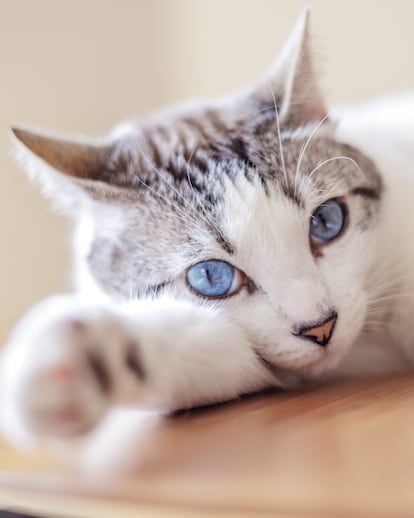
Viviana, a biology professor, says that the key is in what they bring to her life. “An immense companion when they want to be, wonderful affection when they want to give it, and a lot of laughter when they feel like it. My relationship with them is very calm, they sleep with me, they sit with me to watch TV or read and they help me finish my classwork. I mean, they won’t leave me alone, come rain or shine, except for when they are having their afternoon nap. When it comes to allergies, they work as repellant for unwanted visitors — and sometimes as an inconvenience during the visits you do want.”
Elena is comforted by her cats when she comes home. “They always come out to receive me and hang out at my feet. They’re very intelligent, independent, extremely clean, they are great company without overwhelming you, easy to care for, they fill up your house, they keep you entertained, even if they’re not doing anything or when they’re sleeping, because they’re so handsome, soft and they smell so good. I am convinced that they are a superior species.”
They can even keep a person relaxed when they’re not physically present. Laura, an educator who is mother of three children, shares one such situation that might sound familiar. “When I get home after an especially hard day, I collapse onto the sofa to watch cat videos and feel better about the world,” she says.
And of course, behind those videos are cats and their associated content creators. Pablo Bruschi is an Argentinian comic who invented a genre: the bruschimichis. They are video compilations of cats for whom Bruschi supplies voices. “I look for different things to do. You always get stuck watching cat videos, because they capture your attention. I wanted to give them voice and spirit. My first try went well…” and today, between Instagram, TikTok and YouTube, he has more than 25 million followers. “I came from doing humorous monologues. With the cats, my public became more diverse and more international. Who doesn’t like a cat? They are animals who are full of love and change your life,” he says.
Maru, a cat who will soon turn 18 years old, is a YouTube star. In 2016, he was named the most-watched animal in the history of the platform. “Soon after his arrival, I began a photo blog, but the Polaroids didn’t capture his movements, so I started to make videos. That was what turned him into a popular cat,” says the person who films Maru’s videos. Under the name Mugumogu, this Japanese auteur who lives with Maru and two other felines has since uploaded 2,048 videos, some of which have been seen over 28 million times. In his videos, Maru basically does cat things. “They’re sweet at all times. When they play, when they eat, even when they’re sleeping,” says his filmmaker.
Larry, the cat who runs the United Kingdom’s 10 Downing Street, has brought laughs to Twitter since 2011. His unofficial account makes juicy comments about world leaders who visit his roommate, the British prime minister (Larry’s outlasted six of them) and gives his opinion on current events. “We are a nation that loves animals and I thought that people could be interested in his perspective. Obviously they understand that a cat doesn’t talk, but I think that we all need to have fun and laugh a little,” the person who helps Larry type says via direct message.
British philosopher John Gray wrote Feline Philosophy: Cats and the Meaning of Life in 2020, a book about the advantages of taking on existence as cats do. Throughout their lives, Gray and his spouse have had four cats.
— What is the key to understanding the cat boom of our times?
— Cats are so popular because they remind us of the simple pleasure of being alive. They don’t invade our space, but rather calmly complete it. They expect nothing from us, perhaps only food and a little attention, and in exchange they give us so much by the mere fact of being by our side.
— What can we learn from them?
— The primary lesson would be to learn not to worry about the future. Cats are extremely realistic. They know that the present is all there is. The future is a product of the imagination and much of the suffering we go through comes from thinking about it. They love routine, but are not afraid of it ending. If we were able to imitate them by living more in the present, we would be happier.
— Even in such uncertain times?
— Society is turbulent and appears set to be even more so in the future. With inner peace as their natural state, cats are not disturbed by the recurring nightmares of history. This is one of the main reasons why we appreciate their company.
— And having adapted to human beings as they have, do they not run the risk of losing the natural state that makes them so attractive?
— Not at all. They were domesticated thousands of years ago, but haven’t lost the ability to live without us. Cats will continue to prosper long after the human race has disappeared from the Earth.
Translated by Caitlin Donohue.
Sign up for our weekly newsletter to get more English-language news coverage from EL PAÍS USA Edition









































