
The immortal charm of ‘The Goonies,’ an unlikely tale of children standing up to gentrification
No one believed that such a mix of adventure, horror, comedy, and thriller would be a hit. It remains so 40 years later, and new interpretations are emerging all the time
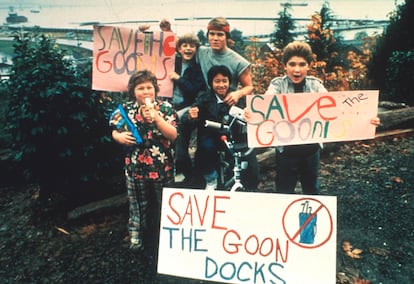

If we had to define The Goonies in one sentence, we might say: it’s the story of a group of children searching for treasure. The fact that 40 years later we’re still talking about it at length, that those who saw it when it premiered in the summer of 1985 still adore it, and that it has continued to attract viewers of new generations, proves that it’s much more. First of all, it represents an unusual mix of genres: thriller, adventure, comedy, and horror, as well as themes ranging from friendship to first love to the end of childhood. As The Independent noted, in this age where teen entertainment blockbusters are sequels or prequels, “The Goonies felt like 15 different original movies hurtling into each other at once, bouncing from genre to genre.”
The Goonies gave meaning to the concept of “suitable for all audiences.” Adults who accompanied children to the movie theaters were just as enthralled by the adventures of the Goon Docks gang as the children themselves. “There used to be children’s movies and adult movies. Now Spielberg has found an in-between niche,” wrote critic Roger Ebert. It’s also proof that it’s possible to make films for children that appeal to their intelligence, something that the 1980s demonstrated with other Steven Spielberg productions like Gremlins, with which it shares similarities, or Young Sherlock Holmes, the devastating first adventure of the celebrated sleuth. Films that didn’t shy away from death, loneliness, or sadness.
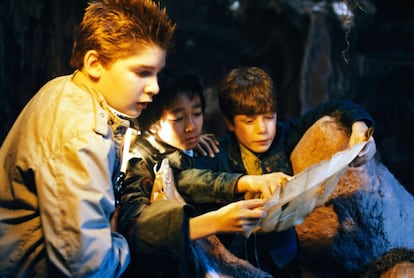
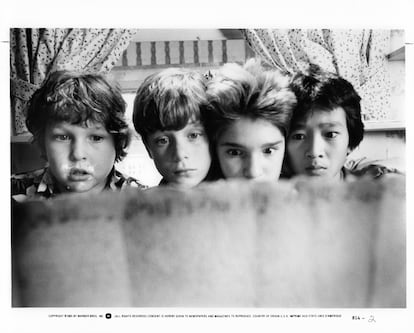
The Goonies also includes a subtle dose of politics that reveals some of the social concerns of the early 1980s, a time when many suffered the consequences of unbridled Reaganism. In the era of “greed is good,” Gordon Gecko’s mantra in Wall Street, the enemy that The Goonies fight is not the scheming Fratelli family, but a real estate developer, and what originates the conflict that leads them to embark on an extremely dangerous adventure is the imminent eviction of their families, who in a few days will see their houses demolished to make way for a golf course.
It’s a theme already present in Spielberg’s previous project, Poltergeist, in which the phrase “You left the bodies and only moved the tombstones!” denounced the lack of scruples and impunity with which the real estate kingpins operated. Once again, those responsible for all the disasters suffered by the protagonists are a group of greedy builders. In Jaws, too, the capitalist greed — which puts commercial interests before citizen safety — proved more dangerous than the great white shark itself.
As Megan Volpert wrote in Salon, “Forty years after its release, The Goonies has proven to be more than a nostalgic romp through booby traps and pirate ships — it’s a blueprint for collective survival and solidarity [...] The looming home foreclosure is not just a narrative device; it’s a symbol of systemic dispossession, of a profit-driven world where communities are expendable. The Goonies suggests there’s a form of wealth that can’t be measured in dollars: the wealth of knowing your neighbors and daring to come together with them for a shared purpose”
How to work with children
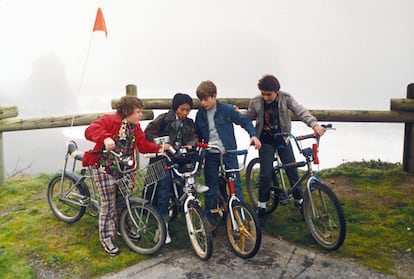
“What would a group of bored kids do on a rainy day?” That was the premise that Spielberg presented to his friend Chris Columbus (future director of Home Alone and some of the biggest hits of the last 40 years), who wrote the script from his idea and tried to convince Spielberg to direct it. But Spielberg was already immersed in pre-production on Indiana Jones and the Temple of Doom and the final choice was Richard Donner, director of classics such as The Omen (1976) and Superman (1978), and who was about to release the delightful Ladyhawke (1985).
Who better than someone who had demonstrated his mastery in so many genres to direct a film that brought them all together? “My first thoughts were, ‘why me?’” Donner said years later. “Because it was Steven Spielberg who made the best movies for kids and for dreaming in the world. So, why are you giving this to me?” “It’s the hardest thing I could have ever gotten into,” he said in a behind-the-scenes documentary, referring to managing a cast of actors ranging in age from 10 to 12, some of them with little experience.
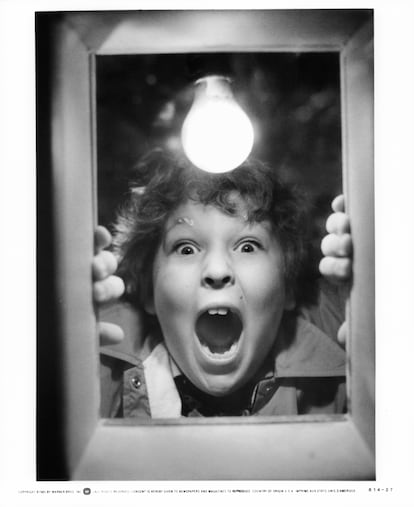
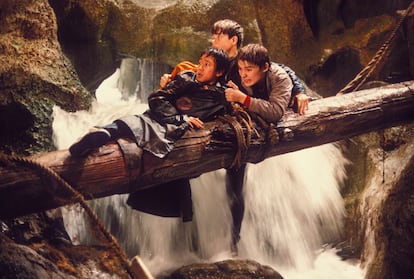
But Spielberg didn’t back down from his idea. He collaborated on the shoot and actively participated in the search for a cast that today we can consider perfect. Playing the brothers Mickey and Brand were what today we would consider two nepobabies: Sean Astin, son of Patty Duke (Oscar winner for The Miracle Worker), and Josh Brolin, son of James Brolin (today Barbra Streisand’s husband and at the time the heartthrob of the famous television show Hotel). Martha Plimpton, who played Stef, the most skeptical Goonie, also came from a family of artists, from the Carradine clan, pure Hollywood royalty. Of all of them, only Corey Feldman, who had previously starred in Gremlins, had relevant acting experience, but the group’s chemistry was instant and Donner opted to let them improvise, especially Feldman.
He also gave free rein to Jeff Cohen, aka Chunk, the protagonist of some of the film’s funniest scenes. Cohen recalls moments from filming that would be unthinkable today, like the trick they used to make him cry in the scene where he confesses all his “sins” — among them the vomit he threw from a movie theater balcony, which is a real anecdote from Spielberg himself. “I’m not sure if it was Robert Davi or Joe Pantoliano [the villainous Fratelli brothers], but one of them was pulling out the hairs on the back of my neck. He made me cry and scared me a lot. That was my version of the Method,” he recalled.
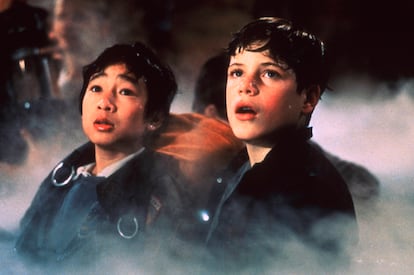
Controlling the actors’ urge to joke around was the most difficult part of Donner’s job, and he confesses that the most important thing was keeping them away from John Matuszak, the former football player who, at over two meters tall and weighing almost 130 kilos, was assigned to play Sloth, the Fratellis’ deformed brother who lived chained in the basement of the house.
Matuszak’s characterization of the endearing Captain Blood fan lasted five hours, and one splash of water to his face was enough to require reworking his make-up. The giant didn’t enjoy much of his cinematic popularity: he died just four years after the film’s release from an opioid overdose.
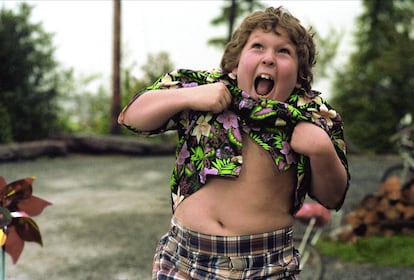
The film presents many conflicting points from a contemporary perspective, such as the treatment of Sloth, the racist tropes, and, especially, the jokes about Chunk’s weight and the fact that he’s called that. The moment where he does his famous belly jiggle, the “truffle shuffle,” something the actor did during his casting call, was “painful” for Donner. “So much humor comes from pain. Although, I’m sure he was too young to be analytical about it, but I’m sure that was part of his instincts. It was a painful scene,” he said.
During the film’s 30th anniversary, Donner explained that Cohen subsequently “lost lots of weight and built this great physique and became captain of his wrestling team in high school, captain of his football team, and president of his school class for two years in a row. I’m not saying I did it, but I know that when he started putting pride into his body and self a lot of things changed.”
Who needs the elderly?
Adults have a less prominent role in The Goonies, but the film would be inconceivable without the charisma of Anne Ramsey, the Fratelli matriarch, a terrifying and unusual character for a Spielberg film, usually full of kind and protective maternal figures, and who is inspired by a real character, the criminal Ma Barker, who not only served as a model for a handful of ruthless movie mothers but also inspired the band Boney M’s hit song of the same name.
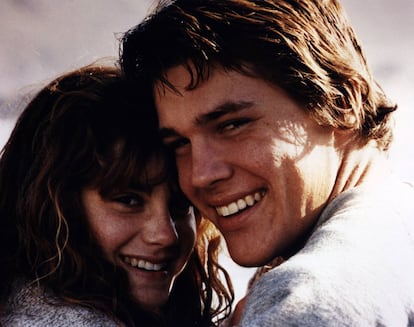
The shoot went smoothly, with visits that delighted the young actors. “Tim Burton and Paul Reubens [Pee-wee Herman] came. Dan Aykroyd, too. In fact, Harrison Ford came and climbed through the caves with us,” Feldman recounted.
A peace of mind that was aided by a generous budget: the names of Spielberg and Donner were sufficient guarantees, and they were allowed luxuries like hand-building One-Eyed Willy’s boat or featuring the compositions of Cyndi Lauper, one of the biggest pop stars of the time: The Goonies ‘R’ Good Enough was one of the most-played videos on the emerging MTV.
Although Donner believed the film they were making would only interest them, it ended up being one of the top-10 grossing movies of the year. Critics were kind, if not effusive. But very few classics enjoy glory during their initial run.
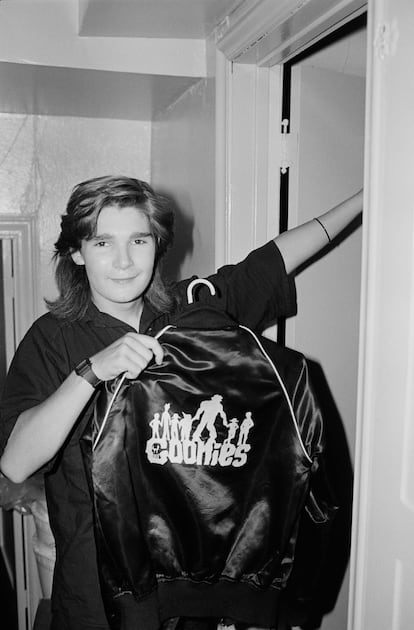
The actors had mixed fortunes. Some, like Feldman, the loquacious Mouth, would become pillars of the 1980s, but also victims of the worst side of the industry. Feldman, a drug addict at 15 and a victim of sexual abuse, saw his career cut short, which, in addition to The Goonies and Gremlins, includes The Lost Boys and Stand by Me.
Years later, Astin found another of those roles that justify a career: the faithful Sam in The Lord of the Rings, and we’ve also seen him in Stranger Things, one of the contemporary releases that draws most heavily on Donner’s film.
Josh Brolin has worked with the Coen brothers, Oliver Stone, and Woody Allen and is the “inevitable” Thanos in the Avengers saga.
Martha Plimpton forged a career in independent film and television.
Less prominent has been Kerri Green, who played Andy and after graduating from the prestigious Vassar College in New York gradually abandoned filmmaking to focus on her work as an artist, although she doesn’t miss a single Goonies convention.
Cohen swapped cameras for offices and was one of the architects of Ke Huy Quan’s return to the big screen: he steeped away from acting because the roles available to Asian actors were limited to stereotypes, until the unclassifiable Everything Everywhere All at Once led him to an Oscar and, once again, to fame.
During the reunion held when Quan left his handprints at the TCL Chinese Theatre in Los Angeles — attended by all the Goonies except Plimpton — the actor confessed that he would be very happy to return to his character, Data. The possibility of a sequel has lingered over the past 40 years, but a concrete project has never materialized. The closest it came to being revived was when Disney picked up a TV project inspired by the classic — originally shelved by Fox — but nothing more was ever heard of it.
Despite this, rumors of a possible reunion for the most famous gang from the Goon Docks resurface from time to time. It seems increasingly unlikely, though it shouldn’t be ruled out because, as we know, The Goonies “never say die.”
Sign up for our weekly newsletter to get more English-language news coverage from EL PAÍS USA Edition









































