
Matt Berninger: ‘Taylor Swift is like John Lennon to many people. She’s undoubtedly one of the best artists working today’
With his new solo album, the frontman for The National, an indie rock band, wants to put the bad times behind him and show that beauty can emerge from the worst of times
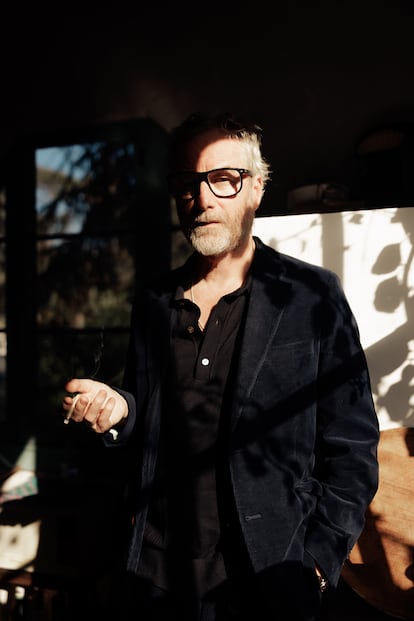
Matt Berninger, 54, has already explained many times that the Covid-19 lockdowns led him to severe depression. And he makes it clear that he doesn’t want to dwell on the subject anymore. “I’m tired of my story,” he sighs. “I’ve told it many times. I recorded two albums about it. And, at first, the songs on this [new] one either revisited my story, grew out of it, or foreshadowed it.”
“Frankly,” he explains to EL PAÍS, “I couldn’t handle the writer’s block anymore. So, the intention was for this album not to be about depression, or about that period, or about politics, or about the pandemic…”
The interview takes place in a London hotel. Berninger puffs on a marijuana vape pen and scribbles on a piece of paper during the conversation. It’s a Sunday in late March. He’s come to Europe for something that isn’t exactly a tour, although he’s (sort of) promoting his second solo album, Get Sunk. While playing a handful of acoustic shows in European capitals, he’s taking the opportunity to give interviews.
Matt Berninger is known as the lead singer and lyricist of The National, a band that rose to fame when its five members were already of a certain age. Specifically, the Ohio-born Berninger was 37 when Barack Obama began using Fake Empire (2007) – one of the songs from The National’s fourth album – at his rallies. This boosted the band’s popularity.
Around the 2008 presidential campaign, the members had only been playing full-time for three years. From its founding in 1999 until 2005, when Berninger quit his job as a graphic designer, music had practically been a hobby. They were so unknown that even though they were living in New York in 2001, when The Strokes made the city the rock capital of the world once again, no one included them on the list of bands to watch.
“We were there, but way behind The Strokes or Interpol. They got all the attention while we were still trying to figure out how to be a band. Thank God, because we were terrible at first,” Berninger recalls.
The truth is, they weren’t that bad. The problem was perhaps that their style of rock – with sad lyrics and an ’80s gothic feel – was too depressing and adult for the festive turn of the millenium.
Today, those other bands have either disappeared or are a shadow of their former selves, but The National still fills stadiums and has reached a new generation. And this is thanks to one fan in particular: they’re Taylor Swift’s favorite band. She said so in 2014 and proved that she wasn’t joking by writing two albums with Aaron Dessner, The National’s guitarist. The first one – Folklore – won the Grammy Award for Album of the Year in 2021.
“It’s incredible, she’s a tremendous talent,” Berninger gushes. “Obviously, we’ve gained a lot of fans thanks to our proximity to her. It’s made a new generation discover my band. Taylor Swift fans understand The National. They get my lyrics.”
Interestingly, Taylor Swift appears in two of the first three songs on Spotify’s This is The National playlist.“It’s true, those three songs are more hers than mine. If you look closely, even the first one – I Need My Girl (2014), which we recorded before we met – could easily pass for one of her songs. Because – thanks to my daughter – Taylor has always been playing in my house. And, from the beginning, I’ve admired her lyrics and melodies. I’ve learned a lot from her. Many people have grown up with her music. She’s John Lennon to many people, not just teenagers. Taylor Swift is undoubtedly one of the best artists today, as well as a lovely person.”
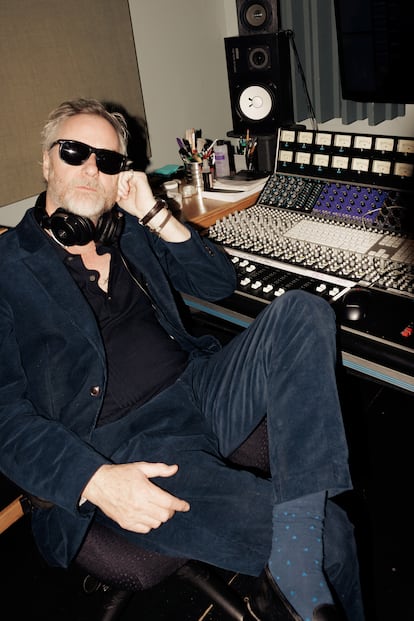
The paradox is that while those new fans were starting to arrive, Berninger was sinking into depression. He couldn’t write and thought he’d never tour again. The illness exacerbated the chronic stage fright that he overcomes with alcohol. The night before his interview with EL PAÍS – at the acoustic concert he gave in London – he downed a pint of something clear.
“It was tequila and soda, to grease the wheels a bit,” he explains. “I have a pretty healthy relationship with alcohol and nicotine. I’ve quit smoking. I don’t drink coffee or use other drugs. I tried mushrooms for a while, but they didn’t do what I expected. But a drink before a show, a few sips during [the performance] and a little marijuana really help me connect with the music, with the audience… [and] with myself, sometimes. It can also be a way to isolate yourself from the world, so I use it that way from time to time.”
“Sitting by the fire alone with a cocktail is also very healthy,” he reflects. “I write like this. I already know how bad alcohol is. Everyone knows that. If you want to say I use it as a crutch, go ahead and say so. Yeah, sure. I do. But I dance well with that crutch.”
After two years, he began to get back to normal, but his recovery was slow and it impacted his work with the band. Get Sunk was the first recording where he felt good after a long time, so he decided to ignore those difficult years, as well as any moderately contentious issues.
What’s left when you strip away all those issues? Well, Berninger basically has his childhood left. Get Sunk is an album about who he was before he became the man he is today. “There comes a point where a story from when you were a kid becomes a memory of a memory. The past you recall is unreal. It’s like trying to remember the future. Your idea of who you’re going to be is a story you’re telling yourself. Your past is also a story you tell yourself: maybe it wasn’t how you think it was, or you’ve forgotten important things.”
He provides an example: he recently discovered that he hadn’t told his wife of 20 years that the person who taught him to play pool was Neil Armstrong, the first man to walk on the moon. “Neil Armstrong had a farm in Lebanon, Ohio. My uncle Howard was his doctor. They had met during the Korean War. I was seven or eight when I saw him. Neil was at my uncle’s pool table. In my memory, I was a kid and he taught me how to play.” The album is filled with (almost) forgotten loves, nostalgia for the weekends at his uncle’s farm in Indiana, as well as descriptions of orange groves, rivers, hills and the tobacco plantations where he worked during the summers. “Yes, it’s an album about growing up in America in the ’80s,” he acknowledges.
Spiritually, Get Sunk is close to Nick Cave’s Wild God, in that it involves overcoming a personal crisis. “Yes, I hope so – [I hope] that my album is full of hope! I feel hopeful and I’m not afraid. I have a 16-year-old daughter and I don’t want this shit to ruin her happiness or her soul.”
“I just want to be brave,” Berninger admits. “That’s my big goal: I have to try to be brave.”
There’s another, less obvious connection: the album is reminiscent of Bryan Ferry’s work in the 1980s. And, as was the case with Ferry and Roxy Music, no matter how many times Berninger records without The National, their shadow still looms.
“It hadn’t occurred to me, but I like the idea. He was always Brian Ferry from Roxy Music. And then, somehow, he became Bryan Ferry. I’d like that: instead of being Matt Berninger from The National, just being Matt Berninger. I’d love it.”
Sign up for our weekly newsletter to get more English-language news coverage from EL PAÍS USA Edition









































