
Medellín went green in order to stay cool, but the heat is catching up
Colombia’s second-largest city created several green corridors over the last decade. But with accelerated climate change and urban sprawl, a different approach is now needed
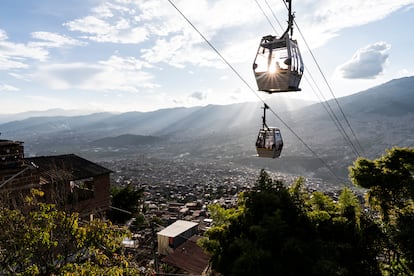
At midday in the summer, Avenida Oriental — a central boulevard in Medellín — is usually congested in both directions. The sidewalks are crowded with street vendors, hawking food and clothing. Amidst the heat, drivers and pedestrians seek shade under the trees that form three long rows along the sides and down the center of this avenue, which is one of the main streets in the downtown core.
For the past 18 years, Medellín has promoted tree planting, which has helped keep the city cool and earned it international recognition. Many cities are turning to trees for shade and other benefits as the world heats up. However, Medellín was one of the first municipalities to adopt this practice and remains an enthusiastic leader in the field.
The tree planting began in 2008, when the city government asked the Botanical Garden of Medellín to identify the most suitable species for the project. Endemic plants from the warm Colombian lowlands were selected, as they were capable of adapting to the urban environment. A goal of planting 880,000 trees was ultimately set. And the largest project of all was the city’s “Green Corridors” program, which promotes the planting of urban-adapted plant species in public spaces, in order to mitigate rising temperatures.
The government of Colombia’s second-most-populous city has invested $165 million in planting trees along roads such as Avenida Oriental, which connects the San Diego neighborhood to the downtown. Since the project began in 2016, 18 major roads and 12 stream basins have been transformed into green corridors.
However, the benefits of this tree planting project haven’t reached all four million inhabitants of the Medellín metropolitan area. And, as global temperatures soar, the city hasn’t been immune. Experts warn that much more needs to be done to address the effects of climate change, especially in areas where the most vulnerable people live and work.
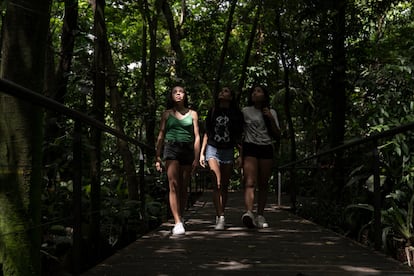
Gloria Morales lives with her family in the Villa Sofía neighborhood, on the slopes of the valley. It’s within Robledo, the second-most-populated of the 16 districts that make up Medellín, with about 200,000 inhabitants.
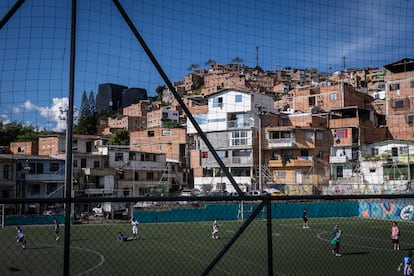
This area encompasses several university campuses and working-class neighborhoods. The narrow, steep streets are lined with bakeries and corner stores. The gray of concrete is everywhere: there are almost no green spaces or trees to offer shade from the midday sun.
The Villa Sofía neighborhood, like much of Robledo, expanded during the second half of the 20th century, without proper urban planning. The growth was driven by illegal construction, land grabs and putting up buildings that met minimal safety standards.
Gloria says that, starting in May 2026, the heat became more oppressive inside her house. And that was a month before El Niño — the climate phenomenon that causes higher temperatures — was officially declared.
In total, 10 people live in the home, including Gloria’s grandchildren (a two-year-old and a 10-month-old). And the rising heat they’re experiencing is despite the fact that the house is shaded by other buildings. “The house doesn’t get direct sunlight. But in the afternoons, everything becomes unbearable. The babies break out in rashes from the heat. We have to bathe them several times, because they can’t stand it,” she laments.
Like most families in the neighborhood, they don’t have air conditioning. “The electricity bill would be exorbitant. We can’t afford those expenses.”
These complaints are very common in Medellín. This year, the record for the highest temperature ever recorded was broken in May (33.8 °C, or 92.84 °F) and then again in July (34.5 °C, or 94.1 °F).
Trees can help keep temperatures cooler, but Robledo, the district where Gloria lives, hasn’t really benefited from the city’s tree-planting efforts. The city’s Urban Tree System (SAU) digital platform confirms that trees are concentrated in the south of Medellín: they’re less common on the northern slopes and in some parts of the downtown. For instance, the Villa Sofía neighborhood lacks green corridors.
No shade, no justice
Alejandro Álvarez Vanegas is a professor at EAFIT University in Medellin and holds a PhD in Higher Education for Sustainable Development. He notes that there’s major inequality in terms of the distribution of vegetation in the city: while the south, associated with higher-income districts, has a large green component, the north, northeastern and northwestern slopes are in a very different situation.
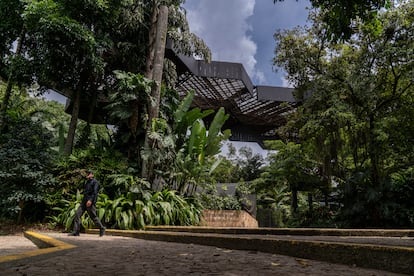
Camilo Quintero – former director of the Environmental and Public Health Legal Clinic at the University of the Andes (Bogotá) – speaks about “climate injustice” in the city. “High-income areas like El Poblado have parks and trees, while others like Manrique or Villa Hermosa have a lack of green public space.”
This inequality is compounded by the heat exposure faced by street vendors, transportation workers and other residents who spend several hours a day out in the open.
Robinson Giraldo has been a taxi driver for four years. He prefers to start his shift at two in the morning, in order to avoid the hottest hours of the day. “[Downtown], it’s all concrete. There’s no green space; you feel suffocated. It’s very different if you go toward Laureles, because there are trees and the shade is refreshing,” he says.
Measuring the heat
Overexposure to heat can also cause medical emergencies. Carmen Cecilia Gómez, an internist at the Cardioinfantil Foundation, the largest cardiology hospital in Colombia, explains that heat exposure initially causes dehydration and cramps, due to the body losing water and essential minerals. And, if this continues, it can lead to exhaustion, dizziness, headaches, nausea and feeling faint.
Medellín is the capital of Antioquia, one of Colombia’s 32 departamentos (states). Since 2021, the Governor’s Office of Antioquia and the University of Antioquia have jointly been developing the Environmental Health Climate Change Adaptation Plan (PACCSA), which gathers information on urban heat islands and other climate variables. This is in order to measure their impact on the local population.
The initiative aims to implement public policies that mitigate the effects of climate change, particularly its impact on the health of residents living in Antioquia’s nine subregions. This includes the Metropolitan Area of the Aburrá Valley, where the municipality of Medellín is located.
Heat islands are present in highly commercial areas, such as downtown Medellín, as well as in industrial zones in the municipalities of Bello, Itagüí, Sabaneta, La Estrella and Envigado.
The fight for green cities
Experts also warn that, in recent years, the pace of reforestation in Medellín has slowed down, while public transit projects such as bus lanes and light rail lines have been prioritized. Álvarez mentions the construction of Metro Line 80, which involved cutting down 84 mature trees. Those directing the project, in turn, have stated that they will offer compensation by planting hundreds more trees in other areas.
Former Congressman Daniel Carvalho, a civil engineer and urban planner by training, co-authored the Green Cities Law, which was passed by the Congress of Colombia in 2025. This law provides mayors with the tools required to strengthen adaptation to climate change and build green, biodiverse and resilient urban centers. This can be achieved, for example, through financial incentives for green infrastructure projects in urban areas, or via support from the federal government when it comes to conducting baseline assessments to determine cities’ needs.
Carvalho states that better integrating nature into urban planning is one of the main measures that Colombia can take to address climate change. Medellín, he adds, is surrounded by rich biodiversity, with thousands of species of plants, insects, birds and other animals.
Quintero, Carvalho and Álvarez agree that the Green Cities Law can promote tree-planting projects linked to biodiversity conservation. These are aimed at benefiting the entire population. The experts state that the law should be used to implement a comprehensive initiative that emphasizes tree planting, but also broadens the response to heatwaves by including other measures.
“We have a long way to go; we need to work on environmental education for citizens, get the private sector involved in ecological projects and replace hard surfaces with green spaces,” Carvalho affirms.
Maps and testimonies portray a city that has become greener, but in a context of rising temperatures, this hasn’t happened quickly enough, nor have the measures been equally distributed.
“Medellín must face the future head-on. If we continue to deny the importance of natural spaces for the physical and mental health of citizens – and for [our global] competitiveness – we’re doomed to continue experiencing disasters in a country that prides itself on being one of the richest in the world in terms of biodiversity,” Carvalho concludes.
This article was published in partnership with Dialogue Earth.
Sign up for our weekly newsletter to get more English-language news coverage from EL PAÍS USA Edition









































