
Cartagena de Indias is sinking: What can the city do to mitigate it?
Sea levels in the bay of the Colombian resort have risen seven millimeters per year for the past two decades, the second-highest rate in the Caribbean after Haiti
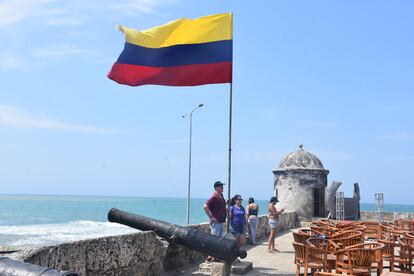

Manhattan, Venice, or Cartagena de Indias. For the inhabitants of these tourist destinations, it is increasingly evident how rising sea levels have been swallowing parts of their bays. In the case of the Colombian resort, recent scientific studies have recorded an average annual rise of seven millimeters over the past two decades. This is the second-highest sea level rise in the entire Caribbean, surpassed only by areas in southern Haiti. The underlying story is the same: greenhouse gas emissions have accelerated the melting of the polar ice caps. Consequently, the coastlines in some of these locations begin to subside in a geological process that poses a threat and a source of anxiety for residents.
The case of Cartagena, however, cannot be entirely attributed to climate change. There are other undeniable realities. “Forty-one percent of the rise in relative sea level is due to geology,” explains marine biologist Juan Darío Restrepo. “It’s nature, and there’s nothing we can do about it. For example, one of the biggest problems in the bay is that it has more than 80 underwater volcanic gas vents. When they erupt, they spew out mud and release pressure, leaving empty pockets that cause cracks. As a result, the city’s ground is sinking.”
The aftershocks of Hurricane Melissa, whose eye formed in Jamaican waters, clearly demonstrate the impact of these phenomena on daily life in the Colombian Caribbean: avenues bordering the boardwalk were flooded; families in low-income neighborhoods like El Líbano reported emergencies; hotel lobbies became waterlogged, while parking areas in wealthier buildings in the Bocagrande sector were battered by water.
The recent torrential rains and storm surges have served as yet another wake-up call to remind authorities of the city’s vulnerability. Restrepo explains that, previously, the season of strong winds and high waves was usually concentrated in the first quarter. Severe flooding happened no more than two or three times a year: “Now, it happens about 15 times a year. It was a phenomenon that was hardly felt in the city until recently. Today, with just a few millimeters of sea level rise, and a high tide 50 centimeters higher, the water level rises and the waves rise too.”
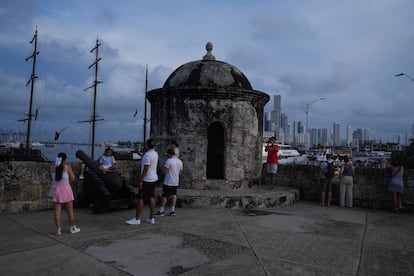
The other part of the problem unfolds in the bay and is linked to the gradual compression of the land. This geological phenomenon is called subsidence. It is a process that has accelerated in other cities like New York, where the weight of its skyscrapers causes a subsidence of between one and two millimeters per year. In Cartagena, a study published in 2022 in the journal Scientific Reports [from the same publisher as Nature] by a group of 10 scientists warns that, by 2050, the decline could reach 8 millimeters per year, if no action is taken.
In addition to the weight of the buildings, another factor should be added to the list: Cartagena de Indias’ water system relies on a network of canals, streams, and wetlands that flow into the bay. These bodies of water carry sediments that have accumulated over decades in areas like the old city. Héctor Mora, a geodetics specialist and co-author of the study, argues that more data is needed to accurately determine the impact of increased rainfall or the management of groundwater and sewage systems. What solutions exist to mitigate the advance of the waves and subsidence?
Authorities in Cartagena, a city with longstanding problems of political corruption, have opted for rock groins to curb coastal erosion. However, Restrepo points out, due to the sandy and muddy composition of much of the subsoil in the bay, these walls represent an innocuous solution: “It’s the best way to bury money.” Shimon Wdowinski, PhD in geophysics and professor at Florida International University, brings up the case of Miami, where state authorities have chosen other options because the city was built on limestone.
In his analysis, the effectiveness of these barriers depends largely on the geology and characteristics of the terrain. He points out that in highly porous soils, water always has free rein to penetrate beneath the walls and seep into the cities, as if through a sponge. Restrepo summarizes: “They can put down as many rocks as they want, and in four or five years the water will be back on top. That’s how they’re rocking Cartagena. And that’s a way to silence the communities of Boca Chica and Tierra Bomba, who have opposed the impact of these dredging operations on beach life.”
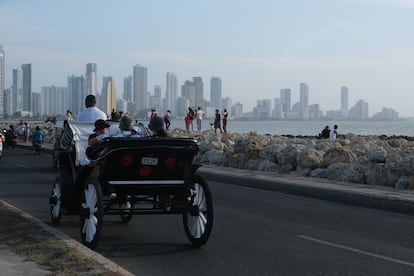
Restrepo’s testimony portrays the social and environmental challenges of a seaside resort full of contrasts. Declared a World Heritage Site by UNESCO, the old town and part of the residential peninsula of Castillo Grande shine like an oasis of luxury, far removed from the rest of a city with alarming rates of poverty and inequality.
For now, Restrepo proposes some actions to begin to alter a bleak future that doesn’t seem so far off: “The city needs a thorough hydraulic assessment to see how to drain the water. Structures and channels must be designed to defend against flooding. For example, we can start with all those internal canals located behind San Felipe Castle. They are all clogged with garbage and clearly demonstrate the city’s environmental collapse. During peak tourist season, the sewage system is overwhelmed, and some of the raw sewage is dumped into the bay. Cartagena is a diamond built on top, but rotten underneath.”
Sign up for our weekly newsletter to get more English-language news coverage from EL PAÍS USA Edition









































