
Deported migrant who testified against drug traffickers is seized by ICE on his return to the US
The informant did not become a protected witness or receive immigration status after collaborating with the US authorities
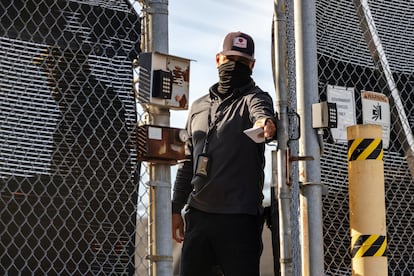

John Doe managed to get out of Mexico safely, but as soon as he set foot on U.S. soil, Immigration and Customs Enforcement (ICE) arrested him and attempted to deport him again. It is the latest chapter in the journey of a Mexican who collaborated with the U.S. government as a witness in several drug trafficking cases and whose life was put at risk after he was deported three times — the most recent, on August 1 — to an area of high drug smuggling activity. He never became a protected witness, nor did he receive an immigration status that would allow him to live legally in the U.S. in exchange for the information he provided.
By order of a federal judge, John Doe — the pseudonym used by the judicial system to protect people’s identities — received support from the authorities themselves to return safely to the U.S. The court order was issued on August 21, but was not complied with until this week. On Wednesday, September 2, prosecutors made a last ditch attempt during a hearing to keep the witness in Mexico. Except for a close relative and his lawyer, Anna Tijerina, no one knew where he was hiding on the other side of the border. They feared that organized criminals would locate and kill him. “Wherever he goes in Mexico, he is at risk due to the drug trafficking there,” Tijerina said in an interview with EL PAÍS.
It is currently not known where ICE is keeping this man in custody. U.S. District Judge Stephanie A. Gallagher ruled that, if the U.S. government detained him again, it should hold him in a place no more than 200 miles from Baltimore, where he lived, while guaranteeing him access to his lawyer. ICE and the Department of Homeland Security (DHS) did not respond to requests for comment made by EL PAÍS.
“How is it possible that the government puts the lives of the people who are helping to make the country safer at risk? Because, obviously, accepting being a witness in a drug trafficking case was what put his life at risk,” said Tijerina. “Before all this, he was not afraid to return to Mexico.”
Almost all of John Doe’s file remains sealed by court order. Which Mexican drug traffickers he testified against in court remains a secret, at least for now. It is also not known what his role was within organized crime. “We are not giving information on the case because we do not want to reveal who my client is or give any information that could put him in even greater danger,” Tijerina said.
The lawyer did confirm that her client was never in the federal protected witness program, a security measure that informants for the U.S. authorities usually take advantage of. “He just testified and went off by himself. And after that he was embroiled in the immigration case,” she explained.
From witness to deportee
After giving his statements to a jury, John Doe ended up in ICE custody for reasons that have not been revealed. In July 2024, an immigration judge deferred his deportation under the Convention Against Torture (CAT), after determining that it was possible “that he would be tortured by the government or by private individuals acting with the consent of the government if he were returned to Mexico.”
ICE released him later that year. However, in January 2026, when he showed up for a routine immigration check, ICE took him back into custody. He spent six months in a Louisiana detention center. During that time, his attorney filed a legal challenge to demand that his incarceration be justified. “They never did a credible interview with him regarding his fears,” Tijerina said, referring to her client’s attempt to claim refugee status.
On July 10, he was deported to Guatemala. Authorities in that country refused to receive him and handed him over to Mexican officials. But after John Doe’s lawyer notified them that her client was protected by the Convention Against Torture, the Mexican authorities decided to return him to the United States.
Upon arriving at a Texas airport, he was held again “without being allowed to speak with his family or his lawyer,” according to court documents. On July 15 and 16, he was deported a second time, this time to Mexico. The authorities of that country again refused to receive him and returned him to the U.S. He then spent 10 days in detention until August 1 when he was taken to the Texas border to be expelled, for the third time, to Mexico, “without his phone or his other personal belongings.”
John Doe’s lawyer finds it ironic that her client has collaborated with the Department of Justice only to find that, years later, it is this very department that legally represents ICE as it tries to justify her client’s expulsion to Mexico. “What this ends up meaning is that people do not want to testify, they do not want to help the United States government,” Tijerina said.
Sign up for our weekly newsletter to get more English-language news coverage from EL PAÍS USA Edition









































