
The women standing by Lindsay Clancy: ‘We need to understand what drove her to kill her children. It cannot happen again’
The pink-dressed supporters, who have protested at the Massachusetts trial, say doctors failed to provide adequate treatment despite the mother’s severe mental health struggles

Jeanne, Marta, Rebeca and Ariana. Four women from four different generations, with different outlooks on life and from different parts of the United States. But they all have one thing in common: the story of Lindsay Clancy, the nurse who strangled her three children on January 24, 2023, before attempting to take her own life, has shattered them. They want to show their support for a woman who, they say, was not only a killer but also a victim of a medical system that did not know how to treat her. That is why they are urging the jury to find her not criminally responsible for the tragedy and to commit her to a psychiatric facility, where she can recover, rather than send her to prison for the rest of her life.
Jeanne Diachun worked as a nurse in Plymouth for 35 years. When she first heard about the Lindsay Clancy case, she was horrified that a woman with three children, a fellow nurse from her own state, could commit such an atrocity. “At first I thought, as anyone would, that she had done something horrible. I can’t even imagine someone doing that. But the more I learned about the case, the more I saw that she had sought help everywhere. And no one knew how to respond,” says the 81-year-old, who was in the courtroom on Tuesday for what is expected to be the final week of the trial. The defense and the prosecution delivered their closing arguments on Thursday. All that remains now is for the jury to decide whether to convict or acquit the defendant.
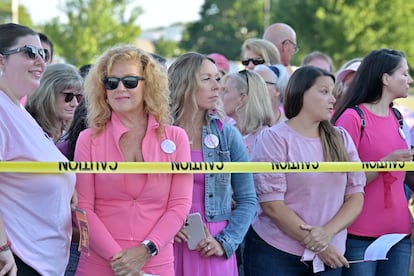
There is something in Clancy’s story that made Diachun think of her own family. “I remembered the day when, when my sisters and I were little, my mother started to scream out the window. I was only four years old. I don’t know exactly what happened to her, but they took her away and she was admitted to a hospital for three months. This case has made me relive my own story,” she says shortly before the hearing begins. “This is all tragic. There are no winners here,” she adds, referring to those trying to score points from the drama.
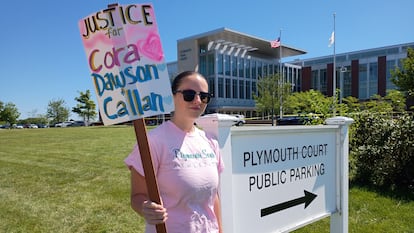
Ariana Anthony was born 65 years after Diachun. But the generational gulf between them does not prevent them from seeing the case in much the same way. The 16-year-old student stands alone outside Plymouth Superior Court dressed in pink and holding a sign calling for justice for Cora, Dawson and Callan, the three children strangled by their mother with exercise bands in the basement of their home in Duxbury, a 15-minute drive away.
The final days of the trial did not see a repeat of the images that had spread around the world: dozens, sometimes hundreds, of women dressed in pink in support of Clancy, often drawing fierce criticism. Anthony is well aware of the backlash: “I’ve been insulted too, called a clown, but I don’t care. I’m here because I believe we all must learn a lesson from this. And that something like this cannot happen again.”
Health experts have expressed hope that the tragedy will at least help shine a light on shortcomings in the treatment of mental health conditions. Terms such as psychosis and postpartum depression have moved from being almost taboo subjects to appearing in headlines, newspaper articles and television programs.
Glorifying a killer?
The wave of support from women has sparked criticism from many who believe it is glorifying a killer. Social media reactions range from measured skepticism about whether Clancy truly did not understand what she was doing to accusations that the women in pink are effectively supporting the murder of children. Some have even gone so far as to link the family’s tragedy to abortion.

One of the loudest critics has been sports journalist and radio host Gerry Callahan, who devoted part of his show last Friday to what he called the “sickos” supporting Clancy.
Anthony argues that many of those criticisms overlook what lies at the heart of the tragedy, beyond what she calls the question of “who did what.” “Obviously, no one supports that she killed her children. But it is important to understand where all that came from: not being heard by doctors and going insane because of it,” she says. “And I also think she must receive help. She should not be locked in a cell, but in a place where they can care for her.” She says the most important lesson for Americans is that the country’s healthcare system is not as effective as authorities claim. “She tried to get help and was denied it,” she adds as a final plea.
Outside the courthouse, attorney Kevin Reddington, whose prominent role in the trial has turned him into a familiar face on television and social media, makes his way toward his car through a crowd of cameras. Just before reaching the vehicle, he offers his view of the pink-shirt movement: “Many women, and I think many men too, support Lindsay. And they do not support any criminal activity, but support her as a person, knowing what she went through. The Lindsay Clancy of January 24, 2023 is not the Lindsay Clancy who is sitting in this courtroom today.”
Alongside supporters such as 81-year-old Jeanne Diachun and 16-year-old Ariana Anthony are middle-aged women, many of them mothers themselves. One of them is Rebeca Olszewski, who traveled more than 600 miles from Cleveland because she felt she needed to be there. The 42-year-old mother of three came to see how the justice system works, but says she found something far more surprising. “Many people see her and simply think she is a monster who killed her children. But seeing her in court these days, I realized that is far from the reality. You only have to be here to see that she’s living through her own personal hell.”
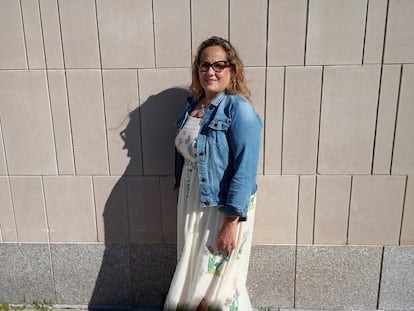
Marta Quijano, 55, was born in Puerto Rico but has spent half her life in Massachusetts. She admits she came to the courthouse because the case struck a deeply personal chord: she, too, suffered postpartum depression that required medical treatment.
But not everyone who has gathered at the courthouse in recent days has come to show support for the woman who has dominated headlines across the United States. It has also attracted people who follow the country’s most lurid crimes, traveling from north to south looking for the next true crime spectacle.
Among them are Shane Bloyer and his wife, who traveled from Maryland to hear testimony from both prosecution and defense witnesses. “It’s our hobby,” he says. They have attended several high-profile trials, including the double-murder case of disgraced South Carolina attorney Alex Murdaugh and the murder of Florida law professor Dan Markel. “That one was really bad. Next to it, Clancy almost seems like a normal person,” Bloyer says while waiting in line to enter the courtroom. A strange joke amid so much solemnity.
Sign up for our weekly newsletter to get more English-language news coverage from EL PAÍS USA Edition









































