
Trump records an electoral win with his candidate’s victory in South Carolina primary
Darline Graham defeated Representative Ralph Norman and will be the Republican nominee for the Senate seat held by her brother Lindsey Graham, who died in July
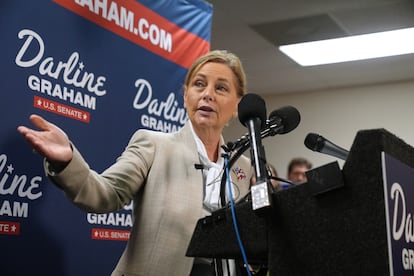

U.S. President Donald Trump scored a significant win in South Carolina in the race toward November’s midterm elections and showed he still commands influence within his party. Voters backed the candidate he supported, Darline Graham — sister of the late senator Lindsey Graham — in Tuesday’s primary in the deeply conservative state to choose the Republican nominee who will compete for a Senate seat in just over two months’ time.
With 99% of the vote counted, Graham had 52.5% to her rival, Representative Ralph Norman’s, 47.5%. The margin, however, was misleading: the difference amounted to barely 15,000 ballots.
The former health fund administrator was already serving provisionally in the seat that will now be contested against Democratic nominee Annie Andrews. It was the seat held by her brother until the conservative lawmaker’s unexpected death from a cardiovascular illness six weeks ago, and Trump was the one who proposed her as his replacement.
For Trump, Graham’s victory is a personal win after a summer in which several candidates he backed lost their primaries. The president poured effort into her campaign, both in public statements and in fundraising. He even traveled to South Carolina last week to take part in a rally for the candidate — something he has rarely done in this electoral cycle. On Monday, MAGA Inc., the political action committee that supports the president and Trump-aligned candidates, spent about $830,000 on last-minute calls and text messages for the senator’s campaign. The sum is all the more notable because the committee has spent very little on these midterm races.
The contrast between the two contenders, beyond their shared party affiliation, could not have been starker. Norman is a career politician who has held a House seat for a decade and has pledged fiscal austerity in line with the Republican establishment. By contrast, Darline Graham was an almost entirely unknown figure with limited interest in politics until her brother’s death. She had not previously followed the news closely.
Lindsey Graham’s death changed everything. Almost immediately, Trump nominated her to fill the seat until elections could be held ahead of the start of the next legislature in January 2027. South Carolina Governor Henry McMaster accepted the president’s suggestion — effectively an order.
Two weeks ago, with Trump’s unfailing support, the novice politician finished first in the preliminary vote ahead of the primary. The president’s backing, and the promise to maintain her brother’s policies and even his staff, seemed enough to convince Republican voters. She beat Norman in that round with 33% of the vote to the congressman’s 25%, winning in 36 of the state’s 46 counties. The other candidates received fewer votes and were eliminated.
But as the campaign progressed, Graham’s inexperience became increasingly apparent. A key moment came during the televised debate of the contenders a week ago. The moderator asked her: why should the United States consider Taiwan and the South China Sea a national security issue? It was one of the topics that had fascinated her brother, a member of the Senate Foreign Relations Committee. She did not know how to answer. She hesitated, then admitted she “didn’t know much” about national security issues “but I do know we must support our armed forces.” That response fueled critics who questioned whether she was prepared for a Senate role.
“Lindsey Graham was well informed on the United States’ national security. Darline Graham admits she’s not. This is not something you inherit. And it’s critical in the U.S. Senate,” wrote former South Carolina governor Nikki Haley, a onetime rival of Trump in the 2024 Republican primaries, who backed Norman.
Internal polls suggested Graham’s remark cost her votes. The inexperienced lawmaker tried to turn necessity into a virtue. Her mistake, she said last week, was precisely because she is not a career politician but an ordinary person who understands ordinary people. “I’ve said many times that I’m not a politician. I am certainly not a career politician. I don’t speak in political language,” she said.
Republican voters on Tuesday sided with that stance. They backed Darline Graham, Donald Trump’s choice.
Sign up for our weekly newsletter to get more English-language news coverage from EL PAÍS USA Edition









































