
Cheng Li‑wun, leader of the opposition in Taiwan: ‘We do not want to become the next Ukraine’
After meeting Xi Jinping in April, the chair of the KMT argues for a rapprochement with Beijing to avoid conflict across the strait
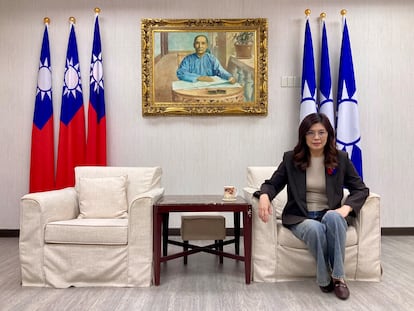

Taiwanese politician Cheng Li-wun, who is notably tall, can be heard approaching with the click of her heels and long strides down the corridor of the headquarters of the Kuomintang (KMT), the main opposition party in Taiwan. In April, during a visit to Beijing, she looked the Chinese president, Xi Jinping, in the eye. In the photograph that captured their meeting in the Great Hall of the People they are not smiling; neither do they appear distant. Their expressions are neutral, perhaps waiting to see how the coming years unfold.
The meeting marked a milestone in the always turbulent cross-strait relationship. With official communication channels between Beijing and Taipei shut down since 2016, Cheng (Kouhu Township, 56) was the first sitting party chair to travel to the Chinese capital to meet Xi in a decade. The encounter was staged to send a conciliatory message. It went down well in Beijing and with the more hard-line wing in Taiwan that favors restoring ties. But many on the island questioned the cost of a potential rapprochement in terms of democratic freedoms.
Cheng, who has led the historic KMT since last autumn, shakes hands with a smile and speaks throughout this interview, held last week in Taipei, in a loud, forceful tone, somewhat like she is giving a rally. She speaks Mandarin, interpreted into English by a translator, though she sometimes switches to English herself. “Today everyone fears a war breaking out across the strait,” she says. “We do not want to become the next Ukraine.” But her strategy to avoid conflict does not rely solely on military deterrence; she advocates strengthening political and civic channels of communication, a stance that has drawn criticism for being too “pro‑Beijing.”
In the complex web of interests that revolve around the self-governing island — one of the planet’s hottest geopolitical flashpoints — the communist authorities see in the KMT, and in Cheng, an opportunity for rapprochement. Taiwan’s current president, Lai Ching‑te, of the Democratic Progressive Party (DPP), is instead labeled in Beijing as a “danger” because of his secessionist leanings.
Since Lai took office in 2024, China has launched numerous rounds of military maneuvers in the strait. Beijing considers Taiwan a breakaway province to be peacefully reunified, but reserves the right to use force if necessary. As such, if elections were held tomorrow, the Asian giant would very likely bet almost everything on a Cheng Li‑wun victory.
The KMT leader says that, during her meeting with Xi, she perceived “goodwill” and “a genuine affection toward Taiwan.” That encounter “has allowed everyone to understand clearly that peaceful exchange between the two sides is absolutely feasible, and that it does not require either party to make sacrifices contrary to its interests or will,” she adds. “If we really want to build a lasting and peaceful relationship between the two sides, under no circumstances can we sacrifice Taiwan’s democracy or its way of life.”
As Cheng answers questions from EL PAÍS, Sun Yat‑sen, the KMT founder and the Republic of China’s first president, looks on from a canvas on the wall. He is an icon shared by both sides of the strait. After his death, Chiang Kai‑shek succeeded him as party leader; Chiang’s nationalist forces were defeated in the Chinese Civil War by Mao Zedong’s communists. Mao founded the People’s Republic of China; the defeated nationalists, under Chiang’s leadership, fled to Taiwan and established a sort of government‑in‑exile of the fallen regime, the Republic of China (which remains Taiwan’s official name). That old conflict has reached the present day wrapped in a delicate diplomatic balance between China and the United States.
“What kind of guarantees did Xi Jinping give you? Many people fear the model will be the same as Hong Kong’s.”
“Taiwan will never be the next Hong Kong, because they are two completely different cases.”
Cheng says Xi acknowledged and respected that the people of Taiwan have chosen and developed a way of life “completely different” from that of mainland China. “He hopes there will be mutual respect and recognition.” In other words, that Taiwan also shows deference to China’s achievements. “Both sides have achieved great things, and those accomplishments belong to the Chinese nation as a whole.”
In her pragmatic view, rapprochement should begin with cultural, sports, religious, commercial, and academic exchanges “to shorten distances and dissolve hostilities,” and she believes it will be necessary to develop mechanisms to ensure they proceed normally. “I hope to build a large, very stable and sustainable platform for peace over time.” It will entail, she says, an “enormous effort.”
“Would that mean giving up sovereignty?”
“There will not be an immediate leap to the question of sovereignty, nor will it be necessary to sacrifice democracy, the rule of law, and the freedoms Taiwan enjoys today. Absolutely not. In the future we will need more creativity and new institutional formulas.”
Her trip to Beijing benefited from a dose of synchronicity: soon after, U.S. President Donald Trump landed in the Chinese capital, where Xi lectured him on Taiwan: it is “the most important issue” in relations with Washington, the Chinese leader stressed, and mismanagement could lead to an “extremely dangerous” situation and even “conflicts.”
At the end of the summit, Trump said in an interview: “I’m not looking to have somebody go independent. And, you know, we’re supposed to travel 9,500 miles to fight a war. I’m not looking for that. I want them to cool down. I want China to cool down. [...] We’re not looking to have somebody say, ‘Let’s go independent because the United States is backing us.’” He also declined to reveal whether he will approve a historic $14 billion arms package to Taipei, which Beijing views unfavorably.
In June, Cheng will complete the triangle with a visit to the United States during which she will deliver a message: “What everyone fears — a confrontation between the United States and China — is something that can be avoided. The peaceful option is absolutely viable and it is the one that truly serves the national interests of the United States.”
She says Trump’s visit to China has not changed Washington’s policy: “The only thing that changed is that [...] he made clear he will not send troops in support of Taiwan’s independence.” She believes the Trump‑Xi summit was “very positive,” and it sends the signal that the two giants “will maintain a relationship of peace and stability.”
She does not, however, rule out a war in the strait. “Relations between the two sides are very deteriorated, and confrontation and hostility are escalating rapidly,” she says. According to her, the DPP is moving increasingly toward independence, defying China’s red lines. “We are very worried that a military conflict could occur in the coming years. That is why I am so urgently demonstrating that we should not go down that path.” She also calls for a distinct space for the island: “Taiwan should not be a pawn in the great powers’ game.”
Sign up for our weekly newsletter to get more English-language news coverage from EL PAÍS USA Edition









































