
Torrential rains trigger rescues, evacuations and more flood warnings in Texas
Governor Greg Abbott reported one death in the affected region, which is still recovering from the 2025 tragedy caused by the Guadalupe River flooding and is facing water levels similar to those recorded last year
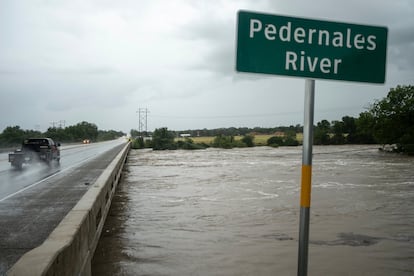

A new flood emergency has struck central and southern Texas following several days of torrential rain that has caused rivers and streams to overflow, prompting large-scale rescue and evacuation operations in the Texas Hill Country. Governor Greg Abbott has reported one death. According to reports from The Associated Press, emergency crews have been working since early Thursday morning to assist people trapped by rapidly rising water levels while authorities maintained alerts in dozens of counties.
The National Weather Service (NWS) has already issued several flash flood emergencies — the highest level of flash flood warning — for communities such as Kerrville, Hunt, Uvalde, Knippa, and other areas of the Hill Country. The agency warned that a “large and deadly flood wave” was moving down the Guadalupe River and urged residents to take immediate action.
In one of its warnings, the NWS stated: “This is a PARTICULARLY DANGEROUS SITUATION. SEEK HIGHER GROUND NOW!” Meanwhile, in another update, it reported that the flood was moving downstream from Kerrville toward Center Point, Comfort, Waring, Sisterdale, Crown, and Bergheim.
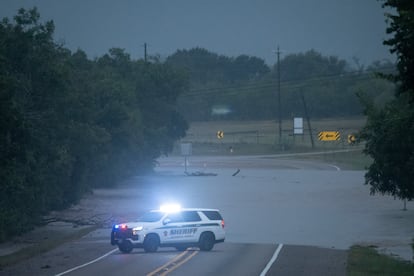
The NWS reported that some areas of Uvalde received between 25.4 and 50.8 centimeters (10 and 20 inches) of rain over the past 48 hours, including up to 20.3 centimeters (eight inches) in just two hours. In addition, meteorologists warned that rainfall could continue at rates of between 5.1 and 10.2 centimeters (two and four inches) per hour, which significantly increases the risk of further flooding because the ground is already completely saturated.
The storm also affected river levels. According to data from the U.S. Geological Survey (USGS), the Guadalupe River at Center Point rose 975 centimeters (32 feet) in four hours, while the stretch at Hunt rose from approximately 274 to 579 centimeters (nine to 19 feet) in one hour. The NWS warned that the predicted water level for the Guadalupe River could reach a peak similar to that recorded during the catastrophic flood of July 4, 2025.
According to the AP, the flooding led to multiple rescue operations throughout the night and into the early morning. In Uvalde, local authorities reported that several motorists were trapped by the water, while emergency crews used boats and prepared helicopters to continue rescue efforts at dawn. The Texas Department of Parks and Wildlife reported that its agents participated in the rescue of more than 40 people, primarily in Uvalde County.
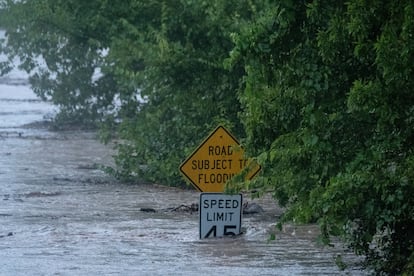
Fox 7 Austin reported that rescue boats were also deployed in Kerr County. At least two bridges were swept away by the current, several roads became impassable, and emergency crews faced difficulties reaching some of the affected communities. Among the rescue operations carried out, 10 people who had taken refuge on the roof of a barn were rescued.
Meanwhile, local authorities issued evacuation orders and opened shelters for those living near the Guadalupe River and other waterways. In Kerrville, residents near Quinlan Creek were asked to move to higher ground, while officials in Kendall County urged people to leave at-risk areas without waiting for the water to reach their homes. Shelters were also set up in Comfort, Bandera, Kerrville, and Ingram to accommodate displaced residents.
The damage also affected road infrastructure. According to the San Antonio Express-News, the flooding forced the closure of a section of U.S. Highway 90 between Uvalde and Del Rio after water covered several segments of the highway in Kinney and Val Verde counties. Local authorities urged motorists to stay off the roads until conditions improved.
During a press conference, Governor Greg Abbott reported that the state had issued disaster declarations for 59 counties, though he noted that the number could rise as the emergency unfolds. The governor stated that more than 75 people had been rescued so far and warned that the storm could bring over 76 centimeters (30 inches) of rain in some areas, surpassing even the rainfall totals recorded during last year’s tragedy.
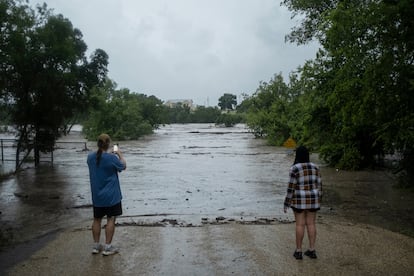
“We are dealing with and responding to a flood that is likely going to break records,” Abbott said. The governor added that over 1,300 state personnel from more than 30 agencies, along with more than 800 vehicles, 75 boats, and 20 aircraft, had been deployed to respond to the emergency. “Our primary focus right now and throughout the remainder of this torrential rain is saving lives,” he added.
Abbot later confirmed that one person had died as a result of the flooding between Kerrville and Comfort. “I have learned that there has been one loss of life now, and that happened overnight,” he said at an event in Austin.
The NWS had previously classified the event as a Level 4 out of 4 risk for excessive rainfall — a category the agency issues only rarely and which historically accounts for a significant portion of flood-related deaths and damage. Although forecasts call for a possible temporary lull in the rain, meteorologists warned that new storms could develop overnight Thursday and prolong the risk of flooding.
The emergency is occurring in a region known as “Flash Flood Alley,” one of the areas most prone to flash floods in the United States. According to the Texas Water Resources Institute, the combination of rugged terrain, low-permeability soils, and moisture from the Gulf causes large volumes of rain to run off rapidly into rivers and streams, triggering violent flooding in a very short time.
The situation brings back memories of the floods that occurred during the Independence Day weekend of 2025, when more than a hundred people died in the Texas Hill Country, including girls and counselors at Camp Mystic.
Sign up for our weekly newsletter to get more English-language news coverage from EL PAÍS USA Edition









































