
The religious leader who symbolizes resistance to ICE in Minneapolis: ‘What Trump had in mind was ethnic cleansing’
Mexican pastor Sergio Amezcua leads a solidarity operation with 4,000 volunteers that feeds 16,000 families in the face of an assault by federal authorities

When Pastor Sergio Amezcua realized in early December that Donald Trump’s decision to send federal agents to launch an anti-immigration operation in a city (Minneapolis) and a state (Minnesota) with a much lower percentage of migrants than in other, Republican-led states was imminent, he told his assistant: “We have to prepare. We’ll have to help the families; let’s send a message on social media.”
Amezcua thought that about 10 or 20 people would sign up. He also thought the government occupation would last about two weeks. “Two thousand families responded,” the pastor explained Sunday night in an interview with EL PAÍS at his church on the outskirts of Minneapolis.
Nearly two months after that double miscalculation, some 28,000 families have already registered for their assistance program, 16,000 of whom have received aid. The phenomenal operation has taken everyone by surprise and has tested the solidarity of a city where some 3,000 federal agents remain deployed, thousands of people have been deported or detained and two Americans, Renee Good and Alex Pretti, have been killed. Both were members of a citizens’ movement protesting against an unprecedented anti-immigration operation.
Amezcua’s program distributes 100 tons of food weekly. Food donations are received on Tuesdays and Thursdays. Monetary donations are channeled through the website and are mostly small, “around $25.” The next step, the pastor reveals, is “to raise money to help people with their rent.”
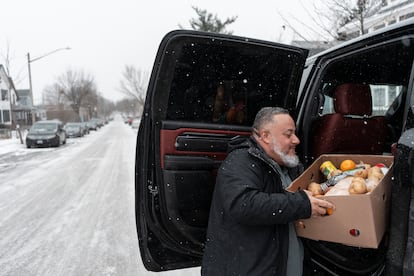
Until that moment arrives — perhaps as soon as the end of this week — volunteers are organizing to distribute aid on Mondays, Wednesdays, and Fridays. They primarily bring vegetables, legumes, milk, chicken, cereal, bread, salads, toys, and — since an immigrant told them she had been recycling them — diapers as well. Not only to undocumented families, Amezcua points out, because “many Americans are affected by the end of food programs.” “We are facing a humanitarian crisis,” he states.
On Monday morning, the “sanctuary,” where Mass is normally held, was filled with dozens of volunteers, almost all white and American, some of the 4,000 who have joined the cause. At one table they signed up; at the next, their information was taken; at the third, they received the addresses of those they were to visit with their cars, once loaded with aid. In the lobby of the church, a dark, straight-lined building, the activity was quite different, resembling that of an assembly line, as people busily filled boxes and distributed them toward the parking lot.
Susan, a white-haired woman who started helping from the beginning, explained that the demand is “so great” that they are “overwhelmed” because the volunteers have to go through training first. John and Davison, two older men, then showed the route they had been assigned. It had eight stops. “It’s our way of feeling like we’re doing something,” said John, a veteran being accompanied by his friend for the first time. “Some are so scared they won’t even open the door. It breaks your heart.”
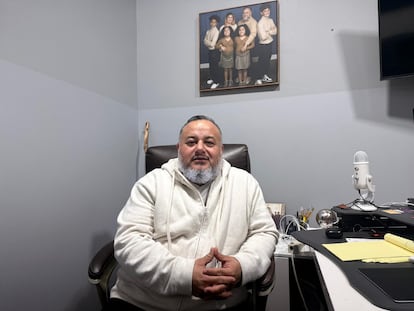
Amezcua is 46 years old. In addition to being a Christian pastor, he’s a businessman. He’s in the insurance industry, which is also being affected by Trump’s actions: he estimates that revenue has fallen by 50% in the last two months, since the takeover of Minneapolis began. “People are losing their jobs, and they can’t afford their coverage,” he explains in his office, sitting under a photo of himself with his wife and their three children, as well as his eldest son from a previous marriage. On the table rests the microphone he uses for his popular podcast. It’s called “Tacos al Pastor,” and in it he discusses current events in the Twin Cities, the conurbation formed by Minneapolis and St. Paul, separated by the nascent Mississippi River.
He arrived in this corner of the world from Mexico 24 years ago and soon after married for the first time. “I was lucky with the green card and residency. It was a different time,” he recalls. Seventeen years ago, he converted to Christianity. In 2011, he became a pastor. Later, he founded the church, which is non-denominational and named Dios Habla Hoy (God Speaks Today). Shortly before the pandemic, he bought the building, then a Lutheran church, which today is the center of a solidarity logistics operation that runs from Monday to Saturday.
He continues to hold Mass on Sundays. Parishioners have dropped by 70% “because people are terrified, even those who have residency,” although, Amezcua says, other churches are registering drops of 80% or 85%. “In our case, the media profile we’ve adopted helps. Since all this started, we’ve seen new faces arrive, many white people, because our service is bilingual. There are also those who have never been to a church, even atheists, who simply want to help,” he explains.
National benchmark
In recent days, he has been constantly giving interviews to major media outlets across the United States. He has become a national figure and a local hero; someone to whom those who don’t know where else to turn go. For example, the mother of five-year-old Liam Conejo, detained along with his father by U.S. Immigration and Customs Enforcement (ICE) last week. His tearful and terrified face has become a global symbol of what is happening in this frigid city on the brink. “His mother called me; she was desperate. We immediately mobilized to help them. The last I heard, they are both in Texas, in a family cell,” he says.
Regarding his sudden fame, Amezcua says it’s “not out of vanity,” but rather an interest in controlling the narrative. “If you turn on the news, it’s either the far right or the far left. But nobody is talking about the truth. Those on the right say there are a lot of professional agitators here and that George Soros is paying them. Which is a lie. And the far left is infiltrating churches. And we don’t agree with that either,” he clarifies, referring to an incident a couple of Sundays ago in which protesters interrupted the service of a pastor they accused of being an ICE agent.

In 2024, Amezcua voted for Trump. “I’m 100,000% sorry,” he laments. “The thing is, we Christians have certain values. I’m conservative, and things weren’t working out with [Joe] Biden. I was looking for some common sense. Then I realized that what Trump had in mind was ethnic cleansing, a resistance to this country becoming less white. They’re losing citizens; they don’t want Hispanics to become a majority,” he warns. “This is all a political war between the governor and the local mayors. And the people are paying a price. If it doesn’t stop, we’re going to end up eating garbage, just like the Venezuelans. I don’t see any difference between what Trump is doing and what Hugo Chávez or [Nicolás] Maduro did to their political enemies,” the pastor explains.
The midterm elections are on the horizon. Amezcua refuses to believe those in Minneapolis (and Washington) who maintain that Operation Metro Surge is a cover for seizing control of Minnesota’s electoral bodies to manipulate the elections in favor of Republicans in a state that, the pastor reminds us, “not even [Ronald] Reagan won.” “I may be naive, but for me it’s a matter of hope. If the Democrats regain the House of Representatives, it will be possible to stop Trump,” Amezcua believes. “Until then, we are at his mercy. He’s the only one making decisions in that White House; he’s surrounded by a bunch of cheerleaders.”
They are also “hypocrites,” he adds when asked about Trump and his allies’ defense of Christianity as the religion that should govern the destiny — political destiny included — of the United States. “They’re reading the Bible backward. There are two commandments: love the Lord your God with all your heart, and with all your soul, and with all your mind, and love your neighbor as yourself. And they’ve failed at both. When they stand before God and say, ‘Lord, in your name we have deported all these people,’ the Lord will say to them, ‘Get away from me, you evildoers,’” Amezcua warns, before his phone rings again. It’s safe to say that in these past eight weeks he may have been the busiest man in Minneapolis.
Sign up for our weekly newsletter to get more English-language news coverage from EL PAÍS USA Edition









































