
The year Trump created 1.6 million undocumented immigrants
Throughout 2025, the Republican administration cracked down not only on illegal immigration, but also on migrants who were in the country with humanitarian protections or certain types of special visas
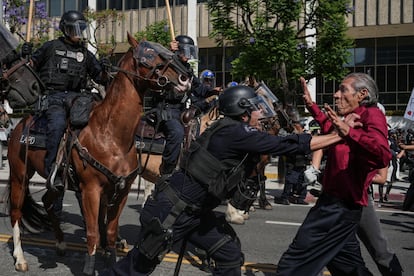

In 2023, the Pew Research Center estimated the total number of undocumented immigrants in the United States at 14 million. In 2024, Republicans campaigned on the promise to deport 20 million undocumented immigrants. By 2025, the figure — on which the U.S. government and international organizations still disagree — was already much higher in official discourse, with Donald Trump even stating that there were 25 million immigrants “who shouldn’t be here.” Amid so many conflicting and unverifiable figures, what is certain as we approach 2026 is that the current administration has made 1.6 million people undocumented this year alone, with a well-oiled anti-immigrant policy that has made those previously protected illegal, revoked the documents of those who had them, and is now deporting those it initially welcomed.
Certain phrases have become repetitive in the nation’s ears: restoring the “golden age” of the United States, undertaking the “largest deportation in history,” or expelling “the worst of the worst.” The Republican administration has operated according to this rhetoric. On the very day of his inauguration, Trump signed an executive order that eliminated the humanitarian parole program, which had allowed 530,000 migrants from Cuba, Haiti, Nicaragua, and Venezuela to enter the country. Overnight, people began receiving messages in their inboxes from the Department of Homeland Security (DHS) making it clear that they had no choice. “You must leave the United States now,” the messages read.
It was no longer a matter, as Republican politicians had promised, of expelling “criminals” or “illegals” from the country. Those concepts have broadened over time. Entire families who had arrived under the promise of two years of legal status, work permits, and other benefits were now being added to the list of unwanted people in the United States.
“People who came to the country with promises of legal protection, such as parole, Temporary Protected Status (TPS), or family reunification programs, were suddenly left in immigration limbo, exposed to detention and deportation,” María Asunción Bilbao, campaign coordinator for the American Friends Service Committee of Florida, told EL PAÍS. She insists that these policies have created “a breakdown of trust between the U.S. government and migrants.” “These people acted in good faith: they followed the rules, registered, provided their information, built a life, worked, and cared for their families. Others had been in the country for years, without formal status, but also without living in constant fear. Today, they all face uncertainty, anxiety, and family separation due to politically motivated decisions that dismantled existing protections,” she maintains.
According to FWD.us, an organization focused on criminal justice and immigration issues, by 2024 approximately 40% of the undocumented population in the United States had some form of temporary protection from deportation, and many had access to work permits. The reality today is very different.
In an effort to close any door to emigration, the government has worked on several fronts: while strengthening the Immigration and Customs Enforcement (ICE) agency to conduct raids and arrests across the country, the administration also sought mechanisms to halt legal immigration. The elimination of parole was followed by other policies within this expulsion machinery. By early February, the elimination of TPS was announced, which benefited 605,015 Venezuelans, 330,735 Haitians, 51,225 Hondurans, 8,105 Afghans, 7,160 Nepalese, 4,920 Cameroonians, 4,540 Ethiopians, 3,670 Myanma, 2,910 Nicaraguans, and 210 South Sudanese.
White House Press Secretary Karoline Leavitt said at a press conference in the fall that the Trump administration “has done more to limit migration, both illegal and legal, than any administration in history.” To that end, the government also deactivated entries through the CBP One app. Thousands of people began receiving frightening messages. “Do not attempt to remain in the United States: the federal government will find you,” read the emails sent to the 936,500 people who had entered the country through the digital immigration appointment platform.
“What seems to be clear from all these policies is that they are based on racism and xenophobia,” states Adelys Ferro, director of the Venezuelan American Caucus. “It is no coincidence that they target very poor countries, or countries with large Black or Hispanic populations. The real result is terror, insecurity, the loss of the promise of hope in this great country, the loss of job opportunities, and the uncertainty of not knowing what will happen.”
Some of the decisions the administration has made in recent months are justified by the idea of maintaining American national security. In November, following the deaths of two National Guard members after being shot by 29-year-old Afghan national Rahmanullah Lakanwal, further restrictions were imposed on migrants, including a freeze on applications for residency and citizenship. This month, the suspension of the diversity visa lottery was announced after a man who had benefited from the program in 2017 killed two people at Brown University.
The government has also boasted of revoking some 85,000 visas across all categories, including more than 8,000 student visas, and of canceling the Family Reunification Permit program, which affects more than 14,000 citizens of Colombia, Cuba, Ecuador, Guatemala, Haiti, Honduras, and El Salvador. As of January 14, 2026, these individuals who entered the country legally will also be included among the large group of undocumented immigrants targeted by the system.
Some migrants are pinning their hopes on the coming year, others on the midterm elections, while others are waiting for the end of the Trump administration. However, these policies are already taking a toll that, according to Bilbao, “is not only legal” but also “human and social.” “Looking ahead to 2026, it is very likely that we will see new attempts at restrictions and revocations, affecting more categories of migrants, including those who were historically considered ‘protected,’” Bilbao argues.
Sign up for our weekly newsletter to get more English-language news coverage from EL PAÍS USA Edition









































