The program that guarantees Denver migrants will end up on the ‘Success Wall’
The Workready initiative offers vocational training and English and cultural instruction so that newcomers to this American city can find decent work
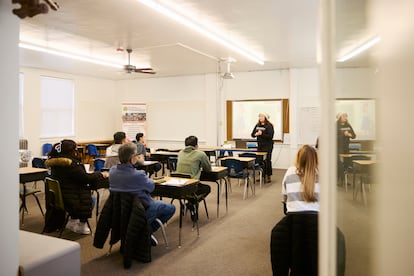

On the “Success Wall” at the Worker Center in Denver (Centro de los Trabajadores, CDLT) hang 154 photographs of people who have achieved part of their goal after risking leaving their countries and making the United States their home. Their “success” is having found decent work that allows them to support their families. They have achieved this through a program called WorkReady Denver, which trains newcomers to enter the job market with fair wages and connects them with companies that have openings. It is run by The Worker Center and funded by the city of Denver.
Theirs is an example of resilience in the face of the wave of xenophobia and racism fueled by the Trump administration. Denver faced a significant challenge when, in 2023 and 2024, buses of migrants arrived, sent by the Republican governor of Texas, Greg Abbott, who wanted to stem the massive influx of foreigners crossing the border. Denver, with a population of around 730,000, received approximately 44,000 migrants in a short period.
Yangcer Alejandro Soteldo was one of them. A 25-year-old Venezuelan, he arrived in the United States in April 2024. “I fled because I was in great danger,” he explains. The journey was not easy. He crossed seven countries on foot and survived the perilous Darién Gap. Upon arriving in the U.S., he surrendered to agents at the border and was put on a bus to Denver. There, he was put up in a hotel and later provided with another residence. He has been working for 10 months as an operator at a Ready Foods factory, a company that produces beans and sauces. Soteldo, a former soldier in Venezuela, trained in construction through the WorkReady program for six months, and it was through this that he landed the job he is now so grateful for. “The English classes helped me communicate, and they also showed me the tools and machines, which I had never seen in my country,” he says.
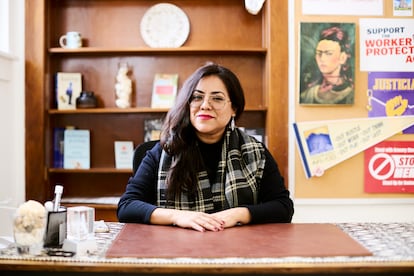
The program consists of three phases: in the first, basic skills are taught, such as computer skills, English, and labor rights; in the second, participants receive on-the-job training; and in the third, once they have been placed in a job, they receive follow-up support. “We also help them with cultural integration, with simple things like getting a driver’s license, opening a bank account, or maintaining personal space... For example, if it’s normal to say ‘mommy’ in their country, here that can get you into trouble,” explains Mayra Juárez-Denis, executive director of the CDLT.
The organization also provides migrants with courses in financial literacy, tax preparation, and labor rights to prevent, for example, wage theft — that is, not being paid for services rendered. Juárez-Denis recalls the case of a migrant whose employer failed to pay him and, when he complained, reported him to Immigration and Customs Enforcement (ICE), resulting in his deportation.
WorkReady is a continuation of another program that the CDLT had in place, which the Denver mayor’s office, led by Democrat Mike Johnston, saw as a solution for integrating undocumented migrants. While their asylum and work permit applications are being processed, they receive training to be prepared when they obtain legal status.

“We had to find a way for these people to support themselves financially,” says Joshua Posner, director of strategic initiatives for the city of Denver. The economic and logistical burden of thousands of migrants arriving was a challenge for the city. WorkReady was part of a broader program, the Denver Asylum Seeker Program (DASP), which began in the spring of 2014. Initially, migrants were housed in hotels, but this proved to be a temporary and prohibitively expensive solution. They switched from hotels to more affordable housing and began processing work permits. It was then that they adopted WorkReady, which received funding of $2.25 million.
The program began in June 2024 and was originally scheduled to run until June 2025, but it was extended until December. Some 315 people benefited from it, mostly Venezuelans between the ages of 18 and 40. Of those, 85% have found employment.
Engineers as workers
Many arrive with degrees from their home countries that are not valid in the United States. There are engineers and lawyers who take the construction course because they cannot practice their professions. The center provides trained workers to companies that need them and, in return, demands that their labor rights be respected. “We sit down with the companies to see what they are offering; we demand that they pay the minimum of $20 an hour and that it be full-time so that they can support their families,” says Juárez-Denis.
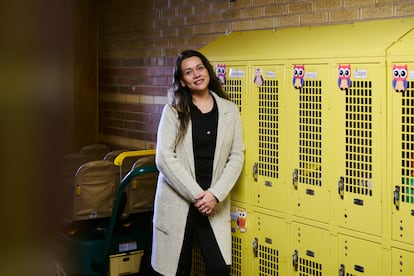
Ready Foods has already hired three workers recommended by the CDLT. “It helps us that they come already trained. They arrive knowing that we have to wear gloves, wash our hands, wear hairnets… The employees we hired through the program have integrated well,” says Rosío Herrera, the factory manager.
WorkReady offers training in three areas: construction, hospitality, and caregiving — sectors with high demand for workers that cannot be met by U.S. citizens. This need for personnel is what allowed Analis del Valle to find a job. For the past month, she has been attending Children Learning Adventure, a Spanish immersion preschool, every day. Most of the students are English-speaking, and the school offers 80% of its classes in Spanish. “The demand for jobs is very low. The people who came applying weren’t bilingual,” notes Cecilia Villalobos, the school’s director. “At CDLT, they give you references for people; they even tell me about what they’ve been through in their lives to be able to be here, and I try to help as much as I can.”
Del Valle, 35, is Venezuelan and arrived in the United States two years ago, accompanied by her son, now 12, her brother, and her sister-in-law. “Because we needed to work, we ended up in jobs that didn’t pay the legally established wage,” she says. “I’ve washed dishes, I’ve cleaned, I’ve done many things, but I always went to my course because I thought that was what would propel me to other opportunities.” In Venezuela, she earned a degree in comprehensive education and, with WorkReady’s training, has obtained an official teaching certificate that is valid throughout the country.
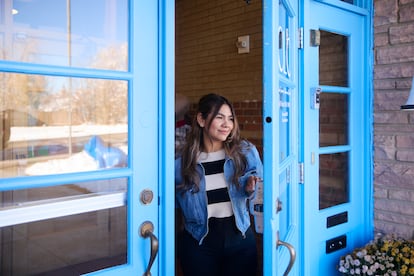
Despite being considered a success, the program is at risk of disappearing due to a lack of funding. The city’s finances were overwhelmed by the expenses of the migrant influx. “The Biden administration allowed us to obtain or apply for reimbursement funds from FEMA [the emergency management agency], but the Trump administration is not paying what was promised to us. We are currently in litigation with the federal government to recover that money,” Posner explains.
The budget cuts have already impacted the program. While the first phase benefited 315 people, the number of places has been reduced to 250 for the second. The mayor’s office has already agreed to renew WorkReady for the first six months of 2026, but the budget for this has been cut to $300,000. “The program is threatened due to the lack of funding,” Posner laments.
Sign up for our weekly newsletter to get more English-language news coverage from EL PAÍS USA Edition