
Family separations and racial profiling: Trump’s deportations tear apart the Maya community in Florida
In a Maya enclave in the southeast of the state, more than 100 people have been detained in recent months. A local organization is working to reunite the children left alone after their parents were deported
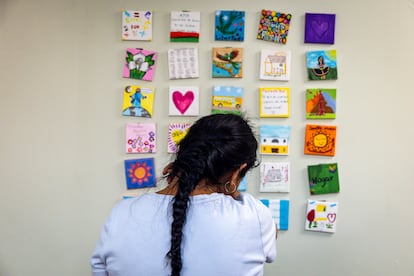

The seven siblings were anxiously waiting for their parents, who had left hours earlier to get them breakfast. That’s when the landlady knocked on the door of the family’s home in Palm Beach, north of Miami.
She confirmed their worst fears: the children’s mother and father had been detained and would be deported back to Guatemala. The seven children — aged between two and 12 — were abruptly left to fend for themselves.
The landlady — who had no ties to the children, six of whom had been born in the United States — took them in as her own. They stayed with her until a local organization intervened to coordinate the reunification of the family, which had been part of a community of Indigenous and Maya descendants in southeast Florida. These people have been hit particularly hard by the Trump administration’s crackdown on migrants.
The Guatemalan-Maya Center — based in Lake Worth Beach, Florida — serves as a hub for the Maya community. And, in recent months, it has become a bastion amid an unprecedented wave of raids and arrests in the region.
The organization learned about the case of the seven siblings and their parents — who were arrested on August 16 and deported to Guatemala a month later — after receiving a call in mid-September. The center gathered all the necessary documents for the children to travel to the Central American country, a place completely unknown to them, but where their parents now reside. The nonprofit also raised funds to cover their plane tickets. And two volunteers accompanied the children on their flight to Guatemala on Monday, September 29.
The work never ends. The center is in the process of coordinating the transfer of a 12-year-old girl, who was born in the U.S., to Guatemala, where her father lives. Her mother has been detained in a migrant detention facility for the past two months. Back in May, the nonprofit undertook the same process for another child, who was also born in the United States.
These cases are the tip of the iceberg of a deeper tragedy that has gripped families in this community for months. They have been marked by the pain and uncertainty of detentions, deportations and family separations.
The community is spread across Palm Beach County, located about 60 miles north of Miami. In the 1980s, Maya people arrived in the area. They were fleeing the genocide perpetrated by the dictatorship of General Efraín Ríos Montt in Guatemala, which left more than 200,000 dead, mostly Indigenous people and farm workers. Upon arriving in Florida, they found work as farmhands in the agricultural fields near Lake Okeechobee, in the middle of the state’s peninsula. In subsequent years, others followed, escaping poverty, drug trafficking and social conflict. They found work in nurseries, construction, and gardening. Settlements in Indiantown, Jupiter and Lake Worth Beach grew to form one of the most prominent Maya enclaves in the region, known for its remarkable cultural heritage.
There’s no exact figure for how many people currently belong to this community, but the Guatemalan-Maya Center estimates that 70% of the 16,000 people it serves each year are of Mayan descent. Many don’t speak English or Spanish. “Most of our families are Indigenous, short and very mixed-race,” notes Mariana Blanco, the center’s director. That’s the reason, she maintains, why many have ended up detained by immigration agents in recent months, even though they’re U.S. citizens. “It’s racial profiling,” the organizer points out.
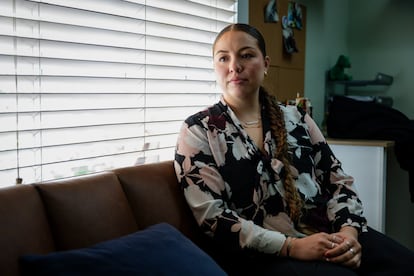
Since March, at least 118 community members have been arrested by immigration agents, according to the nonprofit’s database. Blanco asserts that the exact number is much higher, but they only keep a tally of arrests. “If they’ve already been deported, we don’t include them,” she explains. The database includes Kenny Laynez Ambrosio, an 18-year-old U.S. citizen who was detained during a traffic stop in May while going to work with others. The young man recorded his violent arrest, raising alarms about possible violations of constitutional rights and racial profiling of U.S. citizens.
Florida Governor Ron DeSantis, from the Republican Party, has sought to stand out in the Trump administration’s anti-immigrant crusade. He boasts about having promoted the largest number of agreements between local and federal authorities to increase the number of arrests. Immigration and Customs Enforcement (ICE) reported 400 immigrant arrests in Central Florida in just one week at the end of September.
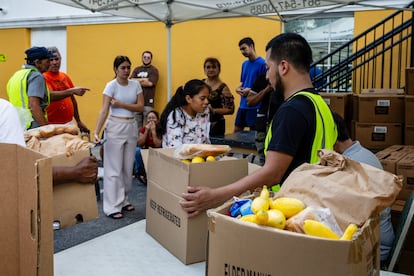
The Guatemalan-Maya Center ‘s database shows that most of the community members’ arrests have been during Florida Highway Patrol (FHP) and Border Patrol (CBP) operations. The list also indicates that many of those detained had valid work permits or driver’s licenses. “They still took them away,” Blanco sighs, during a conversation with EL PAÍS at the organization’s headquarters in Lake Worth Beach. On Friday, October 3, outside the two-story building, in the parking lot, organizers were distributing food boxes to affected families.
Olga — who volunteers in the food-distribution process — says that her husband was arrested last week and is being held at the infamous South Florida Detention Facility (nicknamed “Alligator Alcatraz”), located west of Miami. The man worked in landscaping and was the main provider for the family of four children, says the woman, who prefers not to give her last name. What she earns cleaning houses or doing other odd jobs isn’t enough to pay the family bills: $1,900 a month in rent, plus $400 for electricity, $700 for insurance on the three cars and $200 for the phone plans.
In Olga’s inner circle, nine people have been arrested in the last month, including cousins and nephews. Her worst fear is that she, too, will be arrested, and that her children will be left to fend for themselves. She has lived in the United States for 27 years, while her husband has lived there for 30 years.
“For us, Guatemala is no longer the same,” she says. “I’ve made my life here. What future will my children have if they leave?” she wonders, overcome with tears. “We’re not criminals — we work hard. If I don’t work, how will I pay the rent? I’m leaving [for work] today and I don’t know if I’ll come back.”
“Today is raid day”
Blanco receives a call on her cell phone shortly after noon. “Today is a raid day,” she says. Doña Anita — a neighbor — is calling her. She says that her husband was arrested this morning. The woman recounts that, a little over a year ago, her husband was stopped by the police: he didn’t have a driver’s license. But he took a court-ordered course, paid the fine and followed all the guidelines. She doesn’t understand why he’s now been arrested.
“That’s what they’ve been doing, Doña Anita,” Blanco tries to explain. “Are you with the kids?” The woman says that her eldest daughter was left alone in the house when her husband was arrested, but she’s now with her. She’s desperate, because she hasn’t heard from her husband in hours. She wants to go to the local jail to ask about him. “Doña Anita, you can’t go,” Blanco replies. She tells her that the man will probably be transferred to a detention center the next day.
“Can he read?” Blanco asks. “Yes,” Doña Anita confirms. Blanco tells her that, when her husband calls, she should ask him for the numbers and letters on the bracelet that the agents put on him, as well as the color of his uniform. This will help them find out where he is, because detainees often don’t appear in ICE databases.
On a typical day, the center‘s volunteers receive half-a-dozen calls about people who have been detained. On days when there are raids, they receive a dozen or more.
Before the second Trump administration began, the center educated immigrants about their legal rights and protections. But since the first raid took place in the area back in February, they realized that “the law doesn’t matter anymore.” Instead, they’ve focused on preparing people with reunification plans and everything related to family separations. “We knew that this was what was going to happen,” Blanco confirms.
During the child reunification process, the center prepares the paperwork, coordinates with the consulate and notifies the schools, “so that they know what’s happening.” Blanco explains that they also “talk to counselors” and try “to give the children enough time to complete their work.” Nationally, an estimated 5.6 million American children — 8% of all children in the country — are “at risk” because they live with people who have an irregular immigration status. This is according to a study published in April by the Brookings Institution.
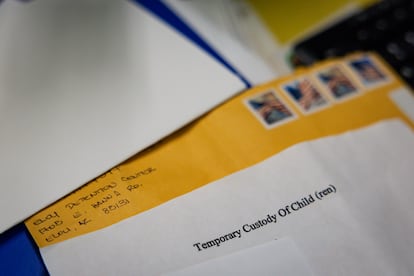
In the case of the seven siblings sent to Guatemala last week, their parents had prepared powers of attorney and the children’s passports were valid, which facilitated the process. The girl leaving this week, on the other hand, has no passport, no power of attorney and no other relatives, Blanco laments. “A neighbor — who has nothing to do with the girl, but felt sorry for her — brought her to the center,” where they found her accommodation and got her a travel permit, so that she could travel to Guatemala without a passport. The boy who left last May also didn’t have a passport, but was able to leave with the special permit.
The Florida Department of Children and Families hasn’t been involved in any of the cases that the center has handled. “It seems they don’t care,” Blanco notes. EL PAÍS contacted the state agency — as well as ICE, Homeland Security and the State Department — but received no response.
A few days before the seven siblings’ trip, the teachers held a party at school for them, so that they could say goodbye to their friends. Blanco took them to her office to fill out some paperwork. She recalls that the eldest — 12-years-old — couldn’t stop crying. He had just been accepted into the school band and had been given a trumpet, which he had to return.
“He was just so devastated, because he knew his life was going to change,” Blanco says. A group of volunteers bought him a trumpet and gave it to him before they left. “At the airport, we hugged them and told them, ‘You’re going to be okay, you’re going to be okay,’ but between us, we knew it was going to be a shock for them to arrive there,” to a country that had never been their own.
Translated by Avik Jain Chatlani.
Sign up for our weekly newsletter to get more English-language news coverage from EL PAÍS USA Edition









































