
Coin bearing Donald Trump’s image runs into an 1866 law
Controversy is growing in the US over whether it is legal for living persons to appear on circulating dollars
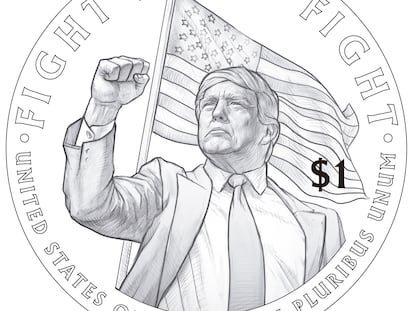

The cult of personality surrounding Donald Trump in some conservative circles in the United States is generating controversy. Several allies have presented some extravagant bills, such as carving Trump’s face into Mount Rushmore, making his birthday a federal holiday, or renaming Dulles International Airport, a few miles from Washington, after him. The proposal that seems to be taken most seriously, however, is the Treasury Department’s plan to mint a coin bearing the president’s image to commemorate the 250th anniversary of the country’s independence, which will be celebrated next year. But their intentions have been thwarted by a law passed in 1866, which prohibits living persons from appearing on coins.
According to The New York Times, coins must bear “designs emblematic of the United States semiquincentennial [...] The 1866 law enshrined a tradition that individuals could appear on U.S. currency only posthumously to avoid the appearance that America was a monarchy.”
In 2020, Congress passed bipartisan legislation, signed by Trump during his first term, authorizing the Secretary of the Treasury to mint one-dollar coins during the commemoration of the 250th anniversary of U.S. independence.
But that law, known as the Circulating Collectible Coin Redesign Act of 2020, also states that “No head and shoulders portrait or bust of any person, living or dead, and no portrait of a living person may be included in the design on the reverse of specified coins”
“On this momentous anniversary, there is no profile more emblematic for the front of this coin than that of our serving President, Donald J. Trump,” stated a post on the official Treasury Department account on Monday.
U.S. Treasurer Brandon Beach announced on social media a few days ago that he will share more information soon, “once the obstructionist shutdown of the United States government is over,” and shared the first drafts of the coin through a post on X.
The coin, which appears to be silver, shows an effigy of Trump under the word “Liberty,” in the style of Roman emperors. And below it, the phrase: “In God We Trust,” the official motto of the United States. It was approved by Congress in 1956 and has been present on all coins minted by the country since the late 1950s.
The obverse of the coin depicts Trump with his fist raised behind a U.S. flag. The word “fight” is repeated three times at the top. Below, the words “United States” appear alongside E pluribus unum, another U.S. motto meaning “out of many, one.” According to the Smithsonian, this motto was suggested by a committee on July 4, 1776, in the Declaration of Independence.
The cultural institution explains that it refers to the colonies’ struggle to fight together for independence from Great Britain. “Out of 13 colonies came one nation. Out of our 50 states comes one nation. The motto describes our history and our belief that we are a nation that should work together as one!” explains the Smithsonian.
The arrival on the agenda of such a seemingly trivial debate, linked to symbolism and political propaganda, but far removed from the problems that concern ordinary people, comes at a time of turmoil for the country, amid a government shutdown. 750,000 federal workers are suspended from employment and pay because Congress has not granted the necessary funds to operate normally due to the lack of agreement between Democrats and Republicans, which is causing, among many other issues, delays in everyday procedures such as student loan payments, affecting more than a million people.
Sign up for our weekly newsletter to get more English-language news coverage from EL PAÍS USA Edition









































