
A night at Maison Colbert: How the Paris residence of Simone de Beauvoir became a luxury hotel
The French writer and philosopher wrote ‘The Second Sex’, a masterpiece of contemporary feminism, on the top floor of this Neoclassical 17th-century building

A soft scent of cherry blossom envelops Maison Colbert. Between that floral sweetness and the garden that surrounds its front entrance, which is flanked by tables perfect for afternoon tea, the 17th-century residence seems to live in a perpetual spring. That’s even the case when there is a torrential rain outside that soaks the golden plaque that commemorates its most illustrious guest, Simone de Beauvoir. More than seven decades have passed since the Parisian author and philosopher lived in this Neoclassical house in the French capital, which has since been converted into luxury accommodation by the Meliá Collection hotel chain.
The presence of Madame Beauvoir can still be felt between its walls, just like her legacy and the ideas that populate her 1949 book The Second Sex (1949). Those partitions are now painted in pastel tones and turquoise, and enclose the modern furniture and mid-century notes of the hotel’s rooms. It was here, on the top floor of the building, now home to the hotel’s most grand suite, where the famed writer conceived of the work that would become the culminating point of contemporary feminism, and generated as much upheaval and controversy as it did sales, with conceptual sentences like: “One is not born, but rather becomes, a woman.” The era’s existentialism, the maturity of a life entering its forties, and the feminist activism running through her veins fueled the text of nearly one thousand pages, which bore the mark of the Gallimard publishing house on its first edition.
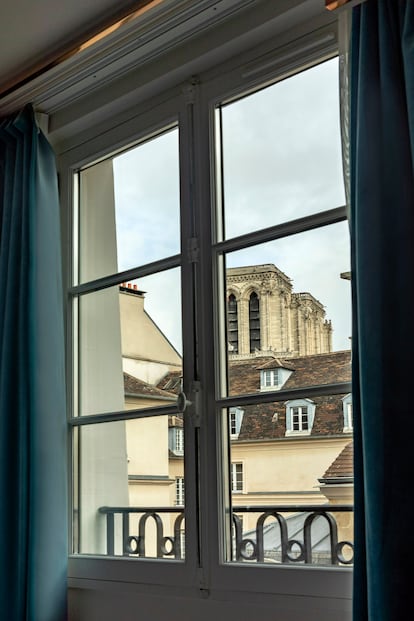
The Second Sex was also a hopeful reflection of a France that had been liberated after World War II, and which de Beauvoir observed from her apartment at 7 Rue de l’Hôtel Colbert in the fifth arrondissement, in the heart of the Latin Quarter. This quiet street, which leads to the Quai de Montebello, the capital’s famous promenade that runs along the Left Bank of the Seine, offers privileged views of its most famous cathedral, Notre Dame, which reopened its doors last December after suffering fire damage in 2019. The area owes its name to the Latin-speaking students and academics of the Sorbonne during the Middle Ages, and which in the mid-20th century continued as a hub for knowledge and creativity in the city.
The atmosphere of this thousand-year-old neighborhood that inspired Beauvoir in her feminist struggle has ignited a multitude of other writers and poets, many of whom have taken Parisian refuge in the Shakespeare and Company bookstore (Rue de la Bûcherie 37). Since its opening in 1951, the historic store, which occupies a former 18th-century monastery, has been a pilgrimage site for literary greats like Ernest Hemingway and James Joyce, in addition to serving as an intellectual set for numerous films, among them the second installment of Richard Linklater’s Before saga, Before Sunset (2004) and the French bohemian fantasy that Woody Allen created in Midnight in Paris (2011).
Homage to the master of lights
Though it carries the last name of Louis XIV’s finance minister, Jean Baptiste Colbert, there is no evidence that the economist was ever the owner of the noble residence, which was built in 1637. Initially conceived as un hôtel particulier, Maison Colbert still features original plaster flower garlands that decorate the windows of the first of its four floors. Its imposing Neoclassical façade was home to the Turgenev Russian Library in 1938, until the collections of the most European of the great Russian writers were confiscated during World War II.
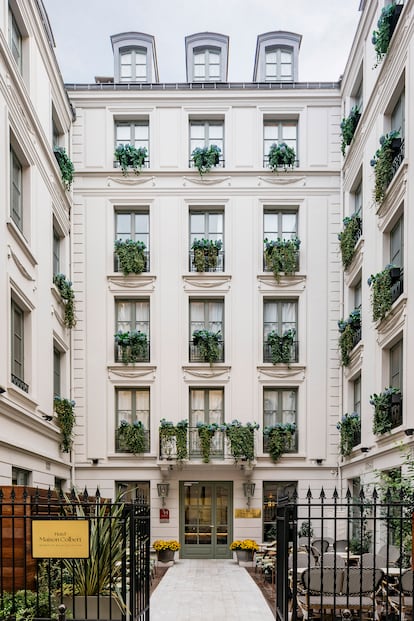
Nearly two decades afterwards, its roofs and façade were recognized as part of the city’s historical heritage, a permanent assignation that architects Álvaro Sans and his daughter Adriana Sans highlighted in their modernization of its facilities. The rest of Latin Quarter, which is also known for having been the haunt of the Impressionist painters, including Renoir, served as major inspiration for the renovation of the building, which takes as its theme the work of Spanish Impressionist painter Joaquín Sorolla. “We wanted to give the hotel a Spanish feel, but linked to the history of Paris,” explains Álvaro Sans. “The idea came from a magnificent exhibition of Sorolla’s work at the Reina Sofía in Madrid. We immediately felt that the light in the paintings would help us bring color and joy to the interiors through the eyes of a great Spanish painter, and link them to the history of fashion in the French capital.”
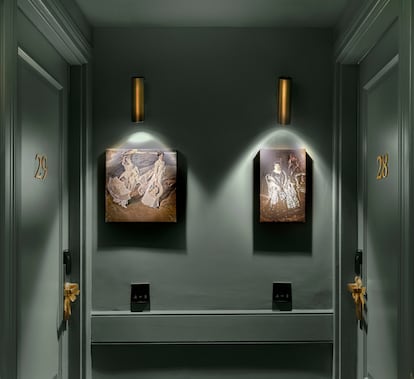
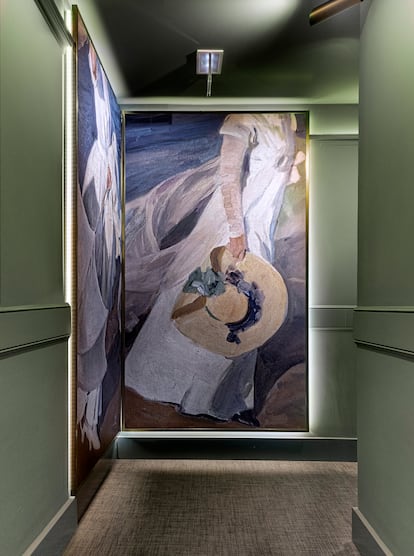
Seven colors characteristic of the painter’s work inspired the palette of the rooms, the hallways and the lobby, including the coral and sky blue that suffused Sorolla’s famous scenes of the Mediterranean coast. Reproductions of his works from the start of the 20th century, like Under the awning on the beach at Zarauz, which is dominated by sandy shades; and Women walking on the beach, which reveals the era’s bohemian influence via the figures’ dresses, along with other family scenes in Biarritz and Valencia, occupy nearly 50 locations in the rooms and common areas of the hotel, serving as connection to that art de vivre so emblematic of Paris.
The grand María Sorolla suite, named in tribute to the painter’s mother, includes in its 580 square feet the room where Simone de Beauvoir also wrote lengthy novel The Mandarins(1954), exploring the new role of that group of French intellectuals at the end of World War II. Clotilde García del Castillo, Sorolla’s muse and spouse who the artist painted until the end of his life (many of his drawings of her dressed in haute couture hang throughout the building), is the other female protagonist of the Maison. Its very reception area welcomes future guests with a photograph of the elegant bourgeois woman, a key figure in Sorolla’s international reputation even after his death in 1923, alongside her husband.
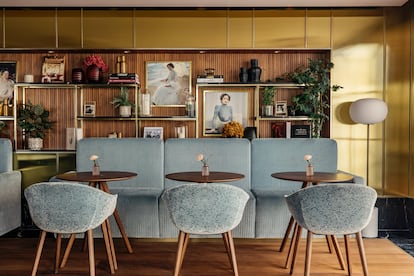
It is no coincidence that this muse’s first name is also that of the hotel’s restaurant, which is run by Nina Métayer, recognized as the world’s best pastry chef in 2024 by The World’s 50 Best Restaurant awards. With a menu that pays tribute to the best of French pastries to enjoy at an afternoon tea or Sunday brunch, Café Clotilde is the perfect place to end a day full of the external experiences offered by the hotel, such as a private cruise on the Seine, a wine tasting in the former 17th-century wine cellar now occupied the restaurant Sola (Rue de l’Hôtel Colbert 12), discovering the great monuments of the city like Grand Palais, the Eiffel Tower and Place Vendôme inside a vintage car, and a tour of artisanal workshops hidden away in the historic Montmartre district. This is the Paris that, century after century, continues to inspire an infinite number of artists.
Sign up for our weekly newsletter to get more English-language news coverage from EL PAÍS USA Edition









































