
Katarzyna Nowaczyk-Basińska, researcher: ‘It will be normal for many people to want to chat with their deceased loved ones’
The professor at the University of Cambridge studies how the consequences of digital immortality will affect us. Technology already makes it possible to create avatars of our ancestors to converse with them, as if they were still alive
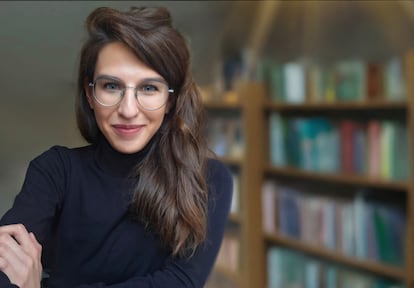

For almost a decade, researcher Katarzyna Nowaczyk-Basińska has been analyzing what death and mourning will be like in a digital world.
There are already companies — especially in the U.S. and China — that offer services which turn our ancestors into avatars, with whom we can chat. Some deceased individuals have already “spoken” at their own funerals, or at the trials of their killers.
Every culture has its own relationship with the afterlife. Each family experiences the loss of their loved ones in its own way. But artificial intelligence (AI) will allow for the creation of a new relationship with some deceased individuals that will depend on new business, ethical and legal decisions. It’s an issue — as with most innovations — that appears before societies and governments get to reflect on it.
For some time now, Nowaczyk-Basińska, 36, has been observing what might happen from her position at the Leverhulme Centre for the Future of Intelligence at the University of Cambridge. Born in Kościan, Poland, she’s been leading the project Imaginaries of Immortality in the Age of AI since 2024. Her latest research is on the various chatbots created by the “digital afterlife industry,” with the use of generative AI.
Question. Will we still go visit cemeteries in 2030?
Answer. That’s going to change. When we visit a cemetery, it’s usually not that often… and when you have your dead loved ones in your pockets — in your phone — you can easily access this person online almost 24/7, which means that it will definitely change the way we communicate with the dead and the way we spend time with them.
I think that it will increase the intensity of these relations, because when our dead loved ones are accessible through these platforms — when these conversations can be immersive and engaging for us, when these technologies are designed to engage us as users — I think it might be tempting for us to use these technologies.
Maybe, at some point, visiting cemeteries will be an old-fashioned practice, because it’s not more interactive [than using technology]. It’s not more engaging. It won’t be like having your loved one on a video call or in an app, with whom you can talk whenever you want.
Q. Will the technology we’re most likely to use be an AI chatbot, generated with messages from our deceased relative?
A. Yes. Those grief bots or post-mortem avatars are the most likely and also the most controversial application: a technology created from our digital footprint that represents us or our loved ones after death.
This technology — and this particular application of AI in this so-called “digital afterlife industry” — can profoundly change the ways in which we engage with deceased loved ones and change social-cultural norms and practices.
Q. Is this already available in certain countries?
A. Yes, the only problem at the moment is language, because most of these companies originate in the United States and China. What you need to do is to find a company [that provides this service] and then grant them access to your personal data, or the data of your deceased loved one. This company will offer you different models: it can be a subscription model or another kind of payment plan to provide you with the virtual representation of that person.
Q. Do we know the consequences of using this type of avatar?
A. Not yet. It’s such a new phenomenon that we don’t yet have clear research or results. There are teams in different parts of the world trying to conduct studies to closely observe how people use it and what effect it has on their well-being or grieving process… but, for now, there’s no solid evidence or data on the real implications of using this technology.
Q. But will we really use this technology?
A. I think it will be quite popular. I’m not sure if it’ll be mainstream, but I think that, at some point, it will be so accessible that many people will be really seriously considering having these technologies.
Five years ago, when I discussed it with people or read articles in the media, the most common expression I heard was “how creepy.” Now, it’s not perceived that way as much. It’s not that it isn’t seen as murky, but it’s changed: now, people are more likely to say it’s ethically complicated, or that it poses dilemmas. But they’re no longer just “freaked out.”
Q. There’s been a recent leap forward.
A. That’s the main interest of the commercial companies at the moment. When I started in [this field] in 2015 or 2016, private companies and CEOs were talking about this technology as something that would revolutionize the whole ecosystem. But, at the time, it was more like selling a promise.
Because of the development of technology and the development of language models, especially ChatGPT, these promises are now real. There are real products on the market that offer this type of technology. It’s no longer a promise, but a real, growing market. I use the term “digital afterlife industry,” which already functions as its own sector, dedicated to how we manage death and everything around it.
Q. This will change what it means to die.
A. Yes, absolutely. It will definitely change the way in which we perceive, experience and understand grief, death and dying. Because these technologies are trying to offer us a completely new experience, where saying goodbye isn’t finite. It’s more like, “see you later.” It’s like a change of status: you’re no longer “in the flesh,” but you can become immortal. I’m only referring to what these companies are trying to convince us of.
Q. You’ll come back from your husband’s funeral and ask him, “What did you think? Did you like the music and what your brother-in-law said?”
A. Exactly. It already happens. Someone created an avatar of their grandfather and right after the funeral asked him, “How are you?” It’s very thought-provoking.
Q. What’s the main concern?
A. I have a long list of worries. The first is that this entire industry is run by private companies: the form it takes depends on what its founders and the people who run them decide, almost arbitrarily. This should change: we should open the door to more stakeholders and make room for professionals who truly have experience in death-related issues. That would be a first step: professionalizing the “digital afterlife industry.”
Another concern is the lack of legal regulation. Today, there are no laws that dictate how to manage this industry. Regulations from other areas can be applied, but there’s no specific legal framework that tells us how to organize this. And then, there’s the whole ethical issue. For example, consent: who decides whether your personal data can be used? Who has the final say in creating someone’s posthumous avatar?
Q. We might end up seeing children asking their parents’ avatars about their will, or who they loved most.
A. That’s why, in my last paper, I propose something that we call the “principle of mutual consent.” Because, when we think about digital immortality, we usually keep in mind only the person who wants to create a digital representation of themselves: the data donor. But you mention a situation where there’s a family and there are siblings. And maybe there’s a situation in which one person is very happy with — and open to using — this technology… but for their brother or sister, this may be an emotional burden. Both sides should have their rights or needs equally respected.
Q. In that article, you talk about the role of the digital embalmer.
A. It’s a fancy name for someone who works with digital remains. It’s a very new concept. I discovered this kind of profession in the U.S. — they’re starting to experiment with it. But there’s a huge debate surrounding this: should we heal or modify the past, adjusting that information to our expectations, or based on how we want to remember that person? Is it worth retouching the past? These are very complicated ethical questions.
Q. All of this would also have some benefits.
A. It’s an opportunity to build new ways of intergenerational communication. We can treat it more like an interactive archive. And for me, that’s less ethically concerning than using this during the grieving process, because this is absolutely uncharted territory. We don’t know how these technologies will influence people who are grieving. That’s why I’m so cautious about the consequences.
Q. This technology can also make us more aware of our digital lives because — depending on what we say — that’s how we might appear to our great-grandchildren.
A. It might change the way we tell our life stories. It also shows how limited all of this will be, because we’re going to be curators of information so that we end up with a good product, something we want to show future generations… even though, sometimes, it may be very far removed from who we really were.
Sign up for our weekly newsletter to get more English-language news coverage from EL PAÍS USA Edition









































