The surreal journey of James Nnaji, the Barcelona youth player selected in the NBA Draft who ended up in the NCAA
The 21-year-old Nigerian center, who never made his debut in the professional league, signs with the Baylor Bears in an unprecedented case
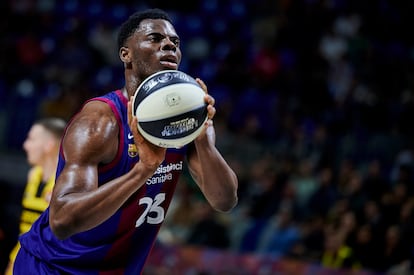

The flood of money that has inundated the NCAA, the U.S. college basketball league, has transformed the youth competition into a major player in the professional sports landscape worldwide. And the boundaries that existed until very recently are now more blurred than ever. A 21-year-old Nigerian, James Nnaji, a basketball player who came up through the Barcelona youth system and was selected 31st overall in the 2023 NBA Draft by the Detroit Pistons, is now at the center of an unprecedented move that has once again opened a Pandora’s box in college basketball.
Baylor University, one of the most successful programs in recent years, has just added the 7-foot center mid-season. It will be the first time a professional player drafted by an NBA franchise, where he has yet to play, has been part of a college roster, a decision that has sparked controversy in a league that until recently was considered strictly amateur.
Nnaji landed on Sunday in Waco, a city of 150,000 inhabitants in Texas and home to the Baylor Bears, the 2021 NCAA champions. On Monday, his new team played its final game before the start of the Big 12, the tournament that should open the door to March Madness. His coach expects the Nigerian to be ready to make his debut on January 3, when the crucial part of the season begins and where the center should bolster the team’s eight-man rotation.
“With three of our guys injured, we knew we needed to add someone this semester. Every coach tries to add the best player available to their team, someone who fits in. James is an exceptional young man, who grew up in the church, a kid with tremendous potential who was drafted high in the NBA Draft. Now we just have to see if his game can live up to expectations,” said Scott Drew, the team’s coach.
“We don’t make the rules”
The coach appreciated Nnaji’s physicality and intimidating presence under the hoop, attributes he can bring to a team that has been lacking a strong inside presence but still boasts a 9-2 record this season. When asked about the controversy surrounding the signing of a full-fledged professional, Drew deflected blame, placing the responsibility on the NCAA’s governing body. “Until we get to collective bargaining, I don’t think we can come up with rules that are agreeable or enforceable. Until that, I think all of us have got to be ready to adjust and adapt to what’s out there. Early on, when it first came out with G League players, I wasn’t in favor of that either. But again, we don’t make the rules and as we find out about things, we’re always going to adapt to put our program in the best position to be successful, because that’s what we get paid to do,” the coach stated.
Legendary coaches like Tom Izzo, who has led Michigan State since 1995, have voiced their outrage at a situation that seems to be accelerating since the start of this season. The first contract between a professional player in the United States and the NCAA came in September, when the association allowed Thierry Darlan, a Central African with two years of experience in the G-League, the NBA’s second division, to enroll at Santa Clara University at the age of 21. London Johnson, a Jamaican of the same age with similar credentials, followed in October.
The NCAA has granted Nnaji a four-year leave of absence to participate in its collegiate competitions. “Each case is evaluated and decided individually based on the facts presented. Universities continue to recruit individuals with professional experience, which is permitted by the regulations under certain parameters,” the organization stated, adding that it intends to clarify its rules on these cases in the coming months.
Debut with Barça in 2021
Nnaji definitively left Barça in August after joining the club at 16 from Hungary. In 2021, he made his EuroLeague debut with the first team under Saras Jasikevicius, and the following year signed a contract with the Catalan club until 2027. Shortly after, he attempted to make the jump to the NBA without success. After being drafted by the Detroit Pistons, he was immediately traded to the Charlotte Hornets, who gave him a trial in the Summer League against players like Victor Wembanyama, but did not guarantee him a contract in the NBA.
After failing to achieve his American dream, which he is now trying to reignite, Nnaji returned to the Palau Blaugrana, where he showed glimpses of his potential, but never managed to secure significant playing time or achieve consistency. Last season, the young center played on loan at Bàsquet Girona, averaging 5.3 points, 4.1 rebounds, and 16 minutes per game in 14 appearances in the ACB. In March, his loan ended prematurely, and he moved to Merkezefendi, third from bottom in the Turkish League. During this period, his NBA rights were acquired by the New York Knicks, who had him play in the Summer League in Las Vegas again in July, but they still couldn’t find a place for him on the roster that had just won the NBA Cup.
Although it’s a unique case in Spain and the United States, Nnaji’s surreal journey underscores once again how the possibility of receiving image rights contracts is transforming a theoretically amateur league like the NCAA, where for over a century players had never earned a single dollar. All of that changed with a 2021 Supreme Court ruling that opened the floodgates and has caused a seismic shift with implications for youth basketball worldwide. Economically, European youth academies find it very difficult to compete with the sums and additional benefits — such as scholarships — available across the Atlantic. This Christmas, 20-year-old Lucas Langarita, a youth player for Casademont Zaragoza, also headed to the University of Utah after failing to find quality playing time in the ACB and terminating his contract with the Aragonese team.
Sign up for our weekly newsletter to get more English-language news coverage from EL PAÍS USA Edition