
From hoops to hooks: Michael Jordan triumphs in the most demanding sport fishing tournament in the world, complete with lie detector
The NBA legend has been participating in the White Marlin Open in Maryland for years. In the most recent edition, his team took home second prize: $400,000 for catching a 32-kilogram fish
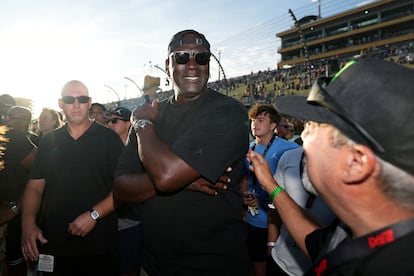

Anyone who thought that Michael Jordan had retired from competition was, in part, mistaken. The NBA legend and one of the wealthiest people in the world — he has a fortune of $3.5 billion according to a recent Forbes list — has stopped competing on the court, but he’s still doing it on the high seas. Specifically, the former basketball player has for years been participating in the White Marlin Open deep-sea fishing tournament, which has been held for more than half a century in Ocean City, Maryland. In the latest edition of the event, scheduled for August 4-8 but extended to last weekend due to poor weather conditions, Jordan and his team took home the second prize: $400,000 for catching a 32-kilo (70-pound) fish on the sixth day of the competition.
A video posted on the White Marlin Open’s Instagram account shows Jordan and the rest of the crew of the Catch 23 (as his boat is called) being cheered to the rhythm of the legendary Sirius theme song — used to introduce the Chicago Bulls during Jordan’s time in the NBA — upon their return to port from the high seas, to face the scales that decide the winners after weighing their catches. The one that gave Jordan and his team second place was a white marlin caught by a fisherman on his team, known as Trey “Cricket” McMillan.
Jordan’s latest victory may seem like nothing compared to his basketball slate (he was a six-time NBA champion), but a closer look at the rules and the complexity of the Ocean City fishing competition makes it clear that prizes aren’t just a free lunch here. In the so-called “White Marlin Capital of the World,” as the city was christened in 1939 by President Franklin D. Roosevelt after he spent a day fishing there, they take the sport very seriously, trying to keep it as democratic as possible: not only can billionaire stars like Jordan participate in the White Marlin Open, but a system ensures that anyone can: each boat participates according to its budget, skill level, and target species (in addition to white marlin, blue marlin, tuna, and swordfish are also available). Furthermore, boat registrations range from $1,700 to compete for prizes of up to $50,000, to over $100,000 to participate at other levels, with the option to win over $10 million.
There are also no age restrictions, meaning it’s not just the most experienced deep-sea anglers who have a chance at the jackpot. Take the 2024 summer individual top prize winner, who earned $1.6 million for his first white marlin catch, a 90-pound specimen. As Madelyne, daughter of founder Jim Motsko and current tournament director, explained to The Times: “My dad always says fishing is the great equalizer. The fish don’t care if you’re a man or a woman. The fish don’t care how much money you have.”
But if there’s one thing that distinguishes the so-called “Super Bowl of Fishing” (specifically, due to its financial implications), it is its scrupulous method for detecting potential cheating in the competition. As the director explains, “20 years ago, we introduced a polygraph.” Yes, a lie detector is the best way the organizers of the White Marlin Open have found to ensure that crew members have complied with the rules on the high seas. In a tournament where up to 200 boats compete, 60 miles from the coast, it’s impossible to stay on top of them: “It got to the point where, with the number of boats, it became difficult to control. So we thought it was a way to ensure a basic level of integrity,” Madelyne tells the British newspaper. The polygraph test, which is conducted by “professionals, including former police officers,” has led to tense moments, including legal battles, such as the time in 2016 when a participant named Phil Heasley was denied the $2.8 million he would have been entitled to for his 75-pound white marlin because he failed the detector. A district court judge intervened in that dispute, ruling in favor of the tournament in a hearing in Worcester County, recognizing the organizers’ right to use a polygraph and also noting the likelihood that Heasley’s boat had started fishing before the official start time. Because, in Ocean City, there is also a schedule that must be strictly followed.
Other White Marlin Open rules
- No boat may start fishing before 8:00 a.m., and any fish taken to the scale — which will have its mouth opened to check for anything that could increase its weight — must be on the hook by 3:30 p.m. The scale closes at 9:15 p.m. to allow time for boats to make the return trip from the high seas.
- No touching: If someone touches the angler during their physical effort to catch the fish — except to prevent them from falling — the catch will no longer be considered valid.
- A boat is only allowed to fish on three of the five days of the competition, which this year was extended to seven due to a storm.
- Most of the fish caught during the competition are released back into the sea. The winning specimens are usually cut into pieces and distributed among various local shelters as food (white marlin has a texture similar to swordfish and a more intense flavor).
In the most recent edition of the tournament, the basketball legend and his team — who last March achieved third place in the Jimmy Johnson Fishing Week FL (JJFishWeek), a prestigious sport fishing tournament held in Florida — were only overshadowed by angler Dan Gough, who competed with the boat Billfisher and took home a first prize estimated at $4.27 million for a 72-pound marlin (about 33 kilos).
Sign up for our weekly newsletter to get more English-language news coverage from EL PAÍS USA Edition









































