
Fugitive Natalio Grueso: In hiding with a glass of wine on an island in the Algarve
The former director of the Teatro Español was admiring the catch of the day and sipping wine in a café in Culatra when the police closed in
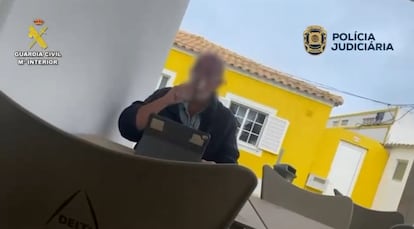

One of the first jobs of officers tasked with locating fugitives is to study their life and work. In author Natalio Grueso’s case, there were plenty of clues. Just a week ago, the Civil Guard found him in the Portuguese Algarve, a region that appeared in his books. There, he was leading what we think of as a writer’s life — taking notes while drinking white wine. Grueso, 55, went missing two years and four months ago, around the time he was expected to start an eight-year prison sentence for the embezzlement of public funds while managing the Niemeyer Center of Asturias between 2006 and 2011. It was a corruption scandal that stained his reputation and drove him underground.
Officers of the elite UCO Fugitives Team hunted Grueso down on the small island of Culatra, located off the coast of Faro and Olhão in the south of Portugal, on the Formosa estuary. The spot, which has no more than 750 inhabitants in winter, could not be more idyllic while also being the perfect hideout as it is rarely patrolled by police. Grueso was seen talking to the owner of the café, who showed him the catch of the day, displayed on the counter, before accompanying him on a walk through the dusty traffic-free streets.

The Spanish officers had warned their Portuguese colleagues that they were looking for Grueso, who could count figures such as Woody Allen and Kevin Spacey among his contacts. The Spaniards were given permission to locate Grueso but not to arrest him. They had to behave like tourists. They had coffee in the bar where Grueso was the only other customer.
“They could not follow him after that as they would have given themselves away, since there were very few people about in the town,” explains the head of the elite team. Grueso’s behavior and his bond with the owner of the café made the officers think that their quarry lived or spent a lot of time in the town. The owner of one of the island’s restaurants confirmed to EL PAÍS that Grueso was his neighbor, though they had hardly spoken, their relationship being limited to polite greetings.
Once Grueso’s whereabouts were established, the Spanish officers took the ferry that connects the island to the town of Olhão. There, while notifying their Portuguese colleagues and planning the arrest, they realized that Grueso had been on the same ferry with a shopping trolley and probably intended shopping in Olhão.

When the Portuguese police stopped Grueso in Olhão, he denied his identity and carried no ID, though he probably realized when he heard Spanish spoken that he was running out of luck. Pretending to be someone else was no longer going to work for the author who had invented such characters as Bruno Labastide, a globetrotter in his first novel La Soledad (or, Loneliness, 2014), and whose adventures he continued to recount in La República de los Ladrones (or, The Republic of Thieves, 2017), traveling through the ports of Seville, Tortuga and Hong Kong in search of lost Spanish gold, work critically acclaimed by authors such as Arturo Pérez Reverte, Fernando Sánchez Dragó, and the journalist Luis María Anson.
Francisco Miranda, Grueso’s lawyer, says that his client has agreed to turn himself over to the Spanish authorities, which is scheduled to happen on December 15, an ignominious end to a career that, besides writing, has revolved around cultural management and international relations. Grueso was director of the Teatro Español and Madrid’s director of Performing Arts from 2012 to 2014. He is also the author of a dozen titles, including the biography Woody Allen, The Last Genius, which paid tribute to the filmmaker, whose friendship he boasted about as Allen turned 80. Grueso is also known for his stage adaptations of Mario Vargas Llosa’s La Fiesta del Chivo and Arthur Miller’s Death of a Salesman. Some of his adaptations have continued to be performed despite his fugutive status, suggesting this has been a source of income while in hiding.
So how did the Spanish team find Grueso? The answer is linked to another maxim espoused by officers specialized in fugitives: do not lose sight of your surroundings. When they were asked to look for Grueso, they observed his friends and family, but noticed nothing suspicious. “He had apparently cut ties,” said one officer. However, over time they detected that some relatives were traveling to Portugal via Huelva.
In October, the officers noted that these relatives left their car parked in Olhão and did not return to pick it up for several days. Later, they established that these relatives had passed through the passenger turnstiles at the dock and that Grueso could be on the island. Once the officers got off the ferry, they didn’t have to look far: they found their target in the first café they encountered.
Sign up for our weekly newsletter to get more English-language news coverage from EL PAÍS USA Edition









































