
Why the internet is obsessed with handsome priests: ‘Nothing challenges their authority more than showing them in their entirety’
After Rosalía’s ‘nun mania,’ fascination with sexy men of the cloth is back. From real spiritual leaders on TikTok to actors like Josh O’Connor, the clergy have become an unhealthy obsession on social media
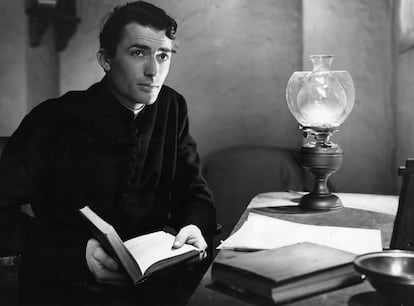

The film Wake Up Dead Man: A Knives Out Mystery, the third installment in the saga, released on November 28 in theaters and on Netflix on December 12, holds a mystery far greater than the usual murders: where does the current fascination with priests come from? Since its announcement, social media has been ablaze with the news that British actor Josh O’Connor would be playing a charismatic priest suspected of murder.
This archetype has become known as the “hot priest,” thanks to Andrew Scott: six years ago, he played a priest who was the love interest in Fleabag. Since then, the internet has been obsessed with hot priests. And not just in fiction.
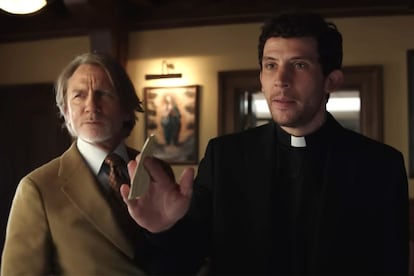
Before the “nun mania” unleashed by Rosalía in Lux, there was already a craze for priests. “Priest mania?” For years, the social media accounts of young, attractive priests have garnered thousands of followers. The most recent case is that of Father Jordan, a British priest who had to disable comments on his videos due to the millions of messages he received this summer praising his “hot priest” physique.
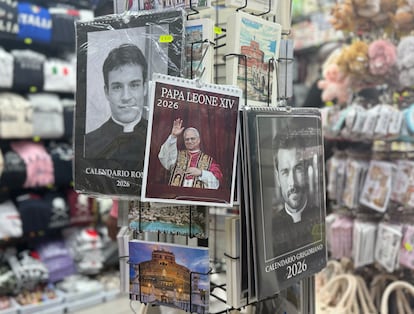
During the meeting of Catholic influencers convened last July by Pope Leo XIV, the term “hot priest” was also trending on social media. But the craze dates back even further. At least 21 years now, which is how long Piero Patzi’s “Roman Calendar,” more popularly known as the calendar of handsome priests, has been in print.
The 2026 edition has just been released with almost the same photos as always, and although most of the priests weren’t real, it has become an emblem of the city. The key is fantasy — which is why it matters little that they are models — and the best place to study fantasy is in film.
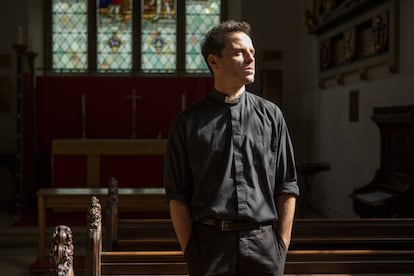
As early as 1944, the conflict of a man torn between romance and vocation was explored with the iconic Gregory Peck in the movie The Keys of the Kingdom. Alfred Hitchcock, true to his recurring theme of religious trauma, also took up the same conflict and raised the stakes with the slicked-back Montgomery Clift in one of his thrillers, I Confess (1953).
Since then, the secrecy of confession and celibacy, combined with the undeniable magnetism of the actors playing the roles, have become a recurring narrative drive across all kinds of genres. Some characters as charismatic figures within a police investigation: Christopher Reeve in Monsignor (1982), Antonio Banderas in The Body (2001), Ewan McGregor in Angels & Demons (2009) or even Ralph Fiennes in the recent Conclave (2025).
But it’s the priests who end up immersed in a game of seduction who make the biggest impression. The most emblematic case is that of Richard Chamberlain in The Thorn Birds (1983), but similar characters also appeared in Sex and the City (1998-2004) and Derry Girls (2018-2022).
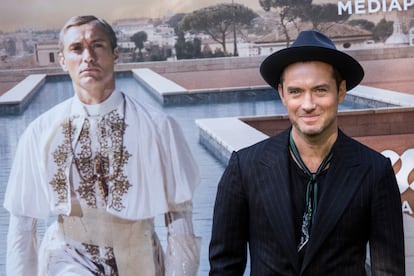
With the exception of Fleabag (2016-2019), which represented a true cultural reset, the most emblematic recent case would be that of Jude Law in The Young Pope (2016), who played the epitome of the hot priest: the hot pope. A pope who was more like a megalomaniacal rock star, always with a cigarette in his hand, and who was even shown wearing white Speedos on the beach. But why do these figures generate so much attraction?
“The fascination comes from the forbidden, from what is out of reach. It is a complete subversion of the norm,” explains Virginia Yagüe, writer, screenwriter, and current president of DAMA, an audiovisual rights management organization.
For her, the obsession with priests follows the same principles as the earlier cases of women who ended up establishing epistolary relationships with prisoners because of that feeling of getting closer, even if only from a distance, to the taboo. Yagüe knows what she’s talking about: she wrote one of the most memorable cases of the “hot priest” in Spain: Rodolfo Sancho in La Señora (2008-2010).
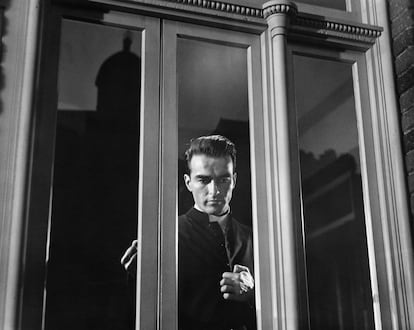
In the series, a marchioness from the early 20th century finds herself in a love triangle between her husband and her childhood sweetheart, Father Ángel. “Rodolfo kept asking us how long it was sustainable for his character to remain a priest, and we told him, until the very end. That impossible love, the tension between desire and duty, was the basis of his conflict, and if he left the priesthood, it would all be over,” Yagüe explains. In the writers’ meetings, they debated how far they could take the love story, and the answer was, “to the very end, to the bedroom.”
Yagüe cited The Thorn Birds as one of her influences, and precisely for that reason, she thought the theme had already been explored. She was wrong. Although the ratings were excellent, it also generated some controversy: “It makes me laugh a little, but I think I have an explicit veto from the Episcopal Conference. One day, they stopped answering the writers’ questions about historical accuracy.”
She argues that in her case, she took refuge in the fact that it was a period piece, but acknowledges that representing hot priests in the context of 2025 raises many more doubts.
Yagüe brought this debate to her fellow screenwriters, and two clear positions emerged. On one hand, there were those who thought it was a mechanism to question the power of priests. “Nothing challenges their authority more than showing them in their entirety,” she explains. Turning a figure with such status into an object of desire is, in part, a way to dismantle the power they have historically wielded. This same mechanism explains the LGBTQ+ community’s fascination with hot priests as a response to the homophobic discourse that part of the Church continues to perpetuate (it’s almost a subgenre within gay pornography, and it made headlines more than a decade ago when Pope Benedict XVI unknowingly blessed two adult film actors who were posing as seminarians).
On the other hand, there are those who believe that glorifying the figure of the priest — even if only aesthetically — is a way of whitewashing the Church at a time when it is still mired in controversy, such as the countless cases of abuse. In other words, giving it a fresh, attractive face ends up reaffirming its relevance and status. So, what does the current fascination of audiences and fiction with priests reveal? A resurgence of religious interest — or quite the opposite?
Víctor Albert Blanco, a PhD specializing in the sociology of religion and a researcher at the Autonomous University of Barcelona, prefers to put this supposed religious moment into perspective. “All these cultural products can emerge at the same time as secularization advances. Believers now practice their faith more intensely, with a lot of activity on social media, and many religious organizations try to link this cultural moment to the rise of Catholicism, but the data indicates the opposite.” For Blanco, this entire debate falls within what sociology calls the paradigm of secularization: “It was previously thought that religion would disappear from public life, but in reality, it has transformed and moved into different spheres.”
Blanco argues that the hot priest phenomenon or Rosalía’s nun-mania are not necessarily linked to a rise in interest in religion. In fact, they demonstrate quite the opposite: they reaffirm the concept of “banal Catholicism,” that is, the process by which Catholicism loses its hegemonic and institutional position to survive only in esthetics or in small gestures rooted in culture. This shift allows, for example, for frivolous fantasies about clerical collars and cassocks. However, Blanco laments that, especially in Spain, the rise of far-right and ultra-religious associations could, through legal challenges, stifle all these cultural expressions that question the role of religion. Perhaps that is why a hot priest is now more necessary than ever.
Sign up for our weekly newsletter to get more English-language news coverage from EL PAÍS USA Edition









































