
Héctor Socas, astrophysicist: ‘If a more advanced civilization contacted us, they should be more afraid of us than we are of them’
Artificial intelligence, extraterrestrial life, the climate crisis, the future of work and global governance. This science communicator uses the lens of science to tackle a much broader question: what kind of civilization do we want to be?

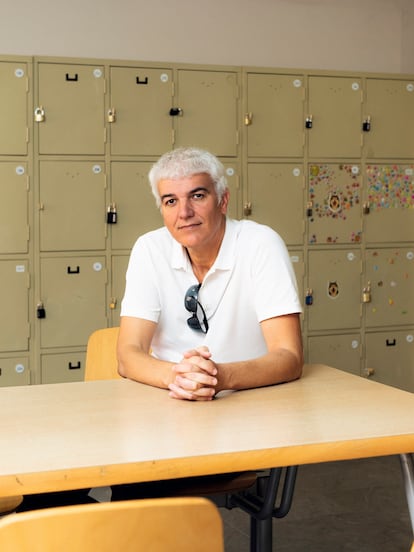
Classes are over at Madrid’s Complutense University, and the corridors of the Faculty of Physical Sciences are nearly empty. But Héctor Socas, 53, a researcher at Spain’s Institute of Astrophysics of the Canary Islands, is spending part of an early summer morning in a meeting of the international AtLAST consortium, which is promoting the construction of a major radio telescope in Chile. Socas also directs the European Solar Telescope Foundation, one of Spain’s most ambitious astronomy projects.
One of his main research interests is solar physics: he wants to learn how to predict solar storms — whose effects on satellites, GPS systems and electronics could be “potentially catastrophic” — “a few days in advance, just as we do with terrestrial weather.” But he also finds time for what he calls “the archaeology of the Sun and the planets,” searching alongside his IAC colleague Ignacio Trujillo for the hypothetical Planet Nine, whose elusive discovery, he says, “would help us understand how the Solar System was formed.”
On an early June morning, sunlight filters through the leaves in the garden opposite the faculty building as birds chirp overhead. Everything seems to invite optimism, much like his book Horizontes de la civilización (Horizons of Civilization), which swims against the current of prevailing pessimism from its very subtitle: An Optimistic Look at the Future of Our Species.
For this affable science communicator, optimism means recognizing that we still have time to shape our own destiny. Sitting on a stone bench, Socas speaks with EL PAÍS about a book that looks to the future while also journeying back to humanity’s origins. Or so we think because, as he points out, “time does not flow, we do.”
“We are at a moment when many doors are opening, and we have to decide which paths to take,” says the creator of Coffee Break: Señal y Ruido (Coffee Break: Signal and Noise), a weekly podcast on science and current affairs. And he is leaving none of those doors unexplored: autonomous artificial intelligence, the search for intelligent life, the meaning of work, planetary risks. All of it serves as a reminder that, to paraphrase Spider-Man, with greater power comes greater responsibility.
Question: Championing optimism can seem naïve to many people who believe the apocalypse is near.
Answer: Some people think it’s a long way off but say so pessimistically [laughs]. Pessimism is in fashion. We are obsessed with it, and that’s a mistake. First, because it isn’t true: we are living in the best period humanity has ever known. We have a psychological bias, understandable from an evolutionary perspective, that makes us pay more attention to bad news. But there is also a kind of intellectual pessimism that has taken hold. When I was young, I read stories that imagined extraordinary futures; now, almost everything is a dystopia. That shapes the collective psyche.
Not only is it incorrect, but it is also counterproductive, because we are on the verge of a collective depression. And the worst part is that, at a certain point, you no longer even want to be cured. I’m optimistic because another future is possible. There are many advances opening up new possibilities for a better world, but achieving it will require a great deal of effort. We are at a historic crossroads, and we cannot face it with apathy. We need enthusiasm.
Q. You open your book with a quotation suggesting that “the universe is not only queerer than we suppose, but queerer than we can suppose.” If, for instance, an ant were to walk beneath this bench right now, it would have no way of knowing that we are here having a conversation. What does that tell us about our own ability to understand the universe?
A. I really like that quote from John Haldane because it reflects an idea that is very present in science today: we have learned to be more humble. We may never fully comprehend the universe. It is possible that achieving that would require an intelligence different from or superior to ours, but we can continue to expand our knowledge and enjoy the pleasure of discovery. Human beings are explorers by nature; we like to learn and uncover new things. I champion science as a human pleasure as well as something that makes life better. In addition, it moves us away from the very human concepts of magic and superstition — the idea that we must do certain things to avoid punishment from some higher being. That more rational worldview makes us freer.
Q. Why did you become interested in science communication?
A. Because the science I consumed when I was young affected me deeply. It not only made me want to pursue science; it also shaped my personality and my way of seeing the world and life. We live in an era in which citizens need scientific literacy to take part in fundamental conversations, which is almost a moral obligation: the risks and opportunities of AI, ethical dilemmas, how to ensure progress leaves no one behind... Those debates require an informed society.
Q. Could an AI come to understand the universe better than we do?
A. Yes, it’s a possibility. You don’t even need singularity; reaching superhuman intelligence would be enough, which is perfectly feasible. It would be wonderful if it could help us understand the universe better, although we might never match its level of comprehension. Just as evolution produced a species with greater cognitive capacity than previous ones, it is possible that we are giving rise to other beings that have a deeper understanding of the universe than we do.
Q. And where would that leave us?
A. That’s a very recurring concern. Some fear that an AI will do literature, music or science better than we do. I stopped worrying about that long ago. There are already people far more intelligent than I am or who write better, and I don’t see that as a threat but as something to enjoy and learn from. Just as I don’t think that a more intelligent person would want to deceive me, I don’t believe a superior intelligence would necessarily become a problem or act malevolently simply because it is superior. Machines also don’t have motivations like power or money. Those stories belong more to science fiction. We train neural networks and AI systems to achieve the objectives we give them; not to self-preserve or destroy humanity.
Q. You explain that, for the first time in history, technological development is advancing faster than generational turnover. Are we prepared to manage that power responsibly?
A. We struggle to adapt to changes this rapid, especially as we age. We must rethink education so it becomes lifelong learning and find ways for older people not to be excluded. Climate change shows we have acquired enormous power to transform the planet and that we are now learning to assume that responsibility, but reversing a process more than a century in the making is like trying to stop a runaway train. Still, I see signs of progress. Today there is an environmental awareness that would have been unthinkable before. We are moving forward, though perhaps not as quickly as we need to.
Q. Speaking of education, you also question the idea of spending your whole life doing the same job.
A. Yes, we tend to understand work as the price we pay to enjoy the rest of life. But time is the most valuable thing we have. I am privileged because I enjoy my work, and I believe progress should lead humans to do increasingly human tasks — less repetitive and more creative— leaving the hardest, most dangerous or most boring jobs to machines. But the scenario in which we no longer need to work also comes with risks. Work gives us routine and purpose. If machines did everything for us, we would need to find new motivations: writing a book, discovering a planet, helping others... The future of work is doing something that fulfills you.
Q. But today work also defines our identity.
A. I think a further step in the evolution of our social model would be to reach a point where people are no longer defined by how they make a living, but by what they choose to do. I find that a very appealing prospect. The risk is that, if we fail to find a sense of purpose, a society of abundance could also give rise to apathy or self-destructive behavior.
Q. What is the probability that we will survive our technological adolescence, this moment when our own development could end up destroying us?
A. We don’t have data to calculate that probability. We would need to find other civilizations because even discovering the remains of an extinct one would give us clues about how long a technological species can survive. Still, I am optimistic: if, as I explain in the book, we apply Gott’s argument [the Princeton astrophysics professor], with 95% probability, we have between 40,000 and 8 million years left on this planet. In other words, it looks like we will live for thousands of years, so I think we will make it.
Q. Of all possible apocalyptic scenarios, which one do you think is most plausible?
A. I don’t think the greatest danger is our disappearance, but rather the loss of our human identity. The worst future I can imagine is the one depicted in WALL·E: a society where everything is so taken care of that people live in a permanent vacation, no longer creating, investigating, helping others or pursuing new challenges. What worries me more is a humanity that has lost its sense of purpose.
Q. If we encounter extraterrestrial intelligence, would it be closer to E.T., Arrival or Mars Attacks!?
A. I would say Arrival or E.T. To start with, I very much doubt we would have physical contact: the distances between stars are enormous and a conversation by signals may not even be feasible. Beyond that, a civilization capable of establishing that contact would have had to overcome its own technological adolescence. It would be a society not only more advanced technologically but also socially.
Q. Should they therefore fear us more than we fear them?
A. Yes, the more advanced civilization should fear the less advanced one. History shows that as we progress, we tend to become more careful. Today, for example, we sterilize space probes to avoid contaminating other worlds. I don’t see the point of stories like Independence Day or V in which extraterrestrials come to invade us to steal our water, eat us or enslave us. A civilization so advanced would likely have those needs covered. The most logical motive would be curiosity to study us, just as we study a newly discovered species.
Q. You advocate moving toward global governance to face challenges such as climate change or the risk of an asteroid impact. Yet the world seems to be moving in the opposite direction.
A. I am not proposing abolishing nations. Just as there are different levels of government today — municipal, regional, state or European — I think there should also be planetary-level competencies. There are problems, such as pandemics, bioengineering and climate change, that can no longer be solved by a single country. But, like any deep transformation, it must start from society. First we must understand that there are problems requiring a global perspective; only then can we demand that institutions take action. You cannot impose a governance model from the top and expect it to endure. We must begin to think as citizens of the 21st century.
Q. You recall in the book that “we stand on the shoulders of giants.” What do you think Carl Sagan would say today about the horizons of civilization?
A. I like to think he would largely agree with what is said in the book. My way of understanding the world is heavily influenced by [Carl Sagan, [Isaac] Asimov and Arthur C. Clarke. Obviously, they wrote in the context of the Cold War and we are facing different challenges, but I believe the principles remain the same: a rational, humanist outlook open to the future.
Q. Would they also share that optimism about our species?
A. I have no doubt.
Sign up for our weekly newsletter to get more English-language news coverage from EL PAÍS USA Edition









































