
Fred Hoyle, the man who gave the Big Bang its name (against his will)
It is due to the English astronomer that we know we are all stardust. Even so, he is remembered more for what he rejected than for what he discovered
For the Romans, Fama was an allegorical goddess representing the voice of the people. With eagle wings that concealed eyes beneath each feather, playing a trumpet, and immune to sleep, she was responsible for spreading news and rumors at lightning speed, without regard for their truth or falsehood. Fama is responsible, among other things, for history remembering as heroes those who did nothing of real value or who took advantage of others’ merits, while forgetting those who truly deserve to be remembered.
Science is not immune to the machinations of this goddess, who seems to still be active and in top form. Many diseases or medical techniques are known by a name that is not that of their discoverer. On other occasions, someone is indeed remembered by history, not for their discovery but rather for their mistake.
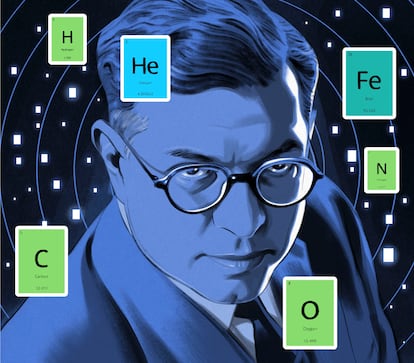
The astronomer Fred Hoyle was born in 1915 in Yorkshire, England, and studied physics at Cambridge, where he later spent most of his scientific career at the Institute of Astronomy, eventually becoming its director. Hoyle’s greatest scientific contribution came in 1946, when he proposed a model to explain how chemical elements are formed inside stars. The process is now known as stellar nucleosynthesis. Until then, it was known that stars generate energy through nuclear fusion. This involves two hydrogen atoms combining to form a helium atom. The origin of the other chemical elements was unknown. Hoyle demonstrated that inside stars, at extremely high temperatures and pressures, atomic nuclei fuse in a sequence that generates heavier elements: carbon, oxygen, nitrogen, and finally iron. Furthermore, he proposed an excited state of carbon-12, now known as the “Hoyle state,” without which not enough carbon could form in the universe to explain the origin of carbon-based life. To date, carbon-based life is the only life we know of. This prediction, made purely theoretically and based on his own mathematical development, was later experimentally confirmed and is considered one of the most brilliant ideas in the history of theoretical physics. Thanks to Hoyle, we understand that we are all stardust, since most of our atoms were formed in stars.
And this is where the goddess Fama comes in. That’s not what Hoyle is best-remembered for today. During his most active period in science, a theory began to gain traction that postulated the universe had a single origin from a Big Bang 13.8 billion years ago. Although this idea fit very well with his nucleosynthesis, since that explosion gave rise to hydrogen atoms and a little helium, Hoyle flatly opposed it. He considered it religious, arbitrary, and poorly founded. Along with his colleagues Hermann Bondi and Thomas Gold, he proposed an alternative: the steady-state model.
According to this model, the universe has no beginning and no end, and matter is continuously created as the universe expands, so its overall density remains constant. And here came the moment that changed everything… During a BBC interview in 1949, he referred to the rival theory as “this Big Bang idea.” He intended to ridicule it, but ended up coining one of the scientific terms most firmly established in the popular imagination.
Hoyle continued working and in his later years showed an interest in investigating the origin of life, in addition to being a renowned science fiction writer. He never won the Nobel Prize, even though his discovery was fundamental to explaining the universe and life on Earth. Legend has it that his fervent opposition to the Big Bang theory weighed heavily on the jury. The goddess Fama is still active in the 21st century.
Some controversial conjectures
— Hoyle supported some controversial theories. Together with his collaborator Chandra Wickramasinghe, he developed the panspermia theory, according to which life on Earth could have arrived from outer space, transported on comets or interstellar dust. Today it is accepted that it is unlikely any form of life arrived from space, but that molecules arriving from space could have played a decisive role in the origin of life.
— After Hoyle's death in 2001, Wickramasinghe turned to the dark side of science, defending increasingly aberrant ideas, such as that the flu virus comes from space, that HIV or even Covid-19 could have extraterrestrial origins, or that human DNA is modified by biological material arriving from space. All this without providing a single piece of evidence.
Sign up for our weekly newsletter to get more English-language news coverage from EL PAÍS USA Edition









































