
Scientific journals place less trust in women researchers
An analysis of more than 36 million articles written by women shows that the gender gap in research is also reflected in specialized journals
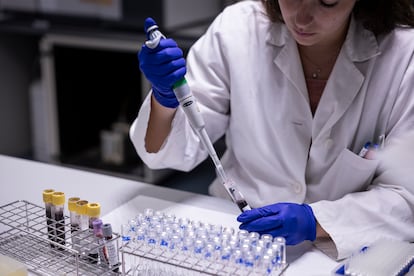

Women have made gradual inroads into scientific careers. In Spain, they represent 39.6% of research personnel. However, their increased presence does not translate into equal conditions, and the differences that still persist also extend to scientific communication. This is demonstrated by a large-scale study recently published in the journal PLOS Biology. The authors analyzed 36.5 million academic articles and concluded that biomedical and life science research led by women spends more time in the peer-review process than that led by their male colleagues.
The study used a sample of texts indexed in PubMed, the biomedical literature database, and compared the time elapsed between manuscript submission and final acceptance. The results show that studies with women as first authors or corresponding authors experienced this delay.
For researcher David Álvarez-Ponce, a professor at the University of Nevada in the United States, and one of the study’s authors, this delay poses a series of long-term disadvantages for female scientists. “If a person publishes 50 articles during their career, those days they wait multiply. In the end, we’re talking about a significant difference,” he says.
Ana González, director of the Center for Advanced Social Studies at the Spanish National Research Council (CSIC), agrees. For the sociologist, who did not participate in the study, the most obvious consequence is related to women’s professional advancement and the funding of their research. “If publications are delayed, there are fewer articles, which are still the primary means of scientific advancement,” she points out.
It also has an effect on the production of knowledge itself. “We are going against the integrity of science,” she argues. “There is a discussion about whether men and women conduct research differently. We have examples of how women began to analyze animal behavior in a different way,” notes González, a member of the board of directors of the Association of Women Researchers and Technologists (AMIT).
Although the study notes that there are some exceptions — the areas of molecular biology, genetics, or women’s health — this difference remains even after taking into account variables such as the field of research and the year of publication.
“It’s discrimination”
The study’s authors suggest several factors that could be influencing the results. “Bias on the part of editors or reviewers is a plausible explanation, but not necessarily the only one,” says Álvarez-Ponce.
Although the underrepresentation of women in scientific leadership positions was not mentioned in the research, another study published in the journal Nature in 2023 found that only 14% of editors were women, and that this proportion drops to 8% for editors-in-chief. The conclusion comes from a dataset that included more than 81,000 editors across 1,167 journals in 15 disciplines over five decades. The proportion of women authors was also striking: only 26%.
Álvarez-Ponce adds that women typically have a heavier teaching and administrative workload. This is compounded by other responsibilities, such as household duties. “This can affect the response time when journals request reviews,” he says.
Although she acknowledges that this plays a role, González considers that explanation too simplistic. “In the scientific world there are more measures to support collaboration and work–life balance than in other sectors. More than childcare, what really has an impact are the responsibilities tied to caring for older adults and dependent people, which are far less regulated,” she says.
González also notes that other studies show that even women without children experience delays in their professional advancement — something that does not happen to men. “It’s discrimination for being a woman, not just for having children,” she stresses.
Men with more years in science
Another factor highlighted by Álvarez‑Ponce is experience. Because women have entered scientific careers gradually, after years of facing barriers, “men tend to be, on average, somewhat older and more experienced, which may also influence how quickly their articles are accepted,” he adds.
The authors clarified that they were unable to determine how much of the delay is due to the journals themselves and how much is due to the time authors take to respond to revisions. “We don’t have those data, although recent studies suggest that both factors play a role,” says Álvarez‑Ponce.
The psychological impact
The gender gap in science has also manifested itself on a psychological level. A recent study from Binghamton University in the United States revealed that 97.5% of women enrolled in STEM graduate programs —science, technology, engineering, and mathematics — have experienced what is known as imposter syndrome, a psychological phenomenon where capable people doubt their achievements.
The research showed that these experiences are associated with worse mental health, greater burnout, and a higher likelihood of considering dropping out.
Resources and constant evaluation needed
For González, while equality policies in science have been essential, they require “leaders to drive them forward, resources, and constant evaluation.” She also stresses the institutional responsibility to correct sexist behaviors and language that have been normalized for decades.
Prejudices persist, she points out. Even at the highest levels. “People still question whether a brilliant woman has sacrificed her family for her career, a question rarely raised in the case of men,” the sociologist argues.
She adds that fostering scientific vocations, especially among girls and young women, is another crucial area. “Education is key, but it’s not solely the school’s responsibility,” she points out. Family and social environment “play a decisive role.” “Boys are told they’re smart; girls, that they’re pretty. That difference matters.”
Sign up for our weekly newsletter to get more English-language news coverage from EL PAÍS USA Edition









































