
Why do we dream?
This process helps us regulate emotions and enhance creativity, but there are still many unanswered questions about how it works
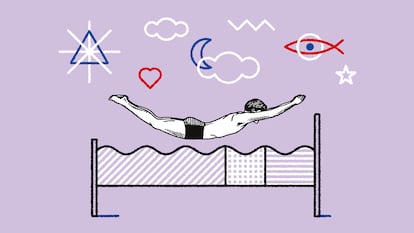

For most of human history, dreams were regarded almost mystically, as messages from gods, demons, or ancestors. “The last place one could imagine dreams coming from was the seemingly inactive flesh in our skulls. The mind during sleep was thought to be dormant, a passive vessel,” writes U.S. neurosurgeon and neurobiologist Rahul Jandial in the book This Is Why You Dream.
Scientific evidence gathered in the last century, and more specifically in recent decades, has debunked this idea. The brain remains in constant activity while we sleep, especially during the REM phase — when most dreams occur, including the most vivid and elaborate ones — during which brain activity even increases in some regions compared to the waking state.
Sleep is an active process consisting of two phases that alternate cyclically throughout the night. On the one hand, there is the non-REM phase, which accounts for approximately 80% of sleep time in adults. On the other hand, there is the REM phase, which represents 20%.
“When we fall asleep, we enter non-REM sleep and then transition to REM sleep in about 90 minutes, completing a sleep cycle,” explains Ainhoa Álvarez, a clinical neurophysiologist at the Sleep Unit of the Araba Health Services Organization, over the phone. “In a single night, we normally go through four to five sleep cycles, with the peculiarity that REM sleep lasts longer each time. Therefore, it’s easier to wake up in REM sleep in the morning and remember what we dreamed. But even if we don’t remember it, we also dream.”
Dreams also occur during non-REM sleep, but as Gerard Mayà, a neurologist at Hospital Clínic in Barcelona, also noted over the phone, these are usually “very simple, and the likelihood of remembering them is much lower.” According to an unpublished study conducted at the Spanish hospital using data from 1,000 naps taken by patients in the Sleep Unit, 60% of people who entered REM sleep during their nap recalled having dreamed when asked immediately upon waking. That figure dropped to 20% for naps that remained in deep non-REM sleep.
“The most determining factor for dream recall is REM sleep,” says Mayà. According to the expert, this phase in people who remember dreams more frequently has two special characteristics. On one hand, increased brain activity in two particular regions (the temporoparietal junction and the medial prefrontal cortex), which have been shown to be more active during wakefulness and REM sleep in people who frequently recall dreams. On the other, a type of electrical activity visible on an electroencephalogram, frontal theta oscillations, especially just before waking.
But why do we dream? Jandial unpacks in his book several theories that remain plausible attempts to answer this question. The first suggests that dreams are a kind of virtual simulation in which we test different responses to threats or situations and imagine the consequences. This would explain why in various studies conducted over the last century, participants’ dreams often repeat regardless of their geographic location or socioeconomic status: we dream that we are falling, being chased or attacked, arriving late, trying to do something repeatedly without success... There is no scientific evidence, but this reality hints at some genetic influence, as if the characteristics and content of dreams were, according to the neurosurgeon, “hardwired into our DNA.”
Another theory suggests that dreaming keeps the brain active and ready, even while we sleep, so that when we wake up, the brain can quickly become active and alert. Furthermore, the fact that dreams are often surreal led U.S. neuroscientist Erik Hoel to propose the so-called overfitted brain hypothesis, according to which dreams help us generalize what we learn during our waking hours, which could lead to more flexible and creative thinking.
According to Mayà, this would explain why composers from groups like The Beatles or The Rolling Stones, among others, have dreamed songs that they later wrote upon waking, or why some dreams preceded technological or scientific discoveries such as the sewing machine, Bohr’s atomic model, or the periodic table of elements.
Finally, there is what Jandial calls the “dream theory,” in which dreams act as a sort of nightly therapist that helps us process and manage emotions related to anxiety — a theory recently supported by some scientific research. “Dreaming is fundamental for emotional regulation. Dreaming, on one hand, helps remember valuable experiences and, on the other, to forget painful ones,” says Álvarez.
The expert explains that the amygdala, a brain structure key to processing emotions, especially fear and anxiety, plays an important role during sleep: “During sleep, especially in REM, the amygdala is highly active and participates in consolidating emotional memory.”
The experts consulted agree that all theories are likely to contain some truth. As Jandial writes in his book, “We shouldn’t expect there to be just one reason why we dream, just as there isn’t just one reason why we think when we’re awake.”
Álvarez points out that the science and medicine of sleep still have a short history, less than a century. “We still have a lot to learn. And dreams are the great unknown,” she acknowledges. One of the pending mysteries is the true importance of dreams for our health. As Jandial notes, there is much talk about the need to sleep to stay healthy, but he wonders if perhaps what we really need is not so much sleep but dreaming.
“Sleep is extremely important, and dreaming — whether we remember it the next day or not — is another element of healthy sleep,” Mayà adds.
According to the neurologist, most antidepressant medications inhibit REM sleep, so when sleep tests are performed on patients taking these drugs, it is common to observe that they do not enter REM sleep until the last hours of sleep or even wake up without having entered this phase — meaning they have less chance of having elaborate dreams or remembering them — yet apparently without any problem or symptoms. “Could it be that REM sleep and dreaming aren’t as necessary in adults?” Mayà wonders.
Mayà raises another question. REM sleep accounts for barely 20% of adult sleep time, but for newborns, this phase represents half of their sleep time, “which would make it possible for humans to dream more during the initial stages of life. Why is this?”
This doubt, in turn, can open space for new questions: do we have the capacity to dream from birth, or does it require the development of other abilities such as visuospatial skills, language, or memory to be possible? Many questions remain. Sleep science continues to seek answers to all of them.
Sign up for our weekly newsletter to get more English-language news coverage from EL PAÍS USA Edition









































