
Nancy Knowlton, marine biologist: ‘Scientists have to speak out against Trump’
The US researcher has studied the effects of climate change on the coral reefs for 50 years
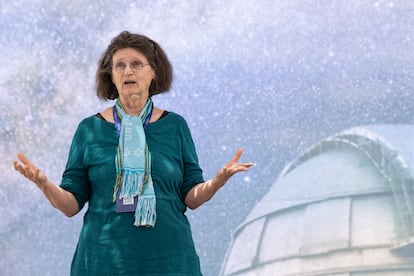

Nancy Knowlton, 75, was born in Evanston, Illinois, but spent nearly every summer of her childhood by the Atlantic Ocean. Her grandparents lived on the Long Island Sound between Connecticut and New York, and it was there she discovered that if you took a snail out of its shell, it can’t get back in. Her desire to observe, learn, discover and understand led her to graduate with a degree in biology from Harvard University, and to get her doctorate in zoology from the University of California. For 50 years, she has studied the coral reefs and the creatures that inhabit them — including snails.
Knowlton visited Spain to give a talk at the eighth edition of Starmus Festival, which recently took place on the Canary Island of La Palma. During an in-person conversation with EL PAÍS, the U.S. biologist spoke of how the ocean’s floor has changed in recent decades, of the loss of biodiversity and the threat of climate change. Knowlton is critical of the policies of U.S. President Donald Trump, whose rhetoric she describes as “crazy,” and calls on scientists to come together and raise their voice — not just as experts, but as citizens.
Question. In 2009, you began to give talks on the good news coming from the ocean, from which was born the Ocean Optimism movement. Why have you focused on this subject?
Answer. At the Scripps Institution of Oceanography at the University of California, San Diego, I created a program training students in the field of biodiversity and conservation. We would lecture the students about the problems in the ocean, and those were really depressing lectures. And at some point, I thought to myself, in medical school they don’t train students to write obituaries. Medical school is about figuring out how to make things better. What we were doing was training our students to write ever-more-detailed obituaries of the ocean. I found that even professionals in marine conservation were really clueless about some of the big successes we’d had. You can’t just talk about problems. You have to give people the sense that they can do something about them, otherwise they won’t care about the problems, they won’t act on them.
Q. Be that as it may, the Trump administration recently reinstated fishing in one of the largest protected ocean areas that lies northeast of Hawaii, which was established during Barack Obama’s first term. How will that news affect global ocean conservation?
A. It’s going to make things worse. The really stupid thing is it’s going to make things worse for fishing, because it’s well-known that when you create marine protected areas, the fish inside get bigger, and those big females produce many more eggs. It’s an exponential relationship. It’s been well-demonstrated in a variety of different places, such as in the Great Barrier Reef, where half of all the fish that are on the reef come from marine protected areas. And in Hawaii, they actually increased fishing capability from the spillover of the fish that move out of the protected areas into fishing zones. So not only is it bad in general for marine conservation, it’s really bad for fishing and the fishing economy.
Q. Are you concerned about the wave of dismissals, closures of diversity programs and political interference at numerous U.S. institutions and universities?
A. The U.S. scientific system is being dismantled. There are two things that are going on. One is that you’re depressing an entire next generation of scientists, whose careers are being destroyed by these steps. Another is that the thing that is hardest to repair is trust. For example, when you create a marine protected area, people have to have a sense of trust that even though there are going to be challenges in the short term, in the long term, things will be better. You have to have that social cohesion. The trust in the United States, the trust in science, are being eroded by these decisions. That breaking of trust is probably the thing that’s going to be hardest to repair. It can be repaired, you know, but it takes decades. And similarly, the breaking of scientific systems.
Q. The attacks on science have been nonstop, although universities like Harvard are standing up to Trump.
A. When initially all these things happened, people were kind of paralyzed. It was so much going on. But people are now starting to come together and say, “No, this is not right.” The crazy thing [about everything the Trump administration is doing] is that everything is being justified in terms of competition with China. And this is making China stronger rather than weaker. The whole thing is not only horrible in terms of people and respect for diversity, it’s also counterproductive. It’s complete insanity, in addition to being a tragedy.
Q. What should be the role of scientists in this context?
A. I think scientists have to speak out. I do feel that policy is a matter of values, and science really doesn’t address values. Science doesn’t tell you what you should do, but it tells you what will happen if you do certain things. And in that role, I think scientists have every right to speak out as scientists. But they can also speak out as citizens and say, “I am opposed to this because this violates my sense of what’s right.” Science doesn’t dictate the policy. But it tells you what the consequences of a policy will be. And we have to talk about it.
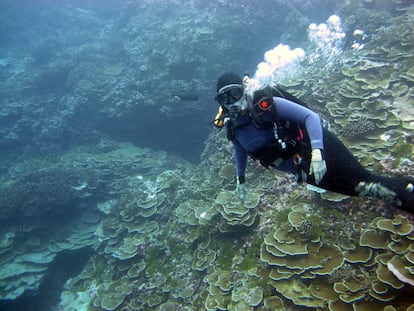
Q. Is there fear in the scientific community about speaking out?
A. There’s a huge amount of fear. I’m retired. There’s nothing that anybody can take from me. I have the freedom to speak my mind, and I’m speaking as an individual, not as a representative of any organizations. For people whose jobs are on the line, it’s much harder. For universities that risk being singled out and attacked, it’s harder still. Conservation organizations also receive money from the U.S. government. I think some of these actions by the Trump administration are going to be defeated in court, but it’s still a scary space to be in, to risk your job, or in terms of an organization, your mission. I really feel for the people who are having to make these decisions, they’re not easy.
Q. In this context, is there room for optimism?
A. People are realizing that there is strength in numbers. We have to be united in talking about what is happening and what the consequences of what’s happening will be for the well-being, not only of people in the United States, but of the world. It’s not like we’re being all locked up in our rooms and not allowed to go out. We can talk in public settings, we can talk with our friends and neighbors. Young people are really engaged. They are not happy about having their future destroyed. I come from the generation that protested the war in Vietnam for a long time. That work changed the world. We can change the world again.
Q. Going back to those days at the beginning of your career, do you remember the first time you saw a coral reef?
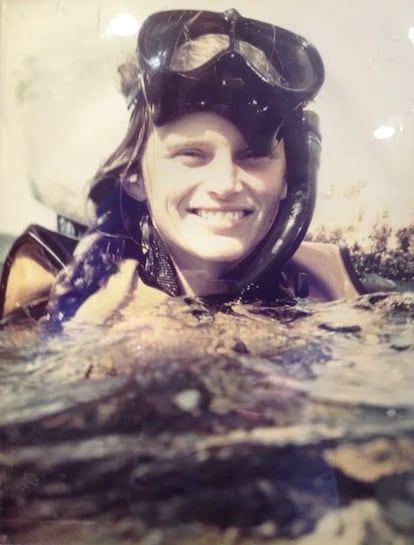
A. That was that summer of 1974, on the north coast of Jamaica. Now, Jamaica has suffered a lot of reef loss, the whole Caribbean has suffered a lot. But back then, the reefs, the live coral, was stretched for as far as you could see. The whole bottom was covered with live coral. You could see for 100 meters. It was just so beautiful, inspiring. At the time, it seemed like they would be there forever. I never worried about something happening to them.
Q. What has changed since then?
A. Globally, we’ve lost about 50% of all the corals. Coral reefs are among the most sensitive of all ecosystems to human impacts. In Jamaica, for example, in 1980 there was a major hurricane which smashed all the corals to pieces. Normally, corals should be able to recover because they’re like plants, you can break them up and they reattach and regrow. But they never came back. And it was a combination of the effects of the hurricane, but also a disease that was killing corals and also one that killed a very important sea urchin which eats seaweed. Seaweed and corals tend to compete with each other. Over the course of a couple of years, we went from the bottom being covered with live coral to just being covered with seaweed. And that story has been repeated in many other places. And now, every few years, sometimes every year, there are these massive heat waves in the ocean which kill corals.
Q. Is climate change today’s biggest threat for the ocean floor?
A. Definitely. Not only for coral reefs, but ecosystems in the ocean around the world, and on land for that matter. It used to be, when I began my career, overfishing and in some places, pollution. We used to think of climate change as something we had to worry about in the future. Well, climate change is now.
Q. How are coral reefs being affected?
A. Corals have inside their tissues little tiny plant cells called zooxanthellae, which are very sensitive to temperature. If the temperature goes one to two degrees centigrade over the normal average, the relationship between the coral and the zooxanthellae breaks down, and the zooxanthellae get ejected, or they leave or they die. They provide a lot of the coral’s color, which is why they call it coral bleaching. When they leave the coral, it becomes completely transparent — you’re actually seeing its skeleton. It’s as if everything on top of your bones went transparent. Corals can survive a certain amount of bleaching if it’s not too prolonged and it’s not too intense. But eventually, they starve to death, and if the heat is really bad, they actually almost cook.
Q. Part of your work focuses on understanding this process and in the coral’s so-called hidden biodiversity. What is that?
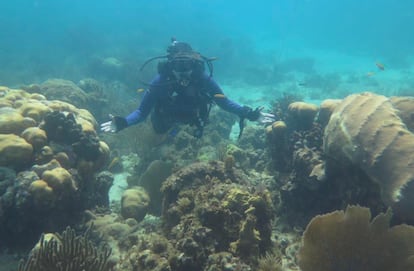
A. Inside of a coral reef are all these cracks and crevices, and that’s where all the biodiversity is. It’s like a tropical rainforest, where the real diversity lies in all the insects that are creeping around all over the place. In the corals, there are crabs and shrimps and little tiny snails and little worms. And that’s where almost all the diversity of reefs are. We call it hidden biodiversity because not only do you not see it from a distance, but because it’s tiny, most people haven’t studied it. Many of these creatures don’t even have scientific names. We used to leave [tracking devices] out on the reef for a year, and you could get sometimes 700 different species just in one of these little structures.
Q. What have you learned from studying the unseen and invisible?
A. It makes you realize that the tiny stuff tends to have a faster rate of change. There’s a lot going on that is hidden from our eyes. It’s obviously important to understand what makes corals happy and what makes them unhappy and get sick and die. Because the corals are the organisms that actually create this underwater city where all these other creatures live. We’ve ignored most of the diversity on coral reefs and its impacts.
Q. Can you give an example of that?
A. There’s one kind of snail called cone snails that have very powerful chemicals they use to kill their prey. In some cases, cone snails are actually fatal to people. But in small doses, their toxins can be very useful, medically. Sort of like how people use Botox to get rid of wrinkles. In big doses, Botox is a deadly poison. But in small doses, it can be very useful medically.
Sign up for our weekly newsletter to get more English-language news coverage from EL PAÍS USA Edition









































