
Marion Cotillard: ‘Losing interest in climate change is totally crazy’
The French actress traveled to Biarritz Film Festival in collaboration with Chanel to support emerging talent, saying, ‘The way that we look at young people, it says a lot about humanity’
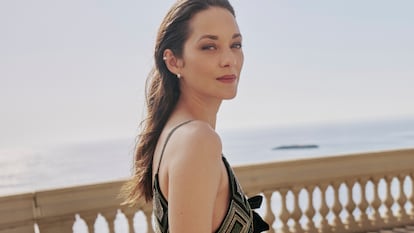

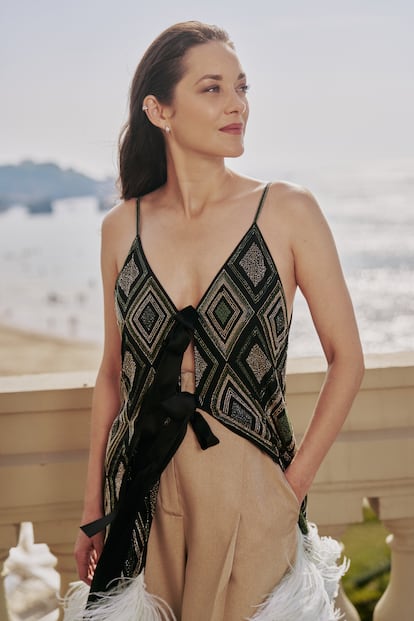
Marion Cotillard (Paris, 50 years old) says that the first time she visited Biarritz “I came with a boyfriend, in my twenties.” This June, amid a heatwave, she returned to the coastal town in southeast France to present an award to Isabelle Huppert in the fourth edition of the Biarritz Film Festival-Nouvelles Vagues, sponsored by Chanel (a brand for which she has been an ambassador since 2020), which centers on new creators. “We would like to give these emerging voices the space, visibility, and confidence they need to take off,” explained festival president Jérôme Pulis-Etchevers. Cotillard, who won an Oscar when she was 32 for La Vie en Rose, knows how important such support can be. She grew up in a bohemian family with parents steeped in visual arts, and has triumphed in Hollywood — but at one point, she considered leaving acting out of fear of being boxed into bland roles.
Question. Why do you think supporting emerging talent is so important?
Answer. Because if you don’t support young talent and youth in general, you don’t support humanity. The way we look at young people, whether we celebrate them or not, that says a lot about humanity. This festival is spot-on.
Q. When one is getting started, it’s often hard to take that first step. It’s difficult to find funding for a project, meet the right people… You have said that you even considered leaving acting because you didn’t want to get boxed into pointless roles. Is it important to have someone who is betting on you, and opening those doors?
A. I will always remember and be grateful to the people who supported me when I was a young actress, who believed that I have something to say and that I have a place in that world. I always felt that my place was there, but you have doubts, you’re not confident in yourself. It is really what I am here for: telling stories, embodying different characters, helping a director to give his or her vision of humanity or the world. But yes, at one point I was not happy, and I was frustrated, and I thought, I should just pause. I love this work so much that I don’t want to spoil it or damage it with anger and frustration. That’s when I decided to take a break, because you can just shake off that energy. But there were some people who believed in me, like Olivier Dahan, who wrote La Vie en Rose for me.
Q. He believed in you.
A. He didn’t know me, I had never met him. He had seen the few movies that I had done, and he saw something that I wanted to give. When he started to finance the movie, people were like, ‘Why her?’ We have amazing actresses in France, and I understand that the people who were going to finance the movie were like, ‘No, we have well-known actresses, names.’ But he was like, ‘No, I wrote this for her, and it is her or I don’t do the movie.’ That is important, that people be like, ‘I see something in you, and I will support you, and you will get there.’
Q. Biarritz also presents the Queer Gaze Award. Is that an important thing to honor right now?
A. Yes, definitely. Because this is about more than supporting the community. We have to fight against obscurism, and they cannot fight alone. Like how women cannot fight alone for women’s rights and we need men, the LGBTQ+ community cannot fight alone for their community. We need to be all together.
Q. Are you looking for an activist stance in the new projects you take on? This year will see the premiere of Emmanuelle Bercot’s L’Enragé, which tells the story of the 1934 rebellion of a group of young people in the custody of the state, who wind up changing the laws around the care of minors.
A. No, I need to support and be part of projects led by artists. As an actress, art comes first for me, although I do believe that nowadays, almost everything is political. Even planting a carrot seed is a political act. But as a producer, yes, I see myself more as an activist. In 2021, I produced the documentary Bigger Than Us, and now I run a company called Punk Fairies with a partner, where we are developing various projects.
Q. Are those also documentaries, or fiction?
A. We’ll see. It’s documentaries for now, but we are exploring. I was part of a hybrid project when I did Mona Achache’s Little Girl Blue, where the boundaries of fiction and documentaries were blurred. That makes for very interesting and unique projects. So no, we don’t have boundaries.
Q. What kind of stories do you want to produce? Earlier, you were talking about how we need to focus on the positive and what’s beautiful, because our reality is full of ugly things and anger.
A. Personally, even for a very dark subject, I like to see a little crack of light. The news is so negative, but we need to know all those horrible things that happen, because if we don’t, more horrible things will happen, because horrible souls will think, ‘Oh, well, it’s okay.’ But we also need to open our eyes more and discuss more and provide more support for the positive energy and projects in this world. We need that double focus.
Q. Bigger Than Us was a documentary on climate activism among the younger generations. How can we raise awareness about that crisis, when it is still being denied by so many people?
A. You know, it’s not a trend anymore, which is absolutely horrifying to say. Today, we live it, and it’s getting worse. But the past 10 years, we talked about it a lot and it was like a ‘hot topic’. And today we don’t. We’ve lost interest, which is totally crazy.
Q. And with those June heatwaves in Biarritz…
A. Yeah, but they will go away, and people will stop talking about them until the next time... and it’s getting closer and closer each time. I don’t know what we’re waiting for.
Q. You appeared in the latest season of The Morning Show, a series produced by and starring Jennifer Aniston and Reese Witherspoon. What drew you to the project?
A. It’s one of my favorite TV shows. So being part of it was a dream that I never had, because I never thought it would be possible to be part of this amazing show. And it came true. What I loved about this show is the first season, where for the first time in the world, a man was portrayed who is a criminal, and he came to that point in himself where he thought, ‘Oh wow, I might be a criminal.’ That has never happened outside of fiction. In France, all the men who were accused of sexual harassment or rape, none of them said that those women told the truth. Are we all liars? It doesn’t make any sense.
Q. In 2018, you and 81 other actresses protested at Cannes against the industry’s gender gap. Has anything changed?
A. It’s still a problem. We’re taking tiny, tiny steps forward, but we will have to fight for a long time. And we cannot have only women fighting for women’s rights. If men had to fight for a right, though I don’t know what it would be, I bet they would be like, ‘Where are the women?’ Now, we are fighting for the protection of young people in France. Where are the men when we’re fighting for youth protection? This is mental.
Marion Cotillard’s summer recommendations

In memory of Jean Cocteau
“My mother is Basque and I grew up here, my connection to the Basque country is deeply personal, almost instinctive. It is rooted in my childhood, in the memories, landscapes and faces that make us who we are. Even after leaving for Paris at 18 years old for college, that link has never faded,” explains Jérôme Pulis-Etchevers, president and co-founder of the Biarritz Film Festival-Nouvelles Vagues alongside Mathilde Henrot. The idea for the honor arose during the Covid pandemic “from a desire to reconnect, share collective experiences and discover emerging voices and projects driven by a new generation of filmmakers, actors, and artists.”
He says its starting point was the Maudit Film Festival that Jean Cocteau held in the same coastal town in southern France 77 years ago. “In 1949, Jean Cocteau sought to revindicate films that defied established conventions, dogmas, and norms, and I think that’s the connection to Nouvelles Vagues. We share the same desire to give visibility to filmmakers who are redefining cinematographic language,” reflects Pulis-Etchevers. Common themes that younger generations approach, in his experience, are “identity, legacy, social relationships, climate, and politics, which are naturally integrated in their work, but never at the cost of narrative or emotion.” The winner of the fourth edition of the award was New Zealand director Paloma Schneideman for Big Girls Don’t Cry.
Sign up for our weekly newsletter to get more English-language news coverage from EL PAÍS USA Edition









































