
Charlie’s Angels 50 years on: The faces of female empowerment under attack
The event that reunited Jaclyn Smith, Kate Jackson and Cheryl Ladd in Los Angeles has led to a digital judgment, with stark criticism of the actresses’ current appearance
There was a time when women’s liberation was measured in inches on the small screen; a bra-less sisterhood and extra-strong hairspray. In March 1976, when Aaron Spelling and Leonard Goldberg, producers with a Midas touch, gave wings to their angels in a pilot of almost an hour and a half, it wasn’t just the birth of a TV series, but also a monumental phenomenon with its own chapter in pop history: the unforgettable tune, the fabulous logo, the inspiring aesthetics, the archetypal beauty, feminist arguments and a mythology that would end up in what we now call the extended universe.
Half a century later, Charlie’s Angels is still present in our lives, between constant reruns, a buoyant film franchise – despite the fiasco of the 2019 film directed by Elizabeth Banks and starring Kristen Stewart, Sony Pictures has a new reboot in the pipeline with Pete Chiarelli in the script – and the currency of nostalgia that has achieved the impossible: namely, that three of those women recruited as private detectives from a police academy by a mysterious, lustful man have reunited in public.
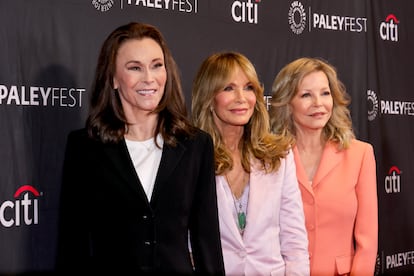
The encounter took place on the night of April 6, at the Dolby Theatre in Los Angeles, during the spring edition of PaleyFest, the most important television festival in the United States. To celebrate the 50th anniversary of the milestone, Kate Jackson, Jaclyn Smith and Cheryl Ladd appeared together just over three decades after their last joint appearance. The expectation was such that the tickets were sold out just hours after going on sale, at the end of January. And, indeed, female camaraderie, empowerment and self-improvement were on the menu.
“Our show was about a sisterhood, loving one other, having each other’s backs,” Smith said. “I knew the show was different, special and unique. Three women chasing danger instead of being rescued from danger… our show was the first of its kind. It gave women permission to be independent and break out of the mold and not be defined by men.” Smith added that the trio were criticized for their looks. Now, half a century later, that criticism is still there.
“Charlie’s Devils;” “Charlie’s Monsters;” “The angels of Botox.” The reunion sparked a furor across social networks. Not because of nostalgia, but because of the current appearance of three actresses who were once a model of angelic beauty. Suddenly, Kate Jackson, 77, Cheryl Ladd, 74, and Jaclyn Smith, 80, have been put on trial and condemned for the cosmetic work they have had done in order to defy the passing of the years.
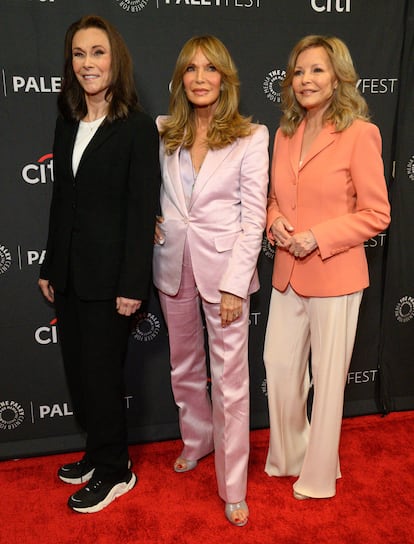
Once again, we have women who are required to grow old with grace, as if growing old in public were a crime and the needle and the scalpel, the proof of the crime. When society has shouted at you for 50 years that your only function is to be looked at, criticizing the lack of expression on a face is hypocrisy at best and a way of perpetuating the same aesthetic violence that has haunted them down the years at worst. According to Smith, the pressure never stops. People continue to expect her to be the 25-year-old running along the shoreline.
It turns out that what was flagged up at the Dolby Theatre was the passage of time. The criticism of the actresses’ faces acts as an echo of the ‘jiggle’ TV that objectified them half a century ago. ‘Jiggle’ TV is a term coined by Paul Klein, then an executive of the NBC network, to describe the bounce of unrestrained breasts that kept 59 million viewers glued to the small screen every Wednesday in the U.S. Charlie’s Angels reached number one in 17 countries and became the most watched program on the planet for three consecutive seasons, between 1976 and 1978. In the Spain of the democratic transition, it generated levels of national paralysis: 15 million people in a country of 36 million tuned in. But what Klein and the critics did not want to see behind the blow-dried hair and bikinis was a dream-crushing machinery and a contractual tyranny that went so far as to alter the history of Hollywood.
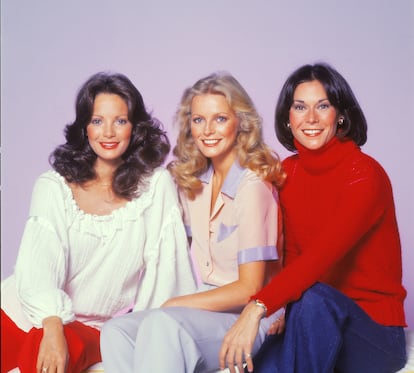
The story of these angels is, above all, a story of chains forged in gold. Being signed by Spelling was a labyrinth with no way out: Kate Jackson, the cerebral angel leader Sabrina Duncan, was picked to star in Kramer vs. Kramer (1979), but the production company prevented her from accepting the role, tying her up with constant schedule changes. In the end, Meryl Streep took the part and won the Oscar for best supporting actress. The same thing happened to Jaclyn Smith, the elegant and ironic Kelly Garrett; the series’ sacred schedule forced her to say no to being the Bond girl in Moonraker. The introduction of Cheryl Ladd who replaced the iconic Farrah Fawcett-Majors in the second season also introduced a hostile element. In an effort to turn the show into more than just a beauty pageant, Jackson decided to declare silent war on Ladd who played Kris Munroe.
Fawcett-Majors, whose then-husband Lee Majors had ensured that her contract allowed her to be home by 6pm, was the genuine Big Bang of the phenomenon, with that poster of her in a red bathing suit that wallpapered 12 million teenage rooms, breaking a record. She was the first to understand that her hairstyle was worth more than any episode and started a legal battle that almost brought down the series. She died on June 25, 2009, at the age of 62, the same day as Michael Jackson, whose death all but eclipsed her own.
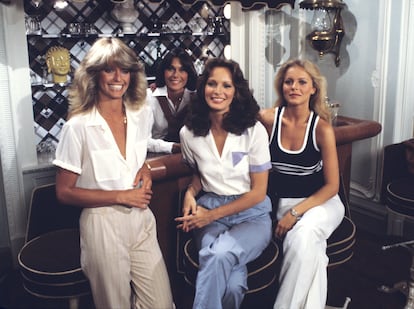
After Fawcett-Majors’ departure, the Spelling shredder did not stop: Shelley Hack (Jackson’s replacement in the fourth season as the sophisticated detective Tiffany Welles) and Tanya Roberts (Julie Rogers in the fifth and final season, who died in 2021) completed a lineup that never managed to attract the audiences of the original line-up. The absence of Hack at this week’s reunion – the forgotten angel who was not officially invited – is not only a glaring omission, but proof that, despite all the nostalgia, there are categories and then there are categories. It is as if this 50th anniversary had preferred to focus only on the hard core of the sisterhood.
For that matter, time has endorsed the voices that knew how to read between the seams of the outfits that Nolan Miller – architect of the power dressing in Spelling and Goldberg’s Dynasty – designed for the angels. The feminist author Camille Paglia has been its fiercest champion, elevating the series to the category of visual epic. According to Paglia, Charlie’s angels were modern Amazons, the embodiment of the professional, athletic woman, a mistress of her own destiny who did not ask permission for her beauty or power and for whom the criticism was pure puritanical misogyny disguised as intellectualism.
In the same vein, the artist Cindy Sherman has explored the construction of female identity through angelic archetypes – the intelligent, the sporty and the glamorous – and critics like Jennifer Keishin Armstrong have claimed that, before Buffy and Katniss Everdeen, there was a trio of women who received orders from a disembodied voice (Charlie) but solved problems without a husband by their side, giving millions of girls their first taste of empowerment.
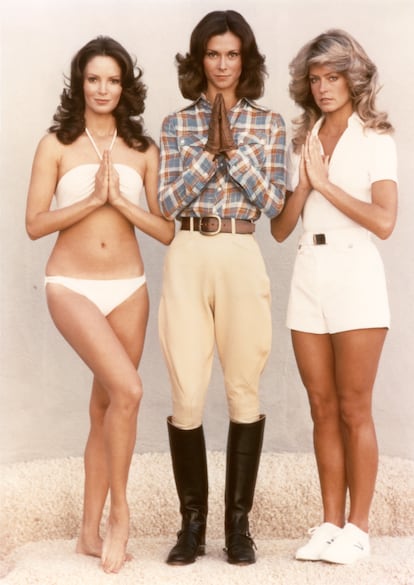
That independence found its most literal translation in Jaclyn Smith. Faced with endless remarks about the elasticity of her cheekbones, the actress, model and businesswoman emerges as a genuine strategist. While her colleagues wore themselves out with lawsuits or watched their careers run aground, the only angel who survived the five seasons understood that the real power did not lie in the script, but in the control of the personal brand. In 1985, she got her own fashion collection with Kmart, making her the first celebrity to license her name. With an estimated fortune of $150 million, Smith’s success is the result of pioneering business vision. After ending her legendary 36-year contract with the American chain, she launched a new line with the Home Shopping Network shopping channel in 2023, which immediately sold out. Her performances have since become promotional sales events, with collections of accessible luxury – the WWD platform estimates that more than 100 million women have bought a garment or accessory with her signature. That’s aside from her beauty brand, developed with her fourth and last husband, cardiovascular surgeon Brad Allen. Splendid at 80, it is said that therein lies the fountain of eternal youth. In September, she will publish her memoirs: Once I Knew a Guy Named Charlie.
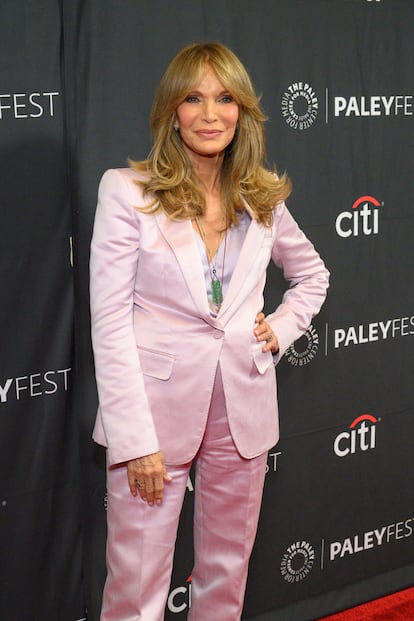
In the end what remains is the triumph of actresses who survived the most crushing machinery in pop culture as well as breast cancer, battled by all of them. “Time didn’t change the friendship,” Jaclyn Smith said on the red carpet. The three angels will be honored again at The Paley Honors gala in New York, on May 14. Of course, if the fashion and entertainment business does not respect the passage of time in the same way, we will continue to watch these kinds of reunions with our finger on the keyboard, forgetting that underneath any aesthetic procedure are trailblazers.
Sign up for our weekly newsletter to get more English-language news coverage from EL PAÍS USA Edition









































