
The Tories: How to bring down the oldest political party on the planet
Reform, the youngest political force in the United Kingdom, could overtake the Conservative Party in the May 7 local elections — despite the latter’s more than three centuries of history

Perhaps not many Europeans have ever envied Britain’s weather, but admiration for its institutions has been unwavering. The explanation is simple: over the past two centuries, Germany has lived under a monarchy, a republic, the Reich, a partition into two opposing regimes, and a federal model. France and Spain have been no less turbulent, and Italy, for a long stretch, did not even exist.
Meanwhile, Britain has spent all this time under a well‑established parliamentary monarchy, without a single revolutionary tremor since the 17th century. Its political life has certainly seen fierce clashes and serious scandals. But what reached the shores of the continent was, instead, the stability of its parliamentary system — “just as the roughest sea,” as a 19th‑century traveler wrote, “from the distance of a mountaintop looks like a placid lake.”
That allure is not merely a thing of the past: Tony Blair and David Cameron inspired shifts among progressive and conservative parties around the world. And Margaret Thatcher continues to cast a long shadow.
And yet it has taken barely 15 years to upend that “placid lake” of British institutional life. The referendum — a tool foreign to its constitutional tradition — has been used twice. It used to be said, quoting Disraeli, that “England does not love coalitions”; well, we have now seen the Conservative David Cameron and the Liberal Democrat Nick Clegg form a joint government, when it once took a war for the Conservative Winston Churchill and the Labour leader Clement Attlee to forge the previous one.
The United Kingdom may also be rather less united for a while: for the first time in history, Scotland, Wales and Northern Ireland could all have pro‑independence regional governments at the same time. And there is more: British bipartisanship seems like a thing of the past, newly transformed into a multiparty system in which four banners — Reform, Labour, Conservatives and Greens — are separated by less than 10 points in the polls.
Yes, anyone who senses that an unusual restlessness is running through British politics is right: as the 10th anniversary of Brexit arrives, a solid majority of Britons now supports returning to the European Union.
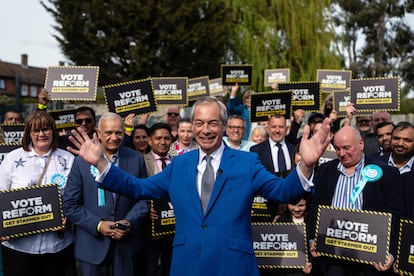
The biggest shift in this period, however, was summed up by Reform leader Nigel Farage when his party overtook the Conservatives in membership: “The youngest political party in British politics has just overtaken the oldest political party in the world.” It was December 2024, and a year and a half later, Reform is already predicting that the Tories — whose history begins in 1678 — are going to “cease to be a national party” after the local and regional elections of May 7. This comes only seven years after the Tories secured — under Boris Johnson in 2019 — their most resounding majority since before the Falklands War.
The stakes in these elections are higher than usual precisely because of Reform’s potential breakthrough. In England’s local elections, they are expected to hold a solid lead. In Scotland, Reform is running second behind the Scottish National Party (SNP). And in Wales, it is battling the nationalist Plaid Cymru for first place. Across Britain as a whole, Farage’s party has been leading the polls for a year: it has drawn in prominent Tories and even a few Labour figures, while taking care not to look like a Collection of washed-up stars. Reform has built enough structure not to be the vehicle of a lone frontman. And Farage, now that the winds are less favourable, has tried to distance himself from Donald Trump.
Even so, Reform’s most remarkable feat coincides with the most striking paradox in British politics: voters are heading to the polls, shaped by the discontent unleashed by Brexit, to support the very party that did the most to turn that discontent into reality. Meanwhile, the Tories are still paying the price for the disasters of Johnson, Liz Truss and Rishi Sunak.
It might seem that the only good news for the Conservatives in this electoral cycle is that some of the misfortune will now be shared with Labour. Prime Minister Keir Starmer could be on his way out at any moment; if he is still in Downing Street by the time of the elections, the results may well encourage an attempt to unseat him. Not for nothing is Labour expected to lose its majority in the Welsh Parliament for the first time since it was created in 1999.
Even so, the landscape is slightly more nuanced for the Tories than it was a few months ago. Reform has seen its lead shrink by seven points between September and today. It has become a cliché to speak of “the comeback” of Kemi Badenoch: the Conservative leader has strung together strong debate performances and speeches, and showed resolve by expelling Robert Jenrick — her former rival in the leadership primaries — before he could announce his move to Reform. Farage, for his part, is paying a price for some of the damage Trump is causing.
Still, Badenoch may end up merely provoking less rejection without generating much more admiration. In the end, one of her strengths is that the 2029 elections are far off. And that Tory defeats are no longer news.
Shortly before falling from grace, Peter Mandelson offered the Conservatives a few reflections drawn from his own experience as a Labour figure in the early 1980s, when the Social Democratic Party (SDP) was polling above 50%. Certainly, the Tories now find themselves at the mercy of a Farage who will succeed if he is seen as disruptive and fail if he comes across — in Mandelson’s words — as an extremist. At the same time, Badenoch must distance herself from the legacy of recent Tory governments and build economic credibility to restore the confidence of businesses and investors. The Social Democrats ultimately had a galvanizing effect on Labour; it remains to be seen whether the Conservatives will experience something similar with Reform.
In a moment of bravado, former Conservative leader William Hague declared that the values of the Tory party “stretch back to the days when Wilberforce freed the slaves, and Pitt led a war against tyranny.” Epic flourishes aside, if the Tory tradition has mastered anything over these years — or over these centuries — it is the ability to distill the paradoxes of British life so effectively that it claimed to be the United Kingdom’s “natural party of government.”
And yes: it has been the party of the racist Enoch Powell and of Kemi Badenoch, daughter of Nigerian parents. The party of the Eurosceptics that once, however, called itself “the party of Europe.” The party of Empire but also of Harold Macmillan’s decolonizing “winds of change.” The party of post‑war interventionists and of 1980s deregulation. The party of the aristocracy and of Brixton boys like John Major. A traditional right that nonetheless embraced transformative policies such as the expansion of public education.
Augusto Assía, the Spanish journalist who best understood the British, wrote that “while other peoples have struggled to cut the Gordian knot of contradiction, the English have turned it into the link of their unity.” It is a talent one must acknowledge in the British Conservatives. But anyone who already had little affection for the Tories should brace themselves for the new populists.
Sign up for our weekly newsletter to get more English-language news coverage from EL PAÍS USA Edition









































