
Gastronomy in the times of Gaza
In such a bleak present, food can matter, especially if we consider the social implications of eating

At the height of the Catalan independence movement, back in October 2017, a couple of people criticized me for tweeting about restaurants and recipes when revolution was apparently about to erupt in Catalonia. Their reproaches seemed so absurd that I didn’t even try to argue with them, but those indignant people planted a seed in my mind, because since then, I’ve wondered more than once what the point is of discussing seemingly trivial matters when the world around us is burning. How can we worry about how to make gazpacho, where to go for sushi, or what the best croissant in Spain is, while all around us tragedies like the housing crisis or poverty are raging, to name just two particularly harrowing ones?
Until now, I had weathered the storm by recalling a quote from Voltaire that a friend had given me one day when I was whining about the unbearable lightness of my work. “If nature had not made us somewhat frivolous, we would be very unhappy. Precisely because it is frivolous, most of society does not hang itself.” In clear contradiction to the above, I have also told myself that eating is a basic human activity, and one that is undervalued when it should receive more attention.
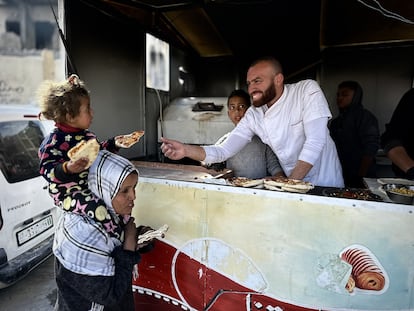
Even so, this year’s news has become so intense that it’s been difficult to navigate. The genocide in Gaza has shocked us all, except for the pieces of human-like meat with a faint smell of decay that mocked a certain flotilla trying to deliver food to starving people. Such horror, coupled with other phenomena like the persecution of migrants, the erosion of human rights, the rise of the far right, and the climate emergency, leads one to wonder: Gastronomy? Now? Seriously?
Perhaps we’ll find answers in some people who, instead of ignoring what’s happening in Palestine, have confronted it through food. I’m thinking of the journalist Mikel Ayestarán, winner of the Ortega y Gasset Award for his project “Menú de Gaza” (Gaza Menu), in which he collected photos and testimonies of what a Palestinian family cooked and showed how Israel has used hunger as a weapon of war. Or of chefs like Andoni Luis Aduriz, who have had the courage to denounce the massacre in an industry as prone to extreme centrism as haute cuisine. There’s Campo Adentro, a project that tries to keep Palestinian vegetable varieties alive in Spain, or (forgive the self-reference) the video we made at EL PAÍS about boycotting Israel through food.
Another clue may lie in a recent study by the universities of Birmingham and Munich. Their researchers analyzed the attitudes of approximately 1,000 white British adults toward migrants and cross-referenced this data with their consumption of Indian, Turkish, Chinese, Thai, Caribbean and Hispanic food. They discovered that enjoying these cuisines was “significantly related” to pro-immigration views and a lower likelihood of voting for xenophobic politicians. In other words, far from being irrelevant, a culturally diverse diet can help combat one of the most inhumane of contemporary scourges: hatred of those who come from abroad out of necessity.
In such a bleak present, gastronomy may matter, but in our present context, it’s crucial to look more closely at what surrounds us. We must continue to champion culinary pleasures and adventures, but also consider the social implications of food. We must understand, for example, that the flavor of a food is no more important than the impact of its production on the land; that a restaurant is not good if it exploits its employees; or that cooking at home is not a trivial matter, but an act of resistance against the most predatory form of capitalism. What doesn’t seem very viable is remaining fixated on exquisite delicacies for the wealthy. As things stand, a gastronomy that ignores reality and continues to revel in luxuries accessible to only a few will resemble the orchestra on the Titanic, but with kitchen instruments instead of music.
Sign up for our weekly newsletter to get more English-language news coverage from EL PAÍS USA Edition









































