
Crickets and grubs on the menu: Are we ready to eat insects?
The consumption of edible insects, a common part of the diet of some Asian and Latin American countries, is tentatively gaining ground in Europe despite the cultural divide. The EU already allows the use of four invertebrates in food products, and some chefs are experimenting with them
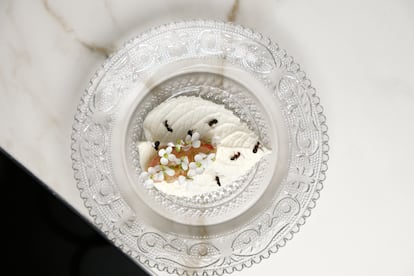

For many years, eating insects has been unthinkable, at least in Western countries. Who would think of putting a caterpillar or a cricket in their mouths? This is in stark contrast to places like Mexico, Colombia, Thailand, Vietnam, Peru, Cambodia, or China, deeply rooted in their culinary traditions since time immemorial. In Asia and Latin America, it’s common to find crispy cockroaches, scorpion skewers, stewed tarantulas, or ant larvae sauce. Entomophagy, as the insect diet is known, is slowly beginning to break down taboos and cross borders.
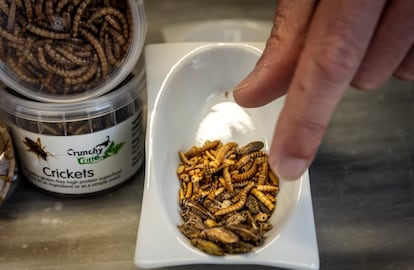
In Europe, there are already a handful of restaurants that have decided to serve these creatures on their menus, in London, Berlin, Copenhagen, Brussels, and Paris. In Spain, it’s possible to try insects, although their consumption is limited and doesn’t extend beyond a starter or snack, presented at specialized tastings. European legislation itself restricts their use. Currently, the EU only allows the sale of four species: mealworm larvae, migratory locusts, house crickets, and dung beetle larvae.
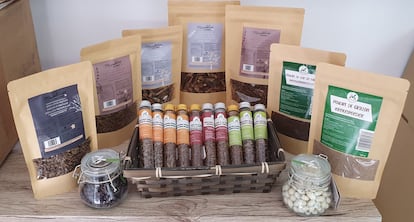
These legal insect varieties are what Alberto José Pérez offers at Insectum, a unique business in Spain located in the Ruzafa market in Valencia. His catalog ranges from jars of natural crickets, worms, and lobsters (smoked, natural, tomato-based, chocolate-coated, powdered, etc.) to protein bars, chips, and beer with insects.
Pérez acknowledges that legislation determines everything. Before 2018, when the first regulatory laws were passed in Spain and the EU, invertebrates could be imported from countries where they were legal. “We sold cockroaches, scorpions, ants, various types of worms. Even tarantulas. But today that is no longer possible, and business has suffered a significant slowdown,” Pérez laments.
Despite the difficulties, he has seen a change in attitude in recent years. The initial rejection has given way to a certain degree of popular acceptance.
“People are now admitting that insects can be eaten. Whether they actually do it is another matter, but they know it’s an option out there, and many are encouraged to try them,” Pérez says.
Visitors to his shop range from private citizens to chefs, restaurant professionals, catering companies, and cooking schools. “Even the army bought from me at one time.”
A marginal business
Even so, the owner of Insectum believes that, “at this time,” there is not enough demand in Spain or the rest of Europe for the business to stop being a niche market.
“There’s a lack of culture and tradition; we need to break that barrier as soon as possible. Objectively, insects are nutritious and delicious. But it will take several generations to make that leap,” he predicts.
Pérez also admits that it’s an expensive product because it’s rarely consumed. A kilo of crickets, for example, costs over €70 ($76). In his opinion, mass consumption, if it ever comes, will be as an ingredient mixed with other foods (in bread, pizza bases, chocolates, etc.).
“Once you try them, they become addictive,” says Isaac Petràs, a pioneer in insect marketing in Spain. From 2003 to 2008, he sold up to 40 items at Barcelona’s iconic La Boqueria market. It began as a kind of game with his customers, as the Petràs family had already been selling mushrooms for decades (and still does). Their idea was to introduce these ingredients to the public, broaden their range of tastes, and help break down prejudices.
“Here we eat snails, frogs’ legs, or rabbit, and we see them as the most natural thing in the world. But people who come from outside can’t understand that. The same thing happens with insects. If you try a big-ass ant from Colombia or a bamboo worm fried in coconut oil, you’ll be amazed at how delicious it is,” he says.
Aware of the cultural gap that exists in Spain regarding entomophagy, the Petràs family opted to sell insects that they knew would work here. “We avoided unpleasant ingredients and went for easy options: the toasted bug with a little seasoning that tasted delicious, some chocolate-covered crickets that were delicious, we had red ant eggs from Mexico that tasted better than caviar, some lollipops with a worm inside the candy…” he explains.
He captured that experience in the book Eating Insects, where he recounts his travels to distant countries in search of these tiny creatures and incorporates various recipes featuring grasshoppers, crickets, and ants. “I simply want people to have fun in the kitchen,” says Petràs, who admits that he will continue to eat insects in Thailand, Sri Lanka, or Mexico. “But in Spain, as much as I like them, maybe it’s not the place. Will we in the future stop eating cocochas and ask for worms? I see that as a difficult question,” he reasons.
At the Mexican restaurant Cantina Machito in Barcelona, they have served a selection of three varieties for years: chicatana ants wrapped in a corn chalupa tortilla accompanied by morita salsa; xumil (a bug) in corn salbutes with green tomatillo salsa; and grasshoppers in a taco with guacamole and pico de gallo. Every week they served around six orders.
“It was a dish we would run out of quickly, and we were out of stock for months because it was difficult to get them,” confirms Javier Ruiz, the chef and owner.
Each of these species has its own flavor. The grasshopper has a crunchy texture similar to a shrimp head and a toasted taste. The xumiles are somewhat reminiscent of smoked beef, and the chicatana ant evokes spices like cloves and pepper. Despite the positive reception to the latter, legislation has forced Ruiz to remove it from the menu.
Innovation and haute cuisine
Even so, there are chefs who experiment and innovate with these ingredients. For more than 15 years, chef Diego Prado, who has worked in research departments at restaurants such as Alchemist and Noma (both in Copenhagen) and started the Fango project in Ávila with Esther Merino, has been exploring the possibilities that different invertebrate species offer in haute cuisine, always with one indisputable premise: that his preparations be delicious.
“We would never serve a dish just because it has a butterfly on it. It doesn’t make sense,” he explains.
Prado emphasizes the versatility of insects in the kitchen and explains that each specific species has its own characteristics. “There are many types of crickets and ants, and each one tastes and behaves differently. It’s like comparing hake to tuna. They’re both fish, but they have nothing in common.”
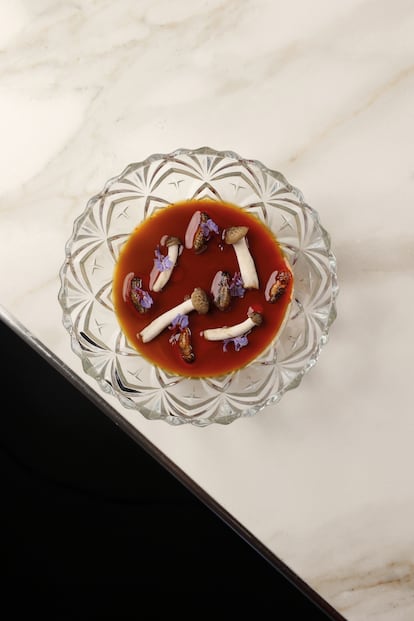
The Chilean chef, now an associate professor at the Basque Culinary Center, has researched moths, butterflies, silkworm larvae (including their excrement, which is used as an infusion thanks to its almond and cherry notes), ants, crickets, and even dragonflies. His experience demonstrates that it’s possible to incorporate these products into the most avant-garde cuisine.
Prado’s offerings stand out for their creativity and innovative nature, and are particularly served in pop-ups and at very specific tastings where diners seek to be surprised at the table. “They’re open to trying new things, which is why they come to our events. And when they try them, they say, ‘Wow, it’s delicious!’” he concludes.
Sign up for our weekly newsletter to get more English-language news coverage from EL PAÍS USA Edition









































