Cuba: An island losing its people
Around two million inhabitants, about 20% of the population, have left the country in four years
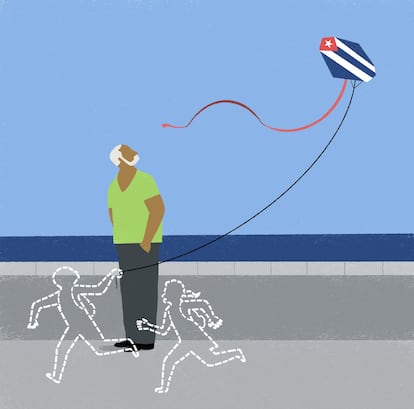

1. At Havana’s José Martí International Airport, in front of one of the airline’s desks, there’s a line that has a striking peculiarity: among the passengers waiting to check in, there are always several families with children. Day after day. An employee of that airline told me: “Every week, a classroom’s worth of schoolchildren leaves the country. Every two months, the equivalent of a school leaves the country.”
This fact, entirely empirical, is nonetheless so real that it provokes, at the very least, some concern. The nation is thus losing part of its future, and this is a situation that will have many consequences.
Now, these travelers — in reality, migrants who are leaving, never to return (at least without any intention of doing so) — are heading to Guyana, the destination for that airline’s flights. Some of them will stay in that South American country, which is somewhat lost to the global migration landscape. However, most will continue on to the Brazilian border, which they’ll reach by various means, some more established than others.
In Brazil, they can expect a fairly quick process to legalize their status. They’ll also have the possibility of finding work. For the parents of these children — and for the children themselves — this is the future. And they trust that it will be better than what they’ve been living through for years in their country.
For a time, before Guyana, the landing point for these Cuban migrants — many of them with their children in tow — was Nicaragua. From there, using a variety of means (with safety and speed depending on what price they were willing to pay), they would set off along the route through parts of Central America and Mexico, using “coyotes,” or human traffickers. They were seeking to reach the southern border of the United States, a country they could enter with relative ease, due to their Cuban citizenship.
This escape route — which many Cubans started using in 2021, when the COVID-19 pandemic restrictions eased — has been estimated to cost around $10,000 per person.
A couple of years ago, with Donald Trump’s return to the White House — and with Nicaragua imposing a visa requirement on Cuban citizens wishing to enter its territory — this option for escape was suddenly closed. And this occurred at the same time as other pathways — such as humanitarian parole, asylum and refugee status, or the family reunification programs established by the Biden administration — were cancelled. Additionally, Trump has ordered the deportation of some of the Cubans who have already benefited from such protections.
A significant portion of the Cuban migrants who arrived in Nicaragua but were unable to cross into the United States now remain in Mexico. They’ve formed large communities, such as those in Tapachula — a city in the state of Chiapas, near the border with Guatemala — and in Cancún, Quintana Roo. Based in Mexico, they strive to build a future for themselves: very few have chosen to return to their place of origin. Meanwhile, in the Brazilian city of Curitiba, a “little Cuba” exists today: many of those who left the Caribbean island have settled there.
Furthermore, in recent years, one of the busiest places in Havana has been the office of the Spanish Consulate General. This is a place where locals seek much more than a “visa for a dream,” as the song by Juan Luis Guerra goes. Rather, they hope to get a European passport, which may be the best inheritance left to them by a Spanish grandparent. In the early-20th century, many Spaniards emigrated to Cuba, fleeing poverty and pursuing what their Cuban descendants now seek: a future.
All these people are driven by more or less the same reasons: the deprivations of daily life in Cuba, which, in recent years, have only grown to grotesque levels. And, especially for those who are traveling with children (enough to fill a school classroom each week), they’re driven by a yearning to build a future that, for them, lies elsewhere. And sometimes, the location doesn’t even matter, only the distance.
2. Figures recently published by Cuba’s National Office of Statistics and Information (ONEI) further highlight the ongoing migration process. Along with other revealing demographic indicators, they offer stark evidence of Cuba’s depopulation.
The numbers speak with the cold certainty of hard facts: at the beginning of 2026, the island’s official population was 9,434,593 inhabitants, reflecting the downward trend that accelerated after 2021, following the lifting of pandemic travel restrictions. In 2022, 11,113,215 people lived in the country, resulting in a population deficit of 1,678,622 “effective residents,” defined as Cuban citizens who spent at least 180 days a year on the island.
Now, this figure can be misleading. A law passed in 2024 — which just came into effect — eliminates the old immigration concept of “definitive departure,” which entailed the loss of Cuban residency if a citizen remained outside of the country for more than 24 consecutive months. Hence, based on this adjustment — which reduces the number of emigrants (on paper) — there must actually be several thousand (if not hundreds of thousands) more “residents abroad” who are currently outside the country indefinitely. I know many of them personally.
So, how many people actually live in Cuba? Possibly fewer than nine million, which represents a population difference of more than two million people in just four years. This represents perhaps 20% of the island’s population. According to the ONEI, between 2024 and 2025, the loss was 313,414 inhabitants, of which a quarter of a million emigrants were recorded in 2025 alone.
We must always remember that, due to the costs and complexities of the most common escape routes, those who left the country were those who wanted to and could, but certainly, many wished to and couldn’t.
Now, if we add to this already dramatic situation (1) the aging process that’s evident in a country where, in 2023, 24.4% of the population was over 60 years old; (2) the decline in births, which are down to only half the number of deaths; and (3) the consequent decrease in the workforce, it’s easy to understand the implications of all these phenomena in the labor, professional and population replacement spheres, since — as even official documents state — “the population is the nation’s main resource for its development.” The situation is, obviously, alarming.
Several factors have been contributing to the migratory phenomenon that’s emptying the island, all of which have been widely discussed. The material conditions of daily life have deteriorated to almost inconceivable extremes. And there’s shared responsibility for this reality: on the one hand, we have the inefficient economic policies of the government, which previously didn’t dare to implement the changes now being sought (few of which have been achieved). On the other hand, there’s the extreme pressure being exerted on the island by the current U.S. administration, which has declared that it has never cracked down this hard on the Cuban state to force a change in the system. Those two forces now act like the slices of bread in a sandwich, squeezing ordinary Cubans in the middle far more than the government, which remains firmly in place and politically unchanged.
Cubans are leaving the island, growing old, suffering from the sense of alienation caused by their circumstances. We are watching the country empty out, being bled dry, with no dam in sight to stem this human tide.
Translated by Avik Jain Chatlani.
Sign up for our weekly newsletter to get more English-language news coverage from EL PAÍS USA Edition