
My North Korean neighbors
The Democratic People’s Republic of Korea keeps its massive embassy in Berlin open, although it is virtually inactive
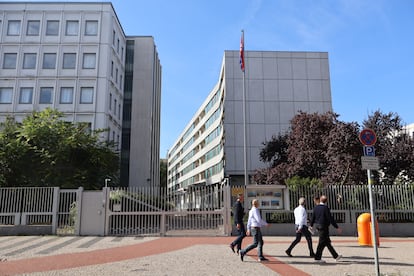

In the morning, when I get up, the first thing I see from my bedroom window is North Korea. I live in the heart of Berlin but my next-door neighbor is the embassy of the Democratic People’s Republic of Korea. In its huge facilities, inherited from when communist Germany (the GDR) existed, German law does not apply. The person who calls all the shots in there is a diplomat named Kim Chol Jun who, according to the German foreign ministry, does not hold the rank of ambassador.
To me, the person in charge is a man I see moving back and forth every day.
“There’s a man in Spain who does it all,” says Astrud’s pasodoble, which one morning I deliberately played as background music while the North Korean official ordered someone to collect some freshly pruned branches, opened the exit gate for one of the mission’s cars, smoked, and talked on the phone — all at the same time.
The man who does everything at the North Korean embassy is bald, potbellied, and dresses the way one imagines North Korean officials dress: a brown sweater, gray trousers, and black fake-leather shoes. My North Korean neighbors have at least two cars, old blue passenger vehicles without diplomatic plates. They park them on the street or under a corrugated-metal shed they have put up in what used to be the parade ground. That space, designed for parades and receptions, is abandoned, overtaken by weeds and tagged with graffiti from kids who have slipped in. Its courtyard faces the entrance to my building and lately a smell of a decomposing animal has emanated from the undergrowth. Could it be a dead cat?
I have also been tempted to go into the North Korean embassy. It is surprisingly easy. I always wanted to travel to North Korea. The closest I ever got was the border with China’s Jilin province. I was there nearly two decades ago, during my years as a journalist in China. From the North Korean side they watched us through binoculars, the way I now watch them just after getting out of bed.
I have never seen anyone visit the North Korean embassy. The German government statistics office reports that 150 North Koreans entered Germany in 2025. The most recent official figures I found, from 2020, put the number of citizens from that country living in Germany at fewer than 500. It makes sense that activity at the embassy is minimal.
It was different in the past, until 2020. That year a guesthouse they ran on the embassy grounds was sealed off as part of Western sanctions on Kim Jong-Un’s dictatorship. Berlin authorities concluded the money it brought in was undeclared and was being used to finance the regime in Pyongyang.
Up to five people work at the embassy, accompanied by their families, according to a 2023 article in Frankfurter Allgemeine Zeitung. In what used to be the guesthouse live at least the man who does everything, three other men, and a woman. They always come and go through the same door. At night, only one light is on across the whole compound — the bulb that hangs over that door. Nothing else.
My other neighboring buildings are interesting, too. To the south is a block of prefabricated GDR housing modules; to the north, the supermarket where former chancellor Angela Merkel does her shopping (she has an office nearby); and, to the west, the Czech cultural center, another semi-abandoned relic of the communist era where, after dark, heroin addicts, homeless people, and drunks gather.
Of all of them, my favorites are the North Koreans. Maybe because there is something irresistibly melancholic about their Berlin existence, isolated in a world that collapsed with the Soviet Union. One night when I went down to take out the trash I was surprised by music coming from the embassy. I went closer to hear the melody: it was a romantic song sung in Korean by a woman. It played through the courtyard loudspeakers and I imagined the man who does everything sitting in his guard booth with a bottle of schnapps, longing for his wife or his homeland, pressing the public-address button so Berlin would hear from him.
Sign up for our weekly newsletter to get more English-language news coverage from EL PAÍS USA Edition









































