
And he never came back’: In El Salvador, mothers desperately search for the disappeared
President Nayib Bukele claims that years of gang violence have left 80,000 people missing. However, the Legislative Assembly has rejected a proposed bill centered around the search for the disappeared, leaving families feeling helpless
Shortly after 9:00 p.m. on August 4, 2021, Herbert Argueta got up from the chair where he had spent the last six hours answering calls at his computer. It was his 30-minute break from his call center shift — a job he did from home.
It had been raining heavily that night. He decided to go outside for a walk. He glanced out the door and saw that his neighbor’s store was closed. So, he walked to the next one — about a third of a mile away — to buy some juice.
“I’ll be right back,” he told his mother, who was watching television on the sofa. “And he never came back,” she recalls today.
Carmen, Herbert’s mother, shares the same uncertainty as thousands of families in El Salvador, who are searching for their loved ones without any government support. Among them is Esmeralda Rosales, whose brother, Fernando Andrés Rosales, was last seen on March 5, 2022. Fernando’s case is among the last disappearances registered in the country, just before the government declared a state of emergency at the end of that same month.
Esmeralda says that the state of emergency — far from providing answers — only deepened the sense of abandonment. “We thought it would help because, before, they told us that the investigators were busy fighting the gangs. Now, they say they’re overwhelmed with trials. They never help us,” she laments.
Fernando, a 32-year-old merchant, was kidnapped by a group of men while dropping off everyday essentials at a market in Santa Ana, the second-largest city in the country, located northwest of the capital. And even though the Attorney General’s Office arrested four alleged associates of the MS-13 gang linked to the kidnapping, his whereabouts remain unknown.
Both Carmen and Esmeralda are members of the Search Bloc for the Disappeared, a collective formed primarily by mothers. They’re conducting the search for missing relatives alone, in the face of institutional inaction. “At this point, five years later, the authorities don’t have a single lead. We’ve reached the point where they ask me, ‘You haven’t heard anything?’ I gave them my son’s tablet and phone — unlocked — so they could check.” Carmen says that the investigators even ask her: “Who do you think took him?”
Recently, the mothers’ collective appeared before the Legislative Assembly — dominated by the ruling party — to introduce a proposed Missing Persons Search Law. The initiative aimed to treat the victims with dignity, guarantee the active participation of family organizations in the search and establish a national search system. The bill was brought to the floor by opposition congresswoman Claudia Ortiz, of the Vamos (“Let’s Go”) party. However, her vote was the only one in favor of the bill: the ruling party rejected it less than 15 minutes after it was presented to the floor.
For at least a decade-and-a-half, El Salvador has been grappling with a serious crisis of missing persons. And no government has been able to provide a solution. A study published in 2021 by Salvadoran researcher Jeannette Aguilar and the Institute for the Application of Law (FESPAD) indicated that, at that time, the number of disappearances during the post-war period — referring to the Salvadoran Civil War, waged between 1979 and 1992 — was estimated at 35,000, most of them victims of gangs. However, the true extent of the underreporting of this crime remains shrouded in secrecy.
In June of 2025, during his sixth year in office — and while claiming victory over the gangs — Salvadoran President Nayib Bukele offered a previously unheard estimate. For the first time, he cited the number of homicides attributed to gangs, which his own administration had compiled: “Some say that the gangs [killed] 120,000 people in El Salvador,” he stated. He then added: “But, if we review the figures for missing persons — 90% of whom were victims of homicide — we realize that the difference is so vast that the real number of homicides is actually over 200,000 Salvadorans, who were killed by gangs in a country of six million inhabitants.”
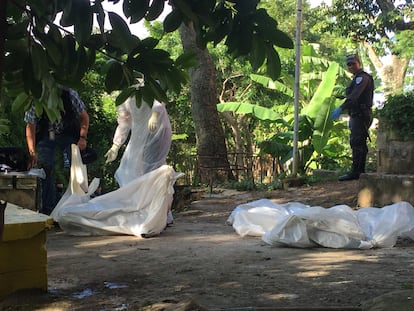
If the president’s projections are accurate, El Salvador would have 80,000 missing persons: a rate of 1,251 per 100,000 inhabitants. In other words, one in every 100 Salvadorans is missing. Two weeks after giving that statement, Bukele reiterated his position on social media, citing his speech alongside a report from the Attorney General’s Office regarding the discovery of two mass graves dug by MS-13, containing 11 victims.
Between March of 2022 and August of 2026, the Bukele administration imprisoned more than 92,000 people on gang membership charges and initiated mass trials to prosecute those responsible for crimes accumulated over decades. However, justice and reparations for the victims’ families remain elusive.
On June 19, 2025, Bukele reiterated his narrative about the figures on X: “For years, thousands of homicides were hidden as ‘disappearances.’ Gangs and the state manipulated the figures with clandestine graves. Today, with fewer than 100 disappearances per year (before, there were more than 1,500), there’s no longer any doubt: there was a hidden, systematic massacre, alongside the one we all knew about. Now comes the challenge of finding all those bodies,” he wrote.
Alba Rosales is part of the search network. Her son, Kevin, disappeared on May 17, 2011, after leaving school. He was kidnapped by members of MS-13 in Flor Amarilla, a district in the city of Santa Ana. Since then, Alba has searched for him among the living, in hospitals and prisons, and among the dead, in morgues and mass graves.
A report on enforced disappearances, published by Colombia’s National Center for Historical Memory, quotes psychologist Silvia Zorio: “In the discourse of their relatives, the disappeared person exists as a dead-alive being: as dead, they remain forever unburied; as alive, they remain perpetually subject to the abuse and torture inflicted by those who disappeared them.”
Alba identifies with that definition: “Sometimes, I ask God where he could be. I wonder if some Mexican cartel has taken him. Other times, I just ask that they return even his bones, so I have somewhere to go and visit him.”
Clandestine graves
A 2019 report on the phenomenon of disappearances produced by the Central Investigations Division of the National Civil Police (PNC), reviewed by EL PAÍS, reveals that by 2011 the number of disappearance reports had risen above 1,000 a year. This surge coincided with the preliminary stages of the so-called “truce” between gangs and president Mauricio Funes’ administration (2009-2014). During this period – from 2012 until 2014 – homicides fell drastically. This was after imprisoned gang leaders received better conditions, in exchange for curbing street violence.
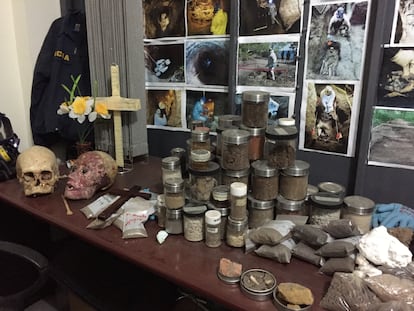
According to the document, 18,735 disappearance reports were filed between 2011 and 2019. Of that total, by 2019, 60% of the victims had been located alive, while 40% remained missing. Data for previous years is unavailable. Meanwhile, the Attorney General’s Office and the PNC have classified information related to the discovery of hidden graves as confidential. A police intelligence report, titled Possible Unmarked Mass Graves, DIP Information 2020, cataloged the exact reported locations of 48 of these sites up to that year.
In the recent mass trials against gang leadership, the testimonies given by cooperating gang members have begun to reveal the scale of the problem. During the trial against 480 MS-13 leaders, the key protected witness — known as “Berlin” — testified that just one clica (cell) of the organization buried more than 200 bodies in the district of Nuevo Cuscatlán, Bukele’s political stronghold. There, he began his rise to power, serving as mayor between 2012 and 2015. It should be noted that, at one point, the gang had a total of 248 cells across the country.
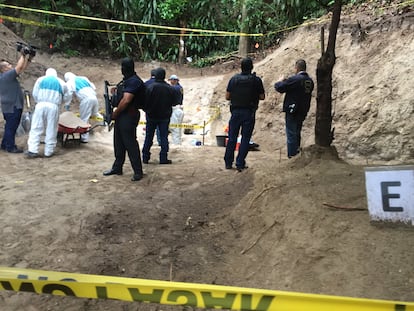
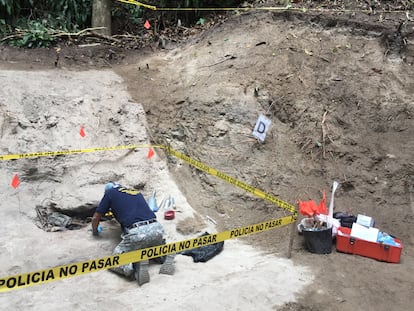
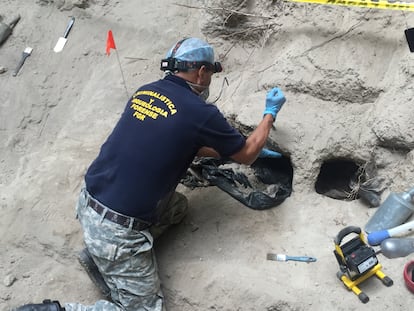
Other internal police files — leaked in the cyberattack known as the “Guacamaya Leaks” — contain similar testimonies. In October of 2019, a member of MS-13’s command structure, which operated in the San Salvador metropolitan area, made a confession to investigators about the existence of three hidden graves. The first was known as El Platanar (“The Banana Plantation”) — in the municipality of Moncagua, located in the San Miguel region — with more than 200 victims buried there. The second — on the Nuevos Horizontes (“New Horizons”) farm, in the district of San Martín — has approximately 75 bodies. And the third, at Poza del Muerto — “Dead Man’s Pool,” also in the region of San Miguel — where, according to the witness, “about 25 bodies tied to rocks were submerged, tied to stones.” Local press reports indicate that only two of these sites have been searched by authorities, with just five bodies recovered.
In June of this year, the local newspaper La Prensa Gráfica revealed that a luxury residential project is currently under construction on a site in Nuevo Cuscatlán where gang members have pointed to the existence of an unmarked mass grave containing more than 200 bodies. The Attorney General’s Office partially confirmed the forensic excavation in the area, after reporting the discovery of “various skeletal remains” and 21 intact bodies.
In a fitting metaphor for the country, the luxury development covers the scars of an unfinished war: thousands of bodies still buried underground and thousands of mothers who refuse to stop searching.
Translated by Avik Jain Chatlani.
Sign up for our weekly newsletter to get more English-language news coverage from EL PAÍS USA Edition









































