
Geographies of cruelty: The shifting map of Mexico’s clandestine graves
The rise in disappearances and criminal violence, together with the growing efforts of citizen search groups, has transformed the pattern of discoveries across Mexico during the administrations of Calderón, Peña Nieto and López Obrador
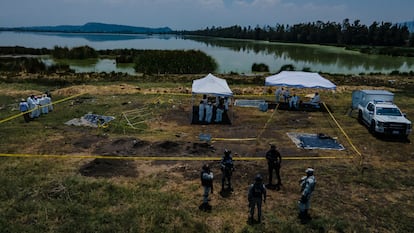
Clandestine graves have spread across Mexico over the past two decades. They are not concentrated in a single region, nor do they follow a single pattern, but their expansion and shifting geography during the administrations of Felipe Calderón, Enrique Peña Nieto, and, especially, Andrés Manuel López Obrador have been driven by the rise in disappearances and intensifying criminal disputes across the country. Search efforts led by victims’ collectives have also played a key role.
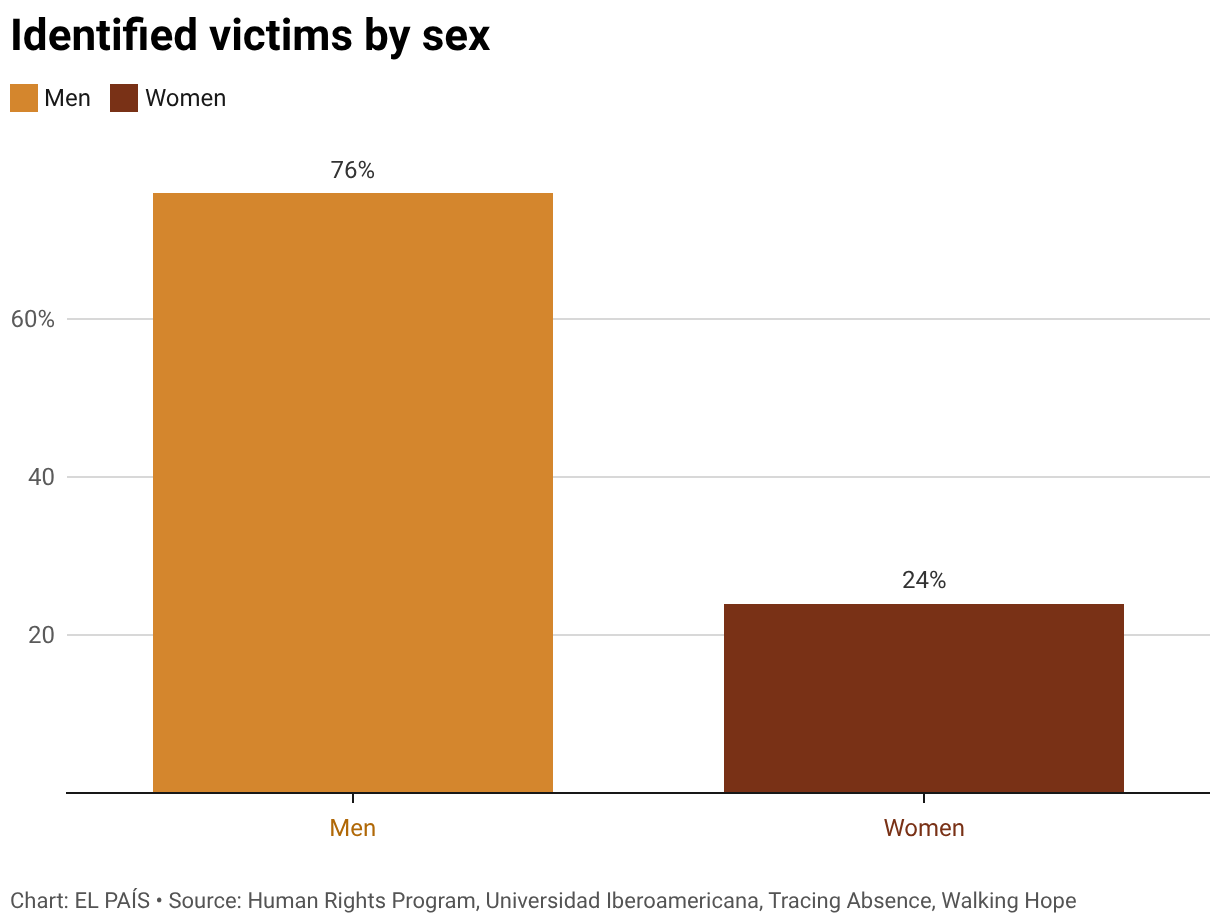
Most of the victims are men, accounting for three out of every four cases, but the phenomenon has also grown significantly in connection with femicides. Several states, including Guerrero and Jalisco, have seen the problem worsen over the past three administrations.
Bodies, bearing different signs of violence depending on the perpetrators involved, have been found in fields, along roads, on farmland, in ravines, wells and private properties, and in some cases close to places where everyday life unfolds.
The report Tracing Absence, Walking Hope: Analysis of Clandestine Grave Discoveries in Mexico, 2006-2024 documents in detail the spread of clandestine graves during the country’s last three administrations.
The report, produced by the Human Rights Program at Iberoamericana University in Mexico City, draws on data from prosecutors’ offices, press reports and interviews with families searching for missing relatives, civil society groups, search commission officials and experts. Its main contribution is not only to count graves, bodies and remains, but also in exposing the difficulties of determining how many actually exist, where they are concentrated and what happens after they are discovered.
Journalistic findings were included only when reported by at least two media outlets. However, because sources use different criteria and levels of detail, their figures are not directly comparable and should be understood as a partial reconstruction of the phenomenon.
Because the report draws on two main sources — news reports and responses from prosecutors’ offices — the contrast between the two reveals a central problem: Mexico does not have a single, comprehensive and standardized registry of clandestine graves. The press documented between 3,516 and 4,071 graves, while prosecutors reported 5,152 records. These figures cannot be added together or interpreted as equivalent measurements, as they were compiled using different methodologies and contain omissions, discrepancies and categories that do not always align.
Clandestine graves reported
by the press
2006–2012
Felipe Calderón government
Coahuila recorded the highest rate of clandestine grave discoveries, with two sites per 100,000 inhabitants, followed by several other northern states. The distribution reflects the geographic concentration of discoveries during the early years of the period examined. .
2013–2018
Enrique Peña Nieto government
Guerrero recorded the highest rate, with six clandestine grave discoveries per 100,000 inhabitants, followed by Veracruz and Zacatecas, with three each. The map shows how the main concentrations of discoveries shifted toward central and southern Mexico.
2019–2024
Andrés Manuel López Obrador government
With 30 cases per 100,000 residents, Colima recorded the highest rate for the period, followed by Sonora, with 12, and Baja California Sur, with six. The highest relative concentration shifted toward states in the western and northwestern parts of the country.
The discrepancy between press reports and official records is particularly stark in some states. Guerrero ranks among the states with the highest number of clandestine graves documented by the press across the three periods analyzed, with a cumulative 416 discoveries. Prosecutors’ offices, by contrast, reported zero clandestine graves in Guerrero during each of those periods.
Guanajuato shows a similar discrepancy: the press recorded 283 graves between 2019 and 2024, while authorities reported none during the same period. The official tally of zero raises serious questions about the actions, or lack thereof, of local authorities.
The shifting geography of violence
The main hotspots have changed over time. Between 2006 and 2012, news reports were concentrated largely in northern Mexico. Between 2013 and 2018, Veracruz, Guerrero and Jalisco stood out. From 2019 to 2024, Sonora, Guanajuato and Colima emerged as the hardest-hit states. The pattern suggests that violence has shifted and reconfigured itself rather than uniformly declined. Population-adjusted rates tell a different story as well: Colima, for example, did not record the largest number of graves in absolute terms, but it posted the highest rate in the most recent period, with 30 graves per 100,000 inhabitants.
Discoveries are concentrated in specific areas. Acapulco, Tecomán, Hermosillo, Veracruz and Ciudad Juárez accounted for 19% of the clandestine graves documented by the press. In some states, a single municipality represented a significant share of all reported sites: Tecomán accounted for 81% of the graves documented in Colima, while Acapulco accounted for 45% of those recorded in Guerrero.
The number of graves alone does not necessarily reflect the scale of the violence. Durango recorded 348 bodies between 2006 and 2012 despite having fewer graves than other states. In Ixtlahuacán, Colima, 170 bodies were recovered from just two graves, while in Delicias, Chihuahua, 80 bodies were found in a single grave.
The dynamics behind clandestine graves
Several of the report’s findings show that clandestine graves do not follow a single pattern of violence. They can be linked to organized crime groups, state agents, territorial disputes and interpersonal conflicts. This diversity is also reflected in the places where they are found, including vacant lots, private properties, roadsides and areas near bodies of water. Clandestine burials occur both in remote locations and in spaces embedded in everyday life.

The report also identifies different forms of violence against victims that reveal the perpetrators’ cruelty. In cases linked to organized crime, dismemberment, gunshot wounds and execution-style killings are the most common patterns. When the perpetrator is a private individual, however, the methods tend to differ, with beatings, strangulation and stabbings appearing more frequently.
The report also documents cases consistent with elements of femicide, as well as disappearances connected to specific occupations, including public transportation and ride-hailing drivers. While these patterns do not allow for definitive conclusions about the cause of each case, they do show that clandestine graves emerge from a wide range of contexts and must be examined in light of their location, the victim, the possible perpetrators and the circumstances of each disappearance.
Recent clandestine graves are not found solely in remote areas. Between 2020 and 2024, vacant lots accounted for 32.9% of documented sites, private properties for 28.3% and roadsides for 10.8%. Abandoned houses, ranches, warehouses, water cisterns and residential neighborhoods all form part of this geography. The report also documented 23 gravesites that were used repeatedly. These cases show that discovering a site does not necessarily mean securing the area, completing the investigation or preventing further burials.
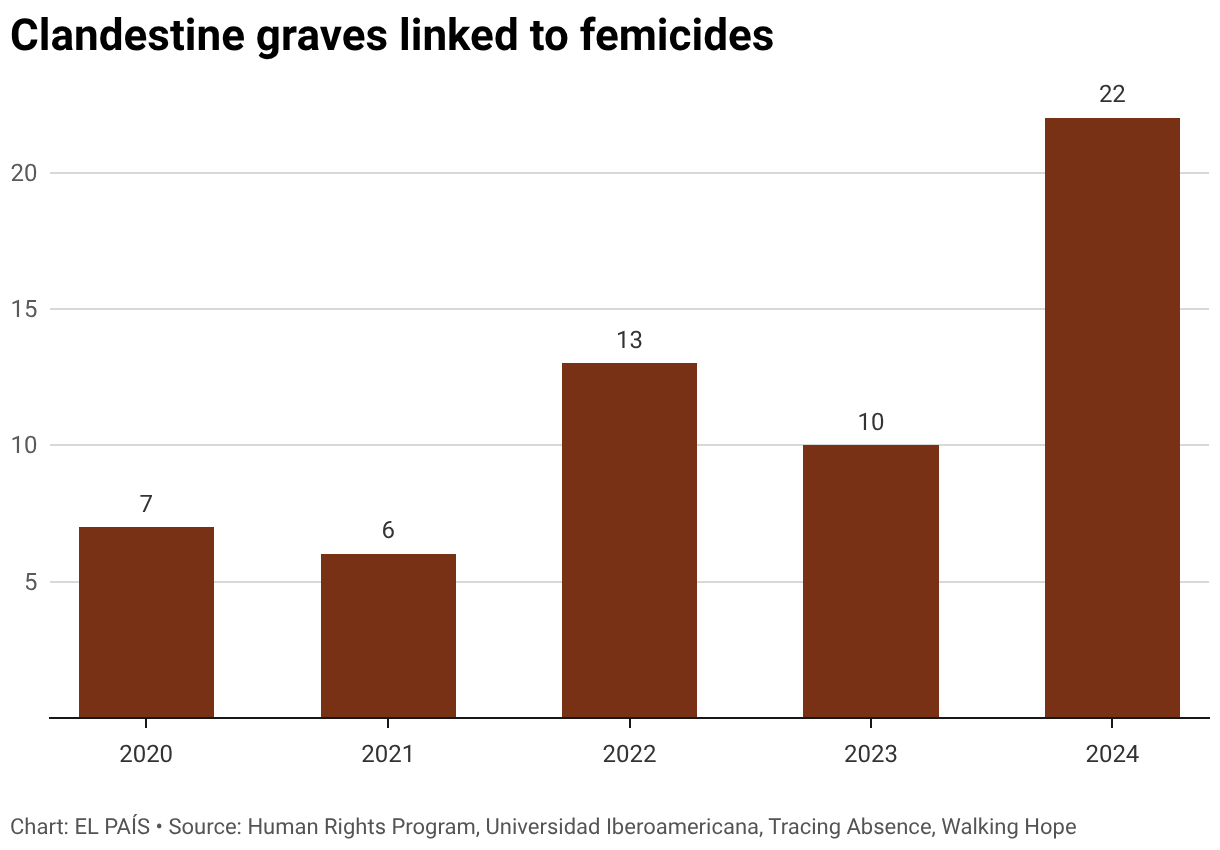
Of the 58 clandestine graves linked to femicides documented between 2020 and September 2024, 39 — 81.2% of the cases in which a perpetrator was identified — were attributed to private individuals, while nine were linked to organized crime groups. In nearly half of the cases, the perpetrator was the victim’s romantic partner, which shows that these killings and subsequent burials do not necessarily stem from drug trafficking networks or the actions of hired killers. Instead, they often occur in contexts marked by intimacy, trust and gender-based violence.
This is also reflected in the locations where the graves were found. Of the 56 graves whose location could be determined, 34 were discovered on private property, including homes, ranches and businesses, and in 13 cases the sites belonged either to the victims or to their perpetrators. The findings suggest that, in these cases, the grave functions less as a tool of territorial control associated with organized crime than as the final stage of violence carried out within everyday settings and preexisting relationships.
Finding a grave, however, does not bring the process to an end. Exhumation, forensic analysis, identification and returning the remains to families must still be carried out. Recovering bodies does not necessarily mean their identities have been established.
Search collectives play a crucial role in this process. They provide local knowledge and, in some cases, locate sites that had not been identified by authorities. Their work expands the available information but also highlights the gap between the responsibilities of state institutions and the tasks that families ultimately take on themselves.
Sign up for our weekly newsletter to get more English-language news coverage from EL PAÍS USA Edition